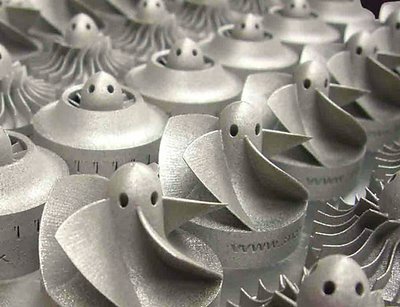
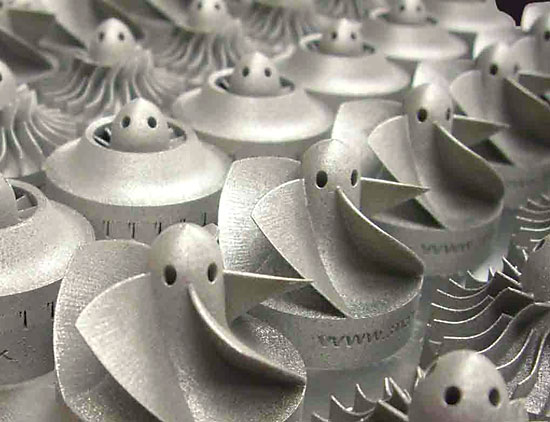
Wicked article on EOS DMLS
Published 04 November 2008
Posted by Al Dean
I’m trying to work out how much designers and engineers are aware of rapid prototyping and direct manufacturing processes and stumbled across this article by the team at MindTribe’s blog. Check it.
What I’m pondering is whether users are aware of the new techniques, new processes, new materials and such that are rapidly coming out, advancing and developing and how they can both be used as part of existing design processes or used to create something new, something exciting? Leave a comment and let me know what YOU want to know, how and what.

Comments:
Thanks Kevin (I keep meaning to pop down and have a chat with you).. I guess the thing I wonder is whether this stuff is well acknowledged and used, or are people just ordering the same prototypes they always have. Things are advancing at such a high rate that its difficult to keep up - new materials, new processes, new machines. It strikes me that there’s a huge amount of noise about the rapid or direct manufacturing, and there’s undoubtedly people using these things for real, it’s always in arty world or tooling - where it makes huge sense - its pretty difficult to get hold of case studies outside of that.. <BR><BR>Interesting workflow concept, I always developed the Design for Manufacture stuff in at the ground level, but that’s an intriguing thought - particularly as it looks like making those ‘fundamental’ types of design changes is going to be a little less error prone and easier than ever before.. <BR><BR>Cheers man<BR><BR>al
Posted by Al Dean on 01 January 1970 at 12:00 AM

Its not really that new though is it Al? Sintered metal has been around for several years - I remember seeing some sample parts about 4 years ago, maybe 5? The surface finish was as rough as bulls lugs! Still is from the latest I’ve seen. I think to be honest as well it very much depends on the markets you work in as to your exposure to the technologies. I suspect most (all?) product designers use RP processes now for plastic or fit and function to test prior to mould tooling. I suspect very few actually design specifically to use the RP parts in manufactured product (because to be frank there are few markets where this is feasible due to surface finish or strength issues).<BR><BR>One area that I think is maybe overlooked is the use of designing prototype pre production parts SPECIFICALLY for RP for the development phases, before switching to “proper” designed for moulded parts at the high volume production phase.<BR><BR>For example. Developing electronics parts often requires constant fiddling with PCBs and so forth. Doing a full on production like part for same a trial using 10 parts is time consuming. So the designer can design the trial parts to use RP functions like zero draft, undercuts, retention details that would be impossible to mould, to make the fitting of the electronics more adaptable.<BR><BR>Once the electronics are tied down then the design for moulding can be finalised.<BR><BR>Personally I am aware of all the metal prototype options but I only use CNC as it is more robust. But then I don’t tend to work in the micro volume product markets.
Posted by Kevin Quigley on 01 January 1970 at 12:00 AM