“Eye tracking technology to revolutionise the design process” says research team… we think.

Published 06 May 2009

Posted by Al Dean

Article tagged with:

It took me a couple of goes to read this through and understand it, so I’m going to pretty much replicate the complete press release verbatim:

Researchers from The Open University and the University of Leeds have been awarded 195,000 GBP from the Leverhulme Trust to develop an intuitive computer aided design (CAD) system that could revolutionise the design process. They will examine how eye tracking technology could recognise which parts of design sketches the designer is interested in, and automatically suggest developments of that element.

Dr Steve Garner, Principal Investigator and Senior Lecturer in Design at The Open University, said: “Our starting point was thinking about what type of computer systems designers will be using in 15 or 20 years’ time. We believe that in the future, CAD systems will work alongside designers to stimulate and enhance their creativity by offering suggestions and highlighting alternative options right from the earliest point in the design process, when they’re sketching out their ideas.”

The research builds on a prototype CAD system funded through the Designing for the 21st Century programme, a joint initiative between the Arts and Humanities Research Council and the Engineering and Physical Sciences Research Council. The Design Synthesis and Shape Generation project (DSSG) produced the world’s first 3D shape grammar-based design system, which succeeded in overcoming a major limitation in current shape grammar-based systems – that of recognising ’sub-shapes’ in early design sketches.

Alison McKay, Professor of Design Systems at the University of Leeds, explains: “Sub-shapes or emergent shapes are those created when two or more shapes intersect. For example, if two squares overlap diagonally, we see a third square created in the middle. But in conventional CAD terms, this middle square doesn’t exist, because it has not been previously defined in the programming and is therefore ignored by the CAD system for design purposes. But in real life, designers use such ambiguities within their sketches to inspire further design developments using their creativity and experience and we succeeded in developing a system that could assist that process from the start.

The new project takes the DSSG software a radical step further by adding eye tracking capability into the mix. It’s a step that could ultimately see the designer and software working in complete creative harmony.

When we’re interested in something or when part of a picture catches our eye, our eyes are naturally drawn back to that part several times over. The eye tracking device could detect this interest and intuitively make suggestions to inspire the design development without the designer having to interrupt his or her train of thought to instruct the computer to work on a certain part,” Professor McKay continued.

The designer wouldn’t have to physically interact with the software – the software would already be in tune, ready to support the creative process by suggesting new ways of seeing the possibilities a shape can offer.

I’ll be perfectly honest with you, I’ve read it again now, I’ve got a nagging feeling in the back of my head that there’s an application for this screaming out at me. but I’m buggered if I can think of what it might be. Anybody got any ideas?

Exploring the DSSG web-site further, I stumbled across this:
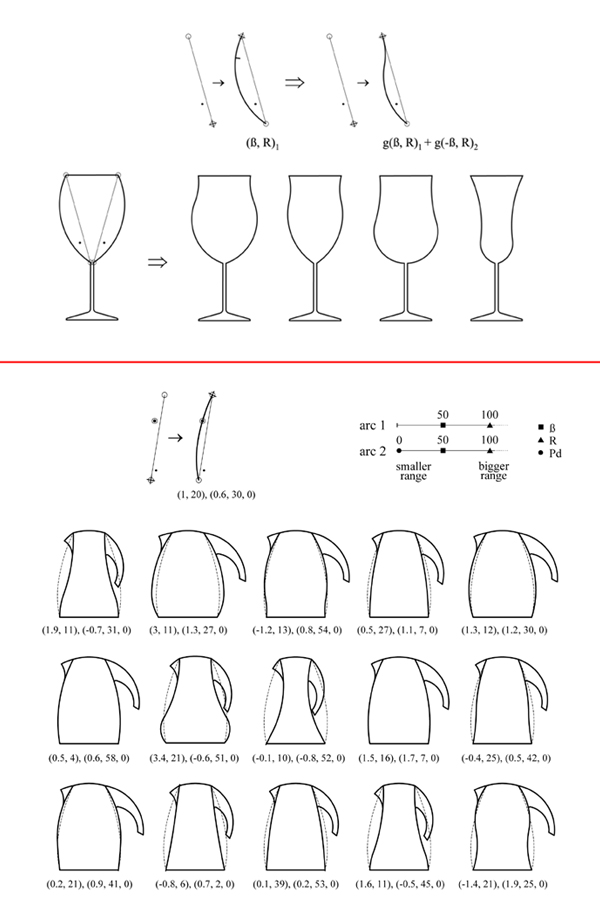
Now that makes much more sense. I think. Help?


Comments:

Hmmm, I don’t think they’re very clear.

As I understand it the point of shape grammars isn’t the definition of a single shape, but the automatic generation of lots of shapes. From this space of shapes a good design can be found. The user defines the grammar (rules to transform the shapes etc.), sets the computer off to be ‘creative’ and interesting forms ‘emerge’.

In practice, I think they’ve found that setting up grammars that do something useful is hard. Ideally, you want the computer to be able to generate many good designs, so you want the grammar to be as expressive as possible, but you risk a combinatorial explosion with millions of (mostly uninteresting) shapes produced. Restricting the representations and rules you use avoids this, but also removes much of the computer’s creativitity. They also have problems identifying the sub-shapes which you want the system to modify.

I think these guys are trying to get around these problems by making the process more interactive. The user can guide the system towards more interesting parts of the space of shapes and (re)define rules on the fly. They get around the sub-shape problem using shape matching techniques from computer vision. I suppose the eye tracking is so that the computer can guess which sub-shapes you’re finding interesting.

In contrast, parametric 3D CAD models do represent a space of shapes but it’s a much more restricted set of shapes. There’s much less scope for the computer to be ‘creative’. Direct modellers (hi Blake!) only represent one shape, but have powerful tools for the user to change the shape interactively, but don’t let the computer do it.

I’ve not seen a good practical example of shape grammars in mechanical design, but in architectural design aren’t Bentley’s GenerativeComponents based on something like shape grammars (I’ve never played with them)?

Posted by DrewSherlock on 01 January 1970 at 12:00 AM

I’m with you, Al, I don’t fully understand it. Plus, if you’re like me, and your eyes are constantly distracted, I can’t see the tracker working too well.

Posted by JeffM on 01 January 1970 at 12:00 AM

My designs would end up looking like a Jackson Pollock if it tracked my eyes – I use 3 computers….wonder how it would handle a dual monitor setup – one for each eye? Stereoscopic design!....where are the asprin….

Posted by Kevin Quigley on 01 January 1970 at 12:00 AM

Uh oh, they’re figuring out the secrets of direct modeling.

But seriously, let me know when someone comes out with an affordable eye tracker. That’s something I’d actually use.

Posted by bcourter on 01 January 1970 at 12:00 AM

Blake Mate… Eye tracker? Seriously.. I’m half blind as it is.. I don’t need no fools ’tracking’ my eyes… all I want is a bloody mouse that works properly and a laptop that doesn’t weight 14 tonnes (that’s metric sunshine). Any Eye-based hardware comes WAY down the list brother..

Al

Posted by Al Dean on 01 January 1970 at 12:00 AM

quite. I read this first, thought “oh, cool” then I realised I didn’t understand it properly. So I looked at it all again. nope, still don’t really understand it and what purpose it serves. The designer’s talent is finding the balance between hard space and empty space to create something pleasing right?

You can do that with a pencil…

And we could get a lot of designers trained (and give them a lot of pencils) for a fifth of a million quid.

Al

Posted by Al Dean on 01 January 1970 at 12:00 AM

I struggle to understand what it means about making suggestions to you… Ideation sketching seems a whole lot simpler to me!

Posted by Louise on 01 January 1970 at 12:00 AM

quite. I read this first, thought “oh, cool” then I realised I didn’t understand it properly. So I looked at it all again. nope, still don’t really understand it and what purpose it serves. The designer’s talent is finding the balance between hard space and empty space to create something pleasing right?

You can do that with a pencil…nice eyes

Posted by alain on 23 June 2010 at 07:16 PM

Leave a comment

Enter the word you see below:

Latest D3D jobs

Design Engineer

Thu, 09 Feb 2012 07:32:39 +0000

Design Specialist/Engineer

Thu, 09 Feb 2012 07:30:23 +0000

CAD / CAM PROGRAMMER

Thu, 09 Feb 2012 07:09:07 +0000

Project Design Engineer

Mon, 06 Feb 2012 10:44:52 +0000