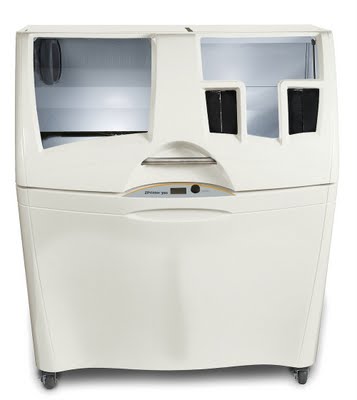


Z Corp have released the latest addition to it’s range of 3Dprinter products with the launch of the ZPrinter 350. As many readers will know, Z Corp is one of the leaders in the 3D printing world, where speed and low-cost are absolutely key to support the product development process. While the company always grabs headlines with its colour printers, there’s still a big market for monochrome machines. Running costs are lower, the machines cost less (due to the reduction in complexity) and for many, the ability to quick create a series of prototypes, discuss them around a table and progress design is all that they want.

What this brings to the product line-up is an advancement of the existing 310 monochrome product, adding in the integrated post processing capabilities of machines like the 450 and 650 (which we took a look at a while back), to give you a system that builds quickly, provides you with the tools to break out the model from the build chamber, recycle the unused material and post process the material. It also takes advantage of Z Corp’s most recent build powder (ZP150) which gives you a much whiter model (which is ideal for concept development and for architectural users, is ideal) and a much more robust green model (green refers to the state before you infiltrate the model to ‘fix’ it).
Build volume is a very usable 203 x 254 x 203 mm, it builds just under Z Corp’s benchmark 1″ per hour (they quote 0.8″ per hour), with layers in the 300 x 450 dpi resolution range (no mention of layer thickness). One thing I did find interesting was the discussion of the affordable nature of the machine.
The ZPrinter 350 costs around $25,900.
While that’s a cheap machine by historical standards, there are much lower cost commercial machines from traditional vendors on the market (the Solido machine and Dimensions’ uPrint spring to mind). The 350 pulls things back in cost of consumables and a greater build volume, but there’s changes afoot in the RP market. One of the other low-cost hopefuls, Desktop Factory, got into financial trouble recently and the assets got picked up by 3D Systems – the results of which still seem uncertain.
Alongside this, there’s the homebrew market that is gaining huge interest amongst many users, purely because of the ability to create parts with very low cost hardware, often self built. Take the MakerBot, the RepRap project (which is now on its second generation).
I’m not for a minute suggesting that professional designers and engineers are going to foresake investment in professional level technology that solves a serious requirement, but there’s a home brew enthusiasm for this type of technology which is now 30 years old in many areas.
Another thing to consider is that many of the original patents are now starting to expire and that always means that the technology can be freed from the stranglehold (a morally correct one I might add) that the originators have on it.
There are interesting times to come for 3D printing. Very interesting indeed.