Solving parametric modelling’s productivity gap
30 October 2008
Process types: Design and Manage
Evan Yares highlights a productivity gap that CAD users have suffered from for the last two decades, exposes its source, and reviews the technology that will make it finally go away
For the last 20 years, parametric feature-based solid modelling has been the de facto standard for MCAD. Chances are that, if you read DEVELOP3D, you use (or have used) a CAD program that is based on parametric feature based modelling. And, if so, then you’ve experienced your share of frustrations with the technology.
It’s always possible to point out weaknesses in particular products, or failures in the areas of training or best practices when using CAD. Yet even in cases where best in class software is coupled with excellent training and best practices for use, there is a persistent gap between the theoretical productivity benefits offered by parametric CAD and the productivity benefits users realise from it in actual practice. In short, there’s a problem, and it’s not your fault.
To understand where the productivity gap comes from, we need to step back and look at the history of CAD.
The Dawn of Parametric Feature-Based Modelling
The vast majority of significant MCAD programs in use today trace their conceptual origins back to 1998, to the release of Pro/Engineer, the first commercially successful feature-based solid modelling system.
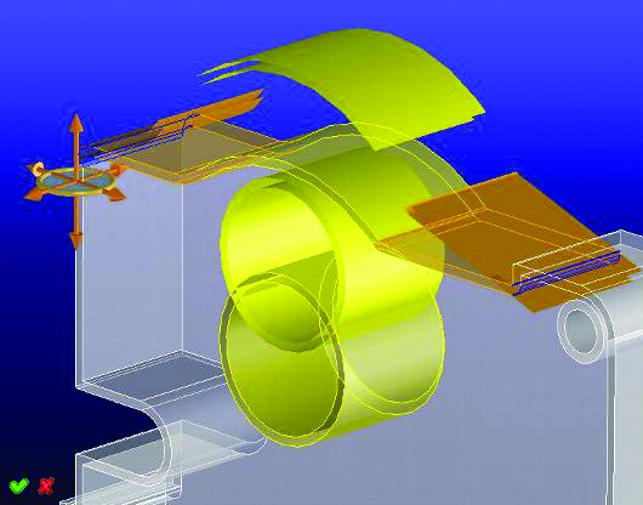
CoCreate. A mature non-history based CAD system that has gained inference capabilities over time
Other companies were working on similar systems at the time, yet Pro/E was notable in that it used parametric feature-based solids and NURBS surface mathematics. It also had a common data structure for all modules, including basic sketching, feature-based modelling, assembly modelling, drawing generation surface geometry and data management.
Pro/E introduced the common work process for solid modelling: draw a 2D sketch, add geometric constraints to it, and then convert it into a solid geometric feature using one of several basic operations. Subsequent sketches could be used to add or subtract additional features to the base model. Pro/E would record all operations, including sketches, constraints and feature creation, in a ‘history tree’.
‘It’s always possible to point out weaknesses in particular products, or failures in the areas of training or best practices when using CAD’
Sam Geisberg, the founder of PTC, said of Pro/E, “The goal is to create a system that would be flexible enough to encourage the engineer to easily consider a variety of designs. And the cost of making design changes ought to be as close to zero as possible. In addition, the traditional CAD/CAM software of the time unrealistically restricted low-cost changes to only the very front end of the design-engineering process.”
Like most new technologies, Pro/E had some flaws out of the chute. Yet the product was impressive enough that it forced competitors, such as SDRC, Unigraphics, ComputerVision and Dassault, to deliver similar capabilities. And it became a prototype for new generation lower-cost CAD products, such as SolidWorks, Solid Edge and Inventor. Ten years after the introduction of Pro/E, its competitors were all conceptually more similar to Pro/E than different.
User Frustrations
New technologies often take a while to mature. CAD, complicated as it is, has taken a very long time. Consider that in 2007, 20 years after it first developed Pro/E, PTC still spent over $100 million on R&D on the product. Competitors spent commensurate amounts on their products. Yet even with this investment, there are two common frustrations repeated by users of almost all parametric feature-based modellers.
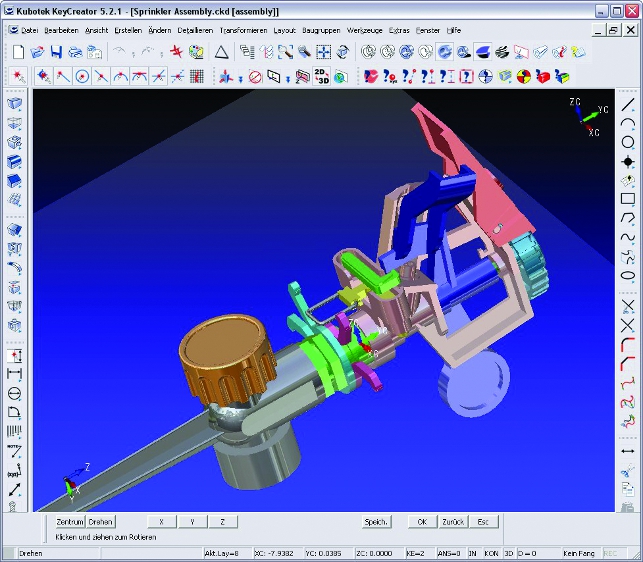
KeyCreator. Has strong support for STEP, model repair, model validation, with inference of common feature types. No history support
You must be an expert to modify an existing model, and models are inflexible, and as they become complex, they fail too easily after changes.
And, while there are things that can be done to reduce the occurrence of these frustrations, there are no universal solutions - if only because these are symptoms of a deeper problem.
The Nature of the Problem
It’s possible to understand the deeper problem with parametric feature-based modelling by considering two fundamental concepts. A process is ‘imperative’ if it describes a sequence of steps to reach an end state (the term ‘procedural’ is also used for this). A process is ‘declarative’ if it describes what the end state is.
Parametric feature-based modelling is, by its very nature, imperative. That is, it is based on a sequence of commands (the history tree) that change the state of the model. Little known to most users is that it’s typical for parametric feature-based modellers to use a LISP interpreter, buried in the program, to evaluate the history tree.
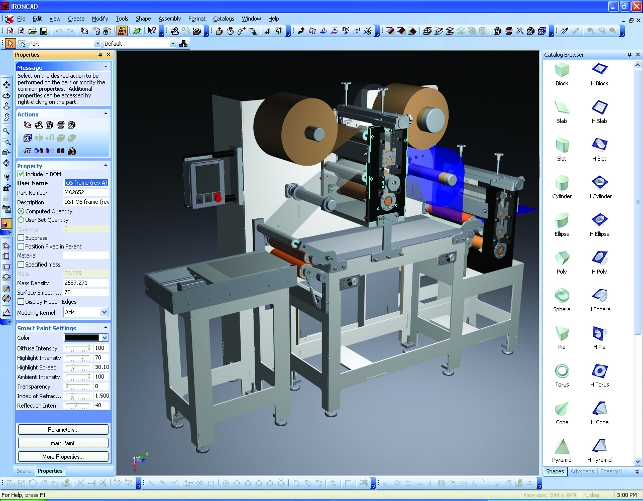
IronCAD. Supports drag-and-drop features, with limited inference on dumb models. Supports both history and non-history based modelling
The process of engineering, as practiced by humans, is primarily declarative, in that it describes what something ‘is’, and is secondarily imperative, in that the process of actually making something often requires a sequence of steps.
While this distinction between imperative and declarative may seem a little esoteric, what it does show is where parametric feature-based modelling works well (with the portion of the engineering process that is imperative), and where it does not work well (with the portion of the engineering process that is declarative).
Because the terms procedural and declarative also relate to forms of human memory, this distinction also provides an explanation of why some people are able to easily learn to use parametric feature-based CAD systems - it is because they have strong functioning procedural memory.
Typical solutions to the problem
It is ultimately the difference between the imperative nature of parametric feature-based CAD, and the declarative needs of the engineering process, that leads to the gap in practice between the theoretical productivity of the software and its actual productivity.
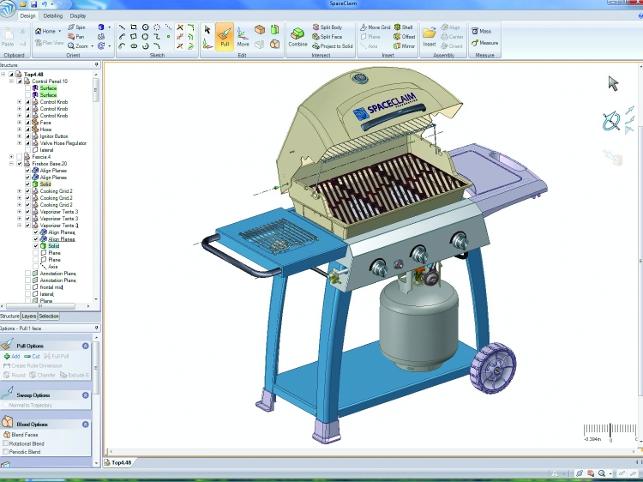
SpaceClaim. A clean-sheet program, supporting direct editing of dumb files, inference of most features, drag and drop editing, and a modern Vista-style interface. No history support
The only practical solution to closing this gap lies in adding declarative design capabilities to CAD software. Of course, it’s easier said than done. Here are some of the more common techniques:
Kludges. These are special commands that let users get around limitations that would otherwise prevent them from getting their work done
Special Modules. Extra-cost add-ons (often expensive), to support a particular type of declarative object
Wizards. These are canned procedures, which create a particular class of declarative object
Knowledge Management Languages. These are essentially powerful imperative languages, which run inside a CAD program, and which can be used to build canned programs representing declarative objects
Application Programming Interfaces. Software interfaces that let you use an external program (eg Excel, or a third-party program).
Towards a real solution
The problem with the typical solutions to the parametric productivity gap is that they most often just make the software more complicated. In a situation where all users are CAD specialists, that’s probably not a major problem. Yet, in a situation where a company would benefit from making it possible for smart engineers and designers to be productive with CAD software without needing to be specialists, extraneous CAD complexity is not really that good a thing in the long run.
Solid Edge/NX with Synchronous Technology. Probably the most extensive implementation of history/non-history, imperative/declarative modelling in mainstream CAD applications. Supporting persistent non-history based constraints - a first
The cleanest solution to the parametric productivity gap is to add declarative modelling/editing capabilities to a program. But clean does not mean easy. A number of CAD vendors have been working on this for several years. Interestingly, their solutions are, in essence, very similar: a combination of direct geometry editing (without reference to history), and local feature inference.
Towards the Future
For 20 years, CAD users benefited from the capabilities of parametric feature-based modelling, but were often frustrated by its limitations. A new class of capabilities, whether called direct, explicit, history free, synchronous or declarative, promises to change CAD from a tool for specialists to a tool that’s actually useful for normal (smart) people. Though the elements of the technology have been around in some form for a number of years, it is only in this year that companies such as PTC and Siemens, in delivering them in a mainstream guise, have raised their profile. Siemens, in particular, has raised the bar by adding support for constraints (including parametric dimensions) without requiring history.
Evan Yares is a writer, consultant, analyst and user advocate, focusing on engineering software. His blog is found at http://www.evanyares.com. He gives Al Dean a run for the scariest man in CAD - and wins every time. His thanks go to David Weisberg, author of The Engineering Design Revolution, The People, Companies and Computer Systems That Changed Forever the Practice of Engineering, available online at http://www.cadhistory.net, for providing a reliable historical reference to the CAD industry.

Comments on this article:
Credit crunch, recession, what impact will this have on engineering firms?
30 October 2008
Process type: Manage
In the last month, we have all learnt a lot about the credit crunch, investment banks, multi-billion dollar rescue packages and bail-outs. While the long-term impact is unknown, most predictions seem bleak. Martyn Day asks if engineering firms will have to tighten their belts
I am sure that, like me, you have been addicted to the news this last month, reading about the financial crisis that’s hit the planet. The numbers involved in the Wall Street bailout of $7billion, and billions in fees paid to shore up British banks and building societies, have been beyond my comprehension. It all makes paying £5 for a glass of wine in London seem pretty good value.
We went from credit crunch and talk of recession to the financial equivalent of Armageddon in a matter of weeks, and now we are left trying to work out what the hell all this will mean looking forward.
For that, you need to have some knowledge of how we reached this disaster point in the first place.
Whenever I have trouble understanding ‘City things’, I always turn to my school friend, Wyn, who used to trade things called ‘Swaps’ and then moved into risk management. He trained as an engineer, being very good at maths and science, but got tempted by the dark side after graduating, heading for the bright lights and financial rewards of banking, rather than working on an oil rig.
I remember about four or five years ago Wyn tried to explain to me how there was too much debt in the system, and how the whole of this CDO (Collateralised Debt Obligation) market was going to end in tears because nobody knew what they were worth and boards of banks didn’t understand their liabilities as the products were too complex. He also pointed out that most of the bankers he was meeting had never actually traded through a recession or been through a financial crisis. I think it’s fair to say that most have that experience now.
Low interest rates over a long period of time, coupled with lax lending criteria, have enabled individuals and companies to leverage up the amount of debt they can take on, and this expansion in cash availability has fuelled some good times for us, our economies and bankers’ bonuses. This debt was packaged up and sold to all sorts of financial firms, and when the defaults started nobody knew who had what liability.
The banks stopped trusting each other, refusing to trade with one another, leading to intervention by national governments. We don’t know how this rescue plan is going to play out or how much confidence these moves will bring, but the UK and the US have done a good job of nationalising a large proportion of the mortgage debt. Still, it’s likely that interest rates will go up and mortgages will suck even more money out of people’s expendable income, leading to further drops in demand for products.
So what does all this mean? The banks’ appetite for lending money has gone and will not return for a long time, so engineering companies that have cash in the bank are in a good position, while those that have been debt-fuelled in the past will start finding it difficult. Already automotive manufacturers in the US have gone to the government and asked for access to $25billion in loans for new tooling as Wall Street doesn’t see them as a safe investment.
Undoubtedly people are cutting back on their purchases at the moment and a brand new car, coupled with the current price of petrol, isn’t high on the list, so automotive will certainly see tough times. In the States, Chrysler has already stopped offering leased purchases. GM’s problems are well known: it announced a $10billion cost cutting plan and $5billion in asset sales to shore up its liquidity. We may well see some big automotive names vanish.
The biggest worry is the lack of investment that comes with tough times, but there’s no reason why this should inhibit innovation as there’s always a market for good ideas
But it’s not all bad news. Firms such as John Deere and Caterpillar have run their businesses cautiously, watching their cash flow and building assets. Many manufacturers have become more efficient users of capital. Engineering firms have followed companies like Toyota and reduced capital spending by getting rid of inventory and shrinking the floor space needed for production.
The George W Bush war on terror has been good to most defense companies, which have significant amounts of cash on their balance sheets after several years of strong earnings. Profits have been fuelled by high-level Pentagon spending on Iraq and Afghanistan and new weapons programmes. That’s not to say a forecasted drop in demand isn’t going to hurt, but the primary reaction is mainly a reduction in expansion plans and delays on acquisitions.
From the engineer’s perspective, recessions have always meant having to do more with less. Fortunately, as most software is on subscription these days, you will always have access to the latest and greatest tools. Being skilled in the use of any of the popular modeling and analysis tools makes you eminently employable as our industry has been facing a shortfall of engineers for many years.
The only ‘IT casualties’ I know of so far have been in the back-offices of banks, of which there are now substantially fewer. The biggest worry is the lack of investment that comes with tough times, but there’s no reason why this should inhibit innovation as there’s always a market for good ideas.
In conversations with my banking friend, discussing economic bubbles and Blair and Brown’s claims of ‘The end of boom and bust’ cycles, Wyn told me, “The only way to end boom and bust cycles is if you can get rid of greed - and I don’t know any way of doing that.” Despite what our procrastinating politicians choose to tell us, the backlash of greed has struck again. We will always have these cycles and we have to cope as best we can, however painful or brutal the next two or three years are.
Comments on this article:
Teetering on the edge of space
24 October 2008
Process types: Design and Manufacture
Teetering on the edge of space, Josh Mings explores the role of multi-touch in the future of 3D interaction in product development
You touch your screen to turn it on. It flashes up instantly. You touch a sphere that opens to reveal 3-dimensional representations of your designs. You select two with your fingertips and flick them toward one edge of an 8-sided screen that immediately displays the content and structure of the 3D model… That was five years ago.
Now we’ve come to a threshold in what is possible with multi-touch technology. It’s not touch anymore, it’s reaching in and pulling out the syntonicly calibrated beating heart of the most adaptive design environment known to humans.
Where we’ve come from
I’m sitting in the back row of a small jet teetering on the edge of an Earthen atmosphere and a void of dark space. On the edge of floating and falling - the perfect place to write about the future of 3D interaction within the field of engineering and design, and the role our ability to manipulate areas of space with our touch is going to play.
Multiple ways to touch, multiple ways to interact with ribbons of our lives in timelines of playful video and digitised images: a technological revolution that linked our minds and our machines in one co-ordinated effort. We learned to create with our hands again, and multi-touch gave way to the mainstream influx of 3D as the only criteria for moving a design from engineering to production, making 2D redundant. All ideas of what CAD was to become had been dissolved with the simple idea of multi-touch. But it wasn’t ‘multi-touch’ we longed for all those years ago. We wanted to reach the limits of controlling multi-dimensional space.

What will the future of 3D interaction look like? Who knows? But it’s going to look pretty damn cool when it does arrive. And shiny. Definitely Shiny
The output previously determined the way in which we interacted with objects on a display. We were strapped to a flattened digital landscape - a single point within that landscape; a single action within that point. Then multiple points of input changed our ideas about the limitations of that landscape. Multi-touch became a symbol of a desire to explore outside of it.
Many people in digitally aided design companies thought the mainstream adoption of multi-touch technology would take a while. Developers had sensed it, but nobody realised the hardware and the software would act as one. It shook the world.
The skeptical majority failed to recognise the expectations of generations already familiar with using multi-touch environments to create libraries of media, networks, interactive games and relations between programs and data. In the CAD industry, the shortsighted simply saw a multi-touch screen as a way to move items about and failed to see 3-dimensional space in the context of multi-selectable, dynamic 3D design.
‘But it wasn’t ‘multi-touch’ we longed for all those years ago. We wanted to reach the limits of controlling multi-dimensional space’
Now, (cue the Theremin*) we float on the edge of the unknown limit of multi-dimensional systems with the possibilities of larger, more adaptive environments residing outside the film of OLED displays and graphical processing power reaching into the terabytes. What started as a theory of physical movement across a screen, designed to work in a 2D world, is rapidly becoming something amazing that will ooze outside the display of every design engineering device.
The possibilities
Multi-touch will be everywhere, but not the flat screen approach we envision. Multi-dimensional design corporations, 3-dimensional digitised media companies, and virtual world communities are leading the push in hardware and software development. The landscape is changing. The 3-dimensional design environments of the future will reside beyond the screen. We will control the movements of commands within a system that adapts to the processes we use to create 3-dimensional geometry. But constructing the geometry will not be the focus. Geometry will be the by-product of criteria entered onto multiple contact points in the surrounding environment of surfaces, lines and envelopes which relay adaptive design changes to the model.
Real-time rendering, tolerance and element analysis pre-empted multi-touch technology, but not to the extent that it will be used within a fully adaptive environment. Just as the measures of a 3D model are composed, the sounds and resonance of surroundings and adjoining parts will adjust in real-time with materials and conditions. The road to consolidating all aspects of design will be revealed in the adaptive environment that combines the requirements of each.
Beyond this, redefining the interface redefines how ideas and product are manufactured, putting designer, 3D modeller and engineer in the midst of the environment where the object will be used. Even in manufacturing, prototyping will stretch beyond the CNC operator moving multiple objects across the display. As a model is created, machine operators will use multi-trajectory tool-pathing techniques to test and create machine operations. And multi-touch technology will affect manufacturing methods even further.
During the spread of multi-touch technology into manufacturing, the idea of rapid laser sintering technology was being developed to bring product design and manufacturing closer together. In the new multi-touch environments, there will be no gap between designer and manufacturer. Flash-atomising of material will give immediate results for each design iteration. Tied to the adaptive revisioning of parts, prototypes can be super-sintered instantly to redefine feel, function, weight and aesthetics. The processes that separated each phase of design and engineering have been brought together by the simple idea of being able to touch each aspect instantly.
The future
Ten fingers used to be the limitation. Now they are the most powerful input devices to deliver precise responses to an environment that is just as responsive. It’s not that ‘multi-touch’ is making all of this possible. It’s the expanse in front of us that hasn’t been explored; the space that hasn’t been moved. Multiple points of interaction within that space will transform design and engineering. The boundary between the inside and the outside of the display will be blurred… and this is just the beginning.
*A Theremin is the earliest known electronic musical instrument. The player controls frequency and volume in 3D space by disrupting magnetic fields with their hands to create sound. It was the first 3-dimensional multi-touch device.
Josh Mings is a mechanical engineer in the aircraft interiors industry. He is also the brains behind solidsmack.com.
Comments on this article:
In this online, hyper-connected world, where do you go for the truth?
17 October 2008
Process types: Collaborate and Manage
In this online, hyper-connected world, where do you go for the truth? What is the truth, and it is variable? Al Dean ponders the distribution of information in the online world and how to navigate a wealth of resources
I feel slightly odd writing about this subject for a print magazine. After all, print is old school. It’s trees. It’s dead trees, chopped up, processed and stuffed through a very large printing press, packaged up, posted and delivered to your door/desk/in tray. It’s not very connected up is it? But it looks nice, it smells nice and it has a tactile response that a web site displayed on a 22” LCD screen simply doesn’t have. So what am I rambling about?
Let’s talk about sources of information. When looking at any form of technology, almost all of us revert to the web to find out other people’s views, how our peers perceive the product we’re looking at. Amazon is a fantastic example. How often when buying something do you have a look at the reviews? There, laid bare, are the product’s functions, features and faults - and with the odd exception of the nut-job, it’s all pretty honest. The same goes for the web.
When the Web 2.0 talk is made, it all comes down to one thing: connecting people and connecting content. I say something - you can feed back, instantly. But while this works perfectly for consumer electronics, music and books, the same is not necessarily so of technology for product development and manufacturing - or so I got to thinking at a SolidWorks press event recently.
Look at the attendees of that event: it was split into three groups, the Press, the Analysts and the newest bunch to join the throng, Bloggers. The Press is what many of us are used to: magazine sent out, typically for free, supported by advertising so you don’t have to pay for it.
Then there’s the Analysts, who conduct work behind closed doors, with little making it to a public airing, funded by the vendors or a user organisation.
Then there’s the Bloggers: the enthusiasts that spend spare time - free time - to create web-based resources that seek to talk about their subject of choice (in this case, SolidWorks). One thing that came up prior to, during and after this event, was the question of who has most authoritative view on what goes on during that press event. The Bloggers make the most noise, reporting directly from the event, to those that read their websites/blogs. The Press, used to a monthly magazine cycle, delay things, tend to make less noise, but do so to a typically large circulation. The Analysts? I’m not too sure what they get out of it. But who has the better idea of what’s going on? Where does the value in reading this information lie, and what should you bear in mind when doing so?
Bloggers. I love them. Well, most of them. These are a bunch of users that feel so impassioned about the tool that they use day in day out that they use their spare time to create some pretty amazing content. I like them so much that we’ve got two of them writing in this issue. In addition to our regular columnist, legend Josh Mings (solidsmack.com), we also have Rob Rodriguez (robrodriguez.com).
There are others within the SolidWorks community that I’d recommend: Gabi Jack (designsmarter.typepad.com/gabijack), Mike Puckett (mikescadblog.com), Ben (Solidmentor.com) and Alex Ruiz (theswgeek.com), Jason (rocksolidperspective.com) and Brian (cadfanatic.com/). These guys do an outstanding job of keeping SolidWorks users up to speed with what’s going on, and the plan is that you’ll see more of them in these pages in the future.
‘It all comes down to one thing: connecting people and connecting content. I say something - you can feed back, instantly’
But should these sources be relied upon as a purely unbiased source of information? There’s an argument that peer created information is going to be more accurate and more honest than that provided by the traditional press - bloggers have no concerns about advertiser relationships, and no need to pull their punches. Or do they?
Take one of the most vocal bloggers in the SolidWorks community, Matt Lombard. Makes a lot of noise, kicks up a stink (in some cases, rightfully so) and claims to independent. But he’s also the author of the SolidWorks Bible - is there a connection? More noise means more book sales… I don’t know. What’s clear is that just because someone is a user doesn’t necessarily mean that their opinion means more or less than someone slightly connected to the software.
The good news is that its now possible to find out pretty much exactly what you want about a product, in the way that you want, how and when you want. What needs to be considered is how you interpret that information. I’m tired of the ‘bloggers vs press’ argument - what I’m interested in whether it’s good content or bad content, because the delivery medium doesn’t really matter.
.(JavaScript must be enabled to view this email address)