
It’s everywhere, it’s overused and it’s a marketing buzzword, but it also holds the key to developing, producing, and supporting profitable products. Jim Brown gives his perspective on that crazy little thing called PLM
By now, everybody knows what this “PLM” thing is all about, right? Now that the PLM market has matured, it seems that most of the misconceptions around PLM should have cleared up. But they haven’t, have they? At the risk of adding yet another viewpoint to the market, I will provide some perspective on the way I think about PLM. Why? I think it is important for manufacturers to get this right. PLM is much more than a marketing buzzword, despite the probable overuse of the acronym. Indeed, PLM holds the key to developing, producing, and supporting profitable products.
What’s in a name? For the software systems known as “PLM” – or “Product Lifecycle Management” – there has been confusion. Some of the confusion may be from the name itself. Although the name is intended to convey that fact that these solutions serve as the backbone for product information and processes across the product lifecycle, somewhere the part about “product information and processes” got left out. This leads to the PLM myth that the lifecycle is the centre of the solution. Truth be told, it is the product. The “lifecycle” is really intended to identify the ideal scope of the solution, starting from early requirements through the service lifecycle. But the very essence of the solution is cantered around the manufacturers’ products. And after all, shouldn’t that be the centre of their business?
The value in PLM
Let’s discuss the core value provided by PLM solutions. The solutions started, for the most part, with Product Data Management (PDM). They have grown well beyond those capabilities, but at the centre PDM is still a very fundamental component of PLM. Products, even those that appear to be very simple products, have complex information associated with them. Keeping all of this information in sync is a tremendous challenge. The challenge is extended when the information includes massive CAD files, with complex associations between them. Simply storing, revisioning, sharing, and protecting these files is a big job. But PLM is much more than product data.
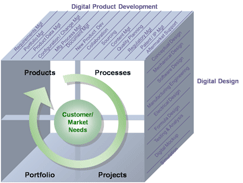
Figure 1: The PLM Framework, broken down into Digital Product Development and Digital Design tools
Beyond information about the product, PLM is about process. Product innovation, product development, and engineering are comprised of a host of different, inter-related processes spread across different departments, different companies, and often-different geographies. PLM extends the core of data management to the processes associated with it. This intersection of the product with the associated processes is the essence of PLM. And of course processes aren’t complete without the people executing them.
The classification of PLM
So PLM is simple. It is a set of software solutions that enables manufacturers to produce more profitable products, by managing product data and processes across the product lifecycle. With that definition, the solutions in PLM can be broken into two major classifications:
Digital Design Tools – software tools designed to enable engineers or others in the product development process to play their role in designing a world-class product. These solutions are also sometimes classified as “Digital Prototyping” tools
Digital Product Development Solutions – solutions that help manage, coordinate, and control the process of bringing a successful commercial product to market.
Together, these solutions form a suite of solutions that help companies compete through better products, better product launches, and better long-term product profitability. Figure 1 shows a sample list of the types of digital design and digital product development solutions that comprise PLM. This list could also be expanded with a myriad of additional solutions depending on the individual company, industry, and products being supported.
As if this wasn’t enough, Figure 1 also highlights another key aspect of PLM, “projects.” Beyond the context of an individual product or process come product development teams and the projects they work on. Keeping product development projects – and their associated team members – working together is a big challenge. This challenge has increased in recent years due to global product development and outsourcing, where it is now rare for all participants in the team to be co-located. Given the importance of successful new product development and launch (NPDL) to company profitability, it is a very valuable capability for PLM to address projects in addition to the underlying products in development. To address this, PLM offers project management as well as collaboration tools. These capabilities play a key role in helping product development teams improve their project performance.
The role of collaboration
Collaboration tools themselves have received a lot of recent attention. Significant emphasis has been placed on the ability to more fully define a product digitally so it can be shared electronically. This allows more people to provide input and feedback early in the product development cycle, to get the product right the first time. It also provides valuable information to help sell and support the product after it is launched.
The ability to readily share rich product information, including 3D models, has enhanced processes from early design, to product documentation, to service.
Collaboration is also expanding as companies are leveraging social computing techniques in product development. The use of instant messaging, social networks, profiles, blogs, and wikis to help product development teams collaborate with their extended networks is highly compelling. Many companies, in fact, are starting to include “Web 2.0” concepts within the scope of their PLM solution. This is a natural extension to PLM, and will likely be commonplace in the leading PLM systems within five years as more manufacturers learn to take advantage of social product development approaches.
The expansion of PLM
Despite trying to simply the definition of PLM, it is important to realize that the scope of PLM continues to increase. PLM is expanding in several key dimensions
Product – A “product” consists of much more than R&D or engineering specifications, and needs to include a richer view that includes commercial considerations that define the “whole product.” In addition, the technical view needs to grow to include mechanics, electronics, and embedded software.
People – Product development and product innovation are expanding across the enterprise to more people inside and outside of the business. More functions are being added, for example integrating marketing, manufacturing, service, compliance, or even software development team members.
Lifecycle – Product-related processes are being integrated across previously disparate functions, encompassing early requirements as well as service characteristics of the product.
As PLM continues to expand, it is encompassing and integrating more processes and functions. For example, it is becoming much more common to address product compliance earlier in the product lifecycle, which drives the need to incorporate compliance information in PLM. In a similar way, costing and supplier information is being integrated to allow companies to “design for supply” in addition to designing the product for performance.
As the realm of PLM grows, so does the scope of the solution. This causes many to wonder where PLM stops and other systems begin. The most contentious issue is typically where to use ERP (Enterprise resource planning) and where to use PLM. A simple guideline is to use PLM for product innovation and product development, and then transfer to ERP for the remainder of the product lifecycle. While this is a compelling model, it is frequently too simple to work for most companies. PLM simply has too much value to offer in later stages of the product lifecycle, including manufacturing, service and support. In addition, integrating these “downstream” functions into PLM provides the opportunity to provide real-world feedback to product developers on how their products are performing after they transition from digital prototypes to physical products.
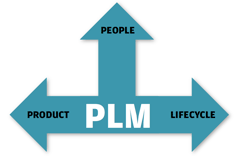
Three Dimensions of PLM Expansion: Product, people, and lifecycle
Perhaps a more compelling way to view the boundaries between PLM and ERP is to view PLM as the backbone for product-related content and processes, and ERP as the execution engine that manages the sales, procurement, and manufacturing processes. Effectively, then, ERP addresses the processes from product demand to fulfilment, and all of the associated financial transactions. Most companies today are approaching this by integrating the “release to manufacturing” and “engineering change management” processes between ERP and PLM first. But determining the roles played by the different solutions promises to be a big question moving forward – particularly as ERP providers mature their own PLM solutions.
At the core, PLM helps companies make more money from their products. That is the business reason that manufacturers of all kinds are investing in PLM. The path to that value differs by company, but the scope of PLM is expanding to encompass most possible business initiatives related to engineering and product development. As this scope continues to increase, it is becoming imperative that manufacturers develop a long-term vision for PLM, and then implement it in smaller, finite steps that provide value along the way. Developing a clear vision helps companies ensure that they can leverage their PLM foundation as subsequent initiatives arise and business needs change, without having to rework or replace solutions. And implementing in a “PLM Program” fashion allows them to reduce risk and gain value as they go, which is critical in today’s difficult, global markets.
I hope that this perspective helps provide some clarity as opposed to confusing the issue. I would love to continue this conversation on my blog at www.tech-clarity.com/ClarityonPLM or via Twitter at www.twitter.com/jim_techclarity.

Jim Brown ponders the scope of PLM