Communicating in the third dimension
05 February 2010
Process type: Collaborate
Face-to-face contact in business is now often a luxury and to most effectively communicate our ideas over the web we need 3D. But until the technology is consumer friendly we’re fighting a losing battle, writes Rob Jamieson
As the global economy is starting to fight its way out of recession some new trends have emerged. Alongside a reduction in workforce, more people are now working from home or working for themselves. Travel bans are also in place at many companies. All of this means less face-to-face contact than ever before, so how do you communicate effectively with your work colleagues and your customers?
A lot of companies started using “consumer” based technologies, and Facebook and Twitter have become all the rage. Personally, I’m not 100% convinced by the effectiveness of these apps in the professional space but for business to consumer it can be strong, but the person Tweeting has to be interesting!
Some companies have embraced new technologies well, and judging by some stats on YouTube, video can be a really effective way of communicating with customers. We all know about the highly crafted viral marketing but a ‘Joe blogs’ video of something being manufactured or a monkey fitting a graphics card certainly work and have changed the way companies talk to their customers.
The 3D challenge
While 2D technologies are everywhere, as engineers and designers we play in a 3D arena but there is still no 3D for the masses quite yet. You could argue that there is 3Dvia (Dassault) or Microsoft Bing, SketchUp on Google etc but you still need some grasp of 3D to use them.
I’ve been recently trying to buy a new house and part of the elimination process is looking at houses ‘virtually’ using 3D street-viewing tools. Watching my wife navigate a street with one of these (badly) and trying my best not to jump in was hard!
Now I have lots of hardware around my house so 3D works well, but using these tools on lesser hardware did not give us the same experience. There is always a requirement for some form of 3D acceleration. However, Fusion chips with both 3D and CPU support are coming out from major manufactures and form factors are getting smaller so expect more out of portable devices.
Using 3D tech should not be like buying a house in England where you need four or five sets of people to move on the same day for it to work. When one part breaks, the whole chain breaks down, but don’t get me started!
Part of my house move now requires me to look at planning drawings (dealing with builders is next). I can’t help myself commenting on hand drawn ones with interesting linework. For me I’m surprised that they are not in 3D - even recent plans. It would be far easier for consumers to realise what has been designed if it was in 3D.
The broader market reach of 3D technology will certainly help us all, but it needs to work out of the box for widespread adoption by consumers. One of the biggest barriers is when it comes to sharing information. Yes you can send another designer or potential business customer a viewer or instructions of how to view your 3D data, but easy access to 3D in this volume prosumer and consumer space is still missing. And while companies continue to fight over an industry standard it will continue to be absent.
As things stand, sharing 3D data is made easier by embedding 3D technology in websites but it often takes time to update the information. One of the successes of YouTube is how easy it is to change and update data. One house I was looking at had recently been renovated but a quick look at street view showed how it was before the paint job. My wife never wanted to see that one, but she would have if data had been kept up to date. This illustrates the importance of relevant data.
In some ways we need something outside of one provider, that supports multiple platforms and level hardware from handheld to workstation. The hardware foundation is there and 3D technologies are more than capable – now it’s down to software companies to agree on a standard. Once this is in place communicating with dispersed colleagues, customers and suppliers will certainly be much easier, but why can’t they get a move on? Surely it can’t be as hard as buying a house in England!
Rob Jamieson is a marketing manager at AMD. He thought he was dealing quite well with the stress of moving and then a man with a large city bonus gazumped him. This article is his own opinion and may not represent AMD’s positions, strategies or opinions.
.(JavaScript must be enabled to view this email address)
Comments on this article:
The Apple iPad and product development
02 February 2010
Process type: Hardware
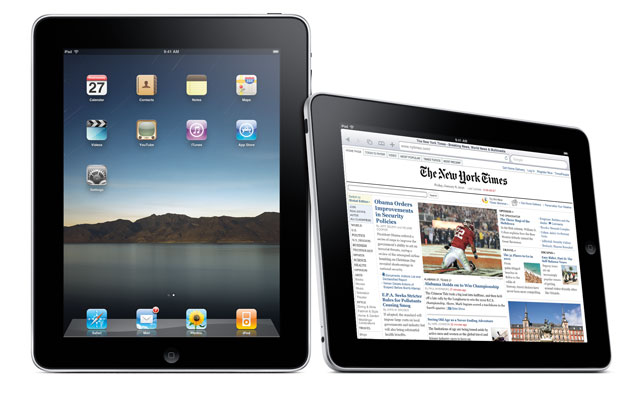
Apple’s iPad looks great for email, web and reading, but what does it mean for the product development community? Al Dean thinks its real potential is in putting 3D into the hands of the
non-expert user
The end of January saw the launch of probably the most anticipated and most hyped device to hit the computing market in decades. Never before has such a fever pitch been created before any details of the device were revealed. No one truly knew what it would do, what it would look like or what it would mean for the computing world. Guerrilla marketing from Apple, perfectly executed.
Just in case you missed it, Apple’s iPad is a tablet computer, a handheld device roughly the size of a magazine for email, web browsing, and for reading journals and books. Like its baby brother it’s multi-touch enabled and this, for me, is where the true excitement is.
For product development the obvious application for the iPad is conceptual design. With its pressure sensitive 9.7-inch touch screen, sketching should come naturally and applications such as Autodesk SketchBook Mobile have already seen much success on the iPhone.
Apple’s iPad: Perfect for reading the New York Times (and DEVELOP3D)
However, where I see the iPad having its greatest impact on the product development process is by putting 3D into the hands of the non-expert user. Just as Apple is targeting occasional computer users in the consumer space, that use a PC for email, web and the odd work-based application, through multi touch the iPad has the potential to proliferate 3D data throughout the enterprise. Whether that’s in management, purchasing, marketing, or on the shop floor, there are a huge range of people who need to gain access to complex 3D data, extract the required information, and feed back their valued input into the development process.
To my mind this all boils down to ease of navigation. With traditional mouse/keyboard interaction, the process of navigating a 3D model, switching between different views and selecting components, is not particularly intuitive. There’s a huge disconnect between the lateral movements of the mouse and manipulating a 3D model on screen.
Unless you’re experienced in the world of 3D (through CAD or games), it’s a difficult process to initially get to grips with. But by letting users manipulate an object with their fingers, select parts, rotate a model, pinch to zoom in and zoom out etc, that disconnect can be removed. Give someone, of any age an iPhone and they can get to grips with it, almost instantly.
There are a huge range of people who need to gain access to 3D data, extract the required information, and feed back their valued input into the development process
Multi touch for 3D is not new. It’s embedded in SpaceClaim 2009+ and not only enables designers to manipulate the model in 3D, but also move and edit geometry. And for the iPhone, Dassault Systèmes has already launched 3dvia which boasts single finger model rotation, two-finger panning and the ninja-pinch for zoom in/out.
Now, despite its exceptional style and impressive multi-touch credentials, I’ve been in this industry long enough to know that Apple’s iPad is not the device that will put 3D data into the hands of every non-expert user. For one, the hardware probably isn’t up to handling complex 3D datasets and there are many rival systems currently hitting the market that offer better compatibility with existing technologies.
What is important, however, is that Apple has undoubtedly put tablet computing firmly in the consciousness of the masses. The iPad is helping create an affordable breed of computing device that removes the legacy of the keyboard and mouse and puts the power literally in the hands of the user. I wonder if the product development software developers have realised its potential. I’m certainly looking forward to see what 2010 brings.
Al Dean is Editor of DEVELOP3D. He is currently running a book on how long it will take Consulting Editor, Martyn Day to buy this latest bit of Apple hardware. The self confessed Mac addict’s inventory of ‘Apple gadgets he really doesn’t need’ has already hit double figures. For the latest odds email .(JavaScript must be enabled to view this email address)
Comments on this article:
The future with Augmented Reality
02 February 2010
Process type: Visualise
Virtual Reality (VR) promised much and delivered little. As a result the ‘virtual’ prefix has become a bit of a millstone for many technologies. With all the hype around Augmented Reality Martyn Day wonders if it will suffer the same fate?
Iam old enough to remember all the original hype surrounding Virtual Reality (VR) and have memories of dark rooms, immersive headsets and gloves with enough cables to double as a walking telephone exchange. Virtual it was. Reality? Well perhaps if you lived on a planet entirely filled with flat shaded prismatic shapes. Thankfully I live in Oxford.
The most realistic virtual environments you can currently experience reside in games and that pretty much sums up the kind of person that got the most excited about VR in the first place - fantasists, whose lives are so dull they need a Second Life Avatar or a trip back in time to shoot their fair share of Nazis. While the ultimate VR experiences certainly capture the playfully minded, the key residual for engineers has been the evolution of existing design systems to model ‘virtual products’ in 3D CAD, so they may be tested with simulation and analysis tools. These can also be rendered for product brochures or videos which saves time and money in removing the reliance on prototypes and ultimately producing higher quality products. All very practical, but not very sci-fi.
Augmented Reality
With the original vision of VR now deemed passé, there’s a new ‘reality’ phrase doing the rounds in technology circles - that of Augmented Reality (AR). AR is defined as a live view of the real world which is merged with contextual computer-generated information or geometry, all in real-time.
As with VR, the first users of AR were the military, which deployed AR technology in Heads Up Displays (HUDs) for fighter jets and helicopters, projecting the navigation and systems status onto the visors of the pilot’s helmet. In some systems targets can even be assigned by tracking the retina of the pilot’s eyes. Technology such as this is now creeping into high-end car design with speed and ‘sat nav’ information being projected onto the windscreen. And with tiny laser projector technology, there are even real-time 3D holographic systems coming online.
Applications for AR
While you may still be wondering why you would want your reality augmented, unlike VR, AR does actually have an array of convincing real-world commercial applications that are available for use now.
It’s already possible to render 3D geometry onto the video view of a mobile phone or link meta data to real world objects. Probably the most interesting vision of this has been provided by the Internet behemoth, Google, with its Google Goggles labs experiment. This allows the web to be searched using pictures from camera phones. The software can recognise landmarks, artwork, places, wine labels, logos and connect that with GPS and video information. For example, you could switch on your phone’s camera and point it at the Golden Gate Bridge. The software will recognise the landmark, pull associated information of the structure and display it live on your camera. Future applications include taking a photo of a chess game to get some help with the next move or taking the picture of a leaf to find out what plant it’s from. It’s nothing less than modern day alchemy!
Engineers could use cameras on mobile devices to recognise installed equipment, and auto- matically bring up service manuals
While this sounds space age, there are applications available now for AR on Apple’s iPhones. For instance Theodolite provides a live in Theodolite read out to the camera view and can be used to measure heights and elevations. Another application, Le Bar from Stella Artois will add pub information to the live camera view. There’s an app to locate your nearest tube stop, Pocket Universe for live astronomy information and ‘car finder’ which directs you back to your car, should you have remembered to tell your iPhone where you parked it. A lot of these may be considered gimicks but the technology is still very interesting, I’m sure you’ll agree.
Engineering Reality
Beyond the many consumer applications for lost tourists, engineering developers are also looking to provide professional applications for AR. No longer will design information need to reside in database silos. Autodesk is already working on linking underground pipework to Google Maps, allowing onsite engineers to use mobile devices to ‘see through’ the ground and locate buried pipework. Architects could use AR to project building models into the live video of sites and engineers could use cameras on mobile devices to recognise installed equipment, and automatically bring up service manuals.
While VR was all about modelling everything, including the virtual world, AR makes much more sense - just overlay the 3D model, or related information to the real world. With the advent of Product Lifecycle Management (PLM), all the lifecycle attribute information will also be available online - so parts of assemblies could be identified by photo and disassembly videos relayed or new parts ordered. This is a true convergence of technologies and capabilities and will make us all look at the Internet in a completely different light. The technology could also be enhanced using Radio Frequency Identification (RFID) tags, linking back to assembly BOMs at head office. The potential for AR usage is nothing less than huge.
Conclusion
As with most technologies, the consumer demand for AR will drive companies like Google to further map out the world and build connections and links to rich databases of existing digital products and projects. As masters of the 3D digital landscape and content, engineers, architects, civil engineers and cartographers will, in turn, benefit from this hybrid of Internet, GPS, live video and digital asset information for many different reasons. Convergence is no longer just an industry mantra, it’s a reality.
.(JavaScript must be enabled to view this email address)