
High-fidelity CAD is extremely powerful, but how well does it support the formative stages of design? In relation to the the latest conceptual CAD tools, Al Dean wonders if anything will ever be mightier than the pen?
Moving on, as concepts get refined, we start to introduce higher-fidelity CAD-based processes. 3D concept models can be quickly knocked up in a CAD system, prototypes move from hand-crafted to machined model board, SLA, SLS or 3D prints, and the product starts to take form.
While these digital tools have an established role in this second stage of conceptual design, will they ever move right to the beginning of process chain?
To my mind, the only product that currently suits this process is SketchBook Pro. Some may also argue Photoshop, though I find this is an incredibly complex product that doesn’t particularly lend itself to the sketching process.
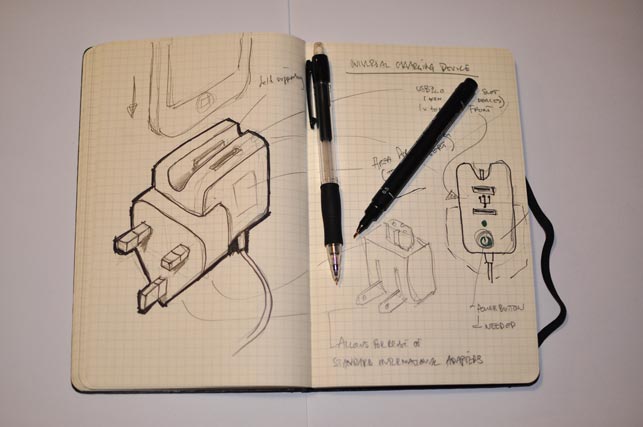
Concept sketches of a universal charging device, made possible by two of mankind’s greatest ever inventions: a 0.5mm fine liner and a Moleskine notebook
Other than that, what else is there? The short answer is not a lot. Yes, there are surface modelling tools like Rhino, Alias, and solidThinking. Or, for those working on more engineering-led products, possibly to try out mechanisms, tools like MathCAD and SpaceClaim. But I don’t believe any of these are suited to the embryonic stage of design where analogue processes are so tightly ingrained in the human psyche.
Despite being easier to use than ever before, all computer aided conceptual design tool are still complex products. They all need the user to concentrate on using software, rather than allowing them to truly immerse themselves in the process and capture ideas directly from imagination.
So what needs to change? To my mind, there needs to be a fundamental shift in ease of use, flexibility and portability. Ease of use needs to improve to the point where the user is solely focussed on the process of developing an idea rather than operating the software. Flexibility needs to improve so that ideas can be captured in many forms, whether that’s a conceptual sketch, mechanism layout or a 3D model. And portability is key, as unfortunately not all moments of creative inspiration occur when you’re sat at your desk and lugging around a laptop and digitising tablet simply isn’t practical.
Flexibility needs to improve so that ideas can be captured in many forms, whether that’s a conceptual sketch, mechanism layout or a 3D model
Technologies like multi-touch where the user directly engages with the form, is a step in the right direction, but I don’t see it as being the technology that will change things for good. It’s too detached, to distracting and too unintuitive. SketchBook Mobile from Autodesk certainly has the mobility problem licked and enables users to capture sketch ideas with nothing more than a touch screen and some slick drawing tools, but you still have the barriers of poor resolution and my finger sure ain’t no pen.
The problem is it’s hard to get round every limitation in a digital device, even if the vendors realise the complexity inherent within their tools, engage the user more directly and address these issues with some real innovation. For this reason alone I doubt anyone will be disregarding their Moleskine notebook, 0.5mm fine-liner and fistful of magic markers quite yet. And that makes me very happy indeed.
Al Dean is Editor of DEVELOP3D. He rather enjoyed doing the concept sketch (left). And yes, even after five attempts, he still managed to get the plug upside down. Donkey.
{encode=”al@x3dmedia.com” title=”al@develop3d.com”}

The pen is still mightier in creating concepts, asserts Al Dean