Guitar hero

30 April 2009

Process type: Design

Thousands of guitarists throughout the world, amateurs and legends alike, use LAG’s guitars. And they’re all made possible with the help of Vero Software’s VISI Series for both design and manufacture

Founded in 1978 by Michel LAG Chavarria in Toulouse, LAG started to make a name for itself after setting up its workshop in Bedarieux, a small town in the hills of Roussillon in the south of France. Since signing a deal with market powerhouse Algam, France’s number one musical equipment dealer, the guitar maker has expanded its customer base far beyond its homeland and now enjoys worldwide recognition.

The company has fourteen staff still designing and building its high-end guitars in the original workshop and further plants in China and South Korea turning out high-quality instruments at more competitive prices, based on prototypes conceived and crafted in France.

From legendary rock riffs to electronic music bizareness, LAG guitars are a favourite of Motorhead and Jean Michel Jarre

As the brand has set out to conquer much bigger markets in recent years, LAG has looked for ways to update its approach to design and manufacturing. The company decided to invest in the latest technologies to enable them to reduce time-to-market for its latest models and ensure it maintained its reputation as a creator of exclusive guitars, using rare woods with luxurious finishing and sharp styling. The company invested in a custom built CNC machining centre from Créneau Industriel that enables them to machine several guitars simultaneously, and Vero Software’s VISI CADCAM system to assist with both design and manufacture.

LAG was looking for an intuitive CADCAM system with both 2D and 3D machining capabilities, and a supplier that would provide local support as the new working methods were phased in. Vero France was on hand to develop the Num 720 post-processor and provide training and consulting services. This allowed LAG to reproduce the machine setup and NC programs in a short timescale. Etienne Réau, CNC manager explains, “Our aim was to develop the ability to respond more quickly to customer enquiries, and build prototypes with a shorter lead-time, without sacrificing the levels of quality and creativity that were the basis of the company’s reputation. This has been achieved and one key factor is that we now machine four bodies and four necks at the same time on our CNC router. This considerably reduces handling times and enables us to get on with other concurrent operations.”

In the eighteen months since VISI was introduced, LAG has produced over 500 NC program files and the software has had a major impact on the company’s working methods. The guitars are designed in a matter of hours and the musician or sales department can get an immediate, detailed idea of what the instrument looks like. This provides a solid basis for either approving or requesting modifications to the design. Since the company invested in a rapid prototyping machine, it has even been possible to watch the guitar being made.

The Chinese-built guitars are also designed with VISI and, as soon as the prototype has been approved, the drawings or models are sent to the Chinese plant for production. To further optimise production, Reau also set out to find ways to reduce handling operations. Turnaround time between operations is now faster and the tooling use has been standardised with the use of Ballnose mills instead of special tools. The combination of efficient tool-paths and post-processor debugging have enabled program optimisation and 3D machining performance.

In terms of quality, the results have been excellent explains Reau, “We spend less time on surface finishing because the machining is so precise. The point distribution is very even and the result is a smooth tool-path. Our complex surfaces come out great first time with an excellent surface finish. The direct consequence is that we save time on finishing passes and a lot of money on the abrasives we use for sanding, not to mention the environmental advantages.”

Concluding, Reau says, “We are fortunate to be working in a niche area with such high added-value. LAG has built up a very special know-how over the years and we have combined this with hi-tech resources. We are now in a position to meet the demands of artists faster than ever, while remaining financially attractive. Not only have we maintained our anchorage in Bedarieux, but we have been able to demonstrate, every day, that our production methods are in line with the company’s international ambition.”

www.lagguitars.co.uk 

www.vero-software.com


Comments on this article:

The mighty atom

24 April 2009

Process types: Design and Prototype

Specialist Industrial model producer Atom has been building every imaginable type of model for over 25 years, using a variety of skills and tools. Stephen Holmes goes behind the scenes at the mighty Atom

Down the idyllic country lanes of Ascot in the Spring sunshine there is a workshop undertaking all the projects too unique for anyone else to possibly specialise in.

Working from a reconditioned village shop-cum-semi-detached house in the village of Sunningdale, model building firm Atom exists amongst a labyrinth of corridors and outer buildings that stretch into a warren of rooms each active with the types of projects that you always wondered where they stemmed from.

Atom is involved in a diverse range of projects. This scale model’s purpose is to demonstrate oil drilling equipment

The variety of projects is astounding; no job is too big (a 30-foot spinnaker installation for the Chelsea Flower Show), too small (resizing rubber straps for a shampoo bottle holder), or too bizarre (constructing a working prototype of a machine to measure the slippiness of a supermarket floor).

“That’s one of our strengths,” explains managing director Peter Day. “We work with toy development, sculpting, packaging, prototyping, the CAD side of things, vacuum forming and stereolithography. A lot of our stuff is unique as it’s not your average model making. It’s stretching the boundaries a bit.”

The quality of the end product is key; with the majority of the models built by hand, noticeable from the seated workers all busy sanding and adding detail to their work. “Our stance is more on the engineering side,” explains Peter. “Our main strength is the variety and the breadth of skills that we have in the one company.” “We don’t necessarily do it all in house, but with our experience we have the contacts of well-tried contractors.

“What makes us different from the bureaux that work with SLA machines, is that we can do all that, and spray it all, but on top of that develop the PCBs [printed circuit board for toys and interactive models] and take the product development further. We can give them a working model.”

Atom is frequently approached to produce large-scale models and displays for products or store fronts. The recent Christmas display at London’s Selfridges of giant red fragmented baubles cascading through the atrium of the store were produced here, requiring a number of different processes to achieve the completed finish.

The product of a commissioned artist, Atom worked to create the full scenario from sketches and a miniaturised model. “They can come with a pencil sketch and we can create the CAD data, we also have the collective experience to know the manufacturing techniques and limitations and can steer them in the right direction.”


www.atomltd.com


MUSIC WITH WINGS ON IT

As brazen, individual and unique as design gets, the Nokia Music Almighty competition fielded a shortlist of bizarre and innovative designs, all of which had to be somehow built.

Nokia

Flying without Wings’ by R Kelly

Using the online design ‘palette’ on Nokia’s web site designers were invited to create their own set of headphones inspired by a music track based on standard Nokia Bluetooth headsets.

Web visitors were asked to vote for their favourites before the winners were selected by a panel of design industry judges and musicians including Felix Buxton from Basement Jaxx and Dick Powell of Seymourpowell. The five winning designs were then given to Atom to produce as working prototypes adhering as closely as possible to the original design concept.

“All we had was a sketch,” reveals Peter. “We worked directly from the visuals and everything else, all the engineering inside it, making it work and fitting the components, making it strong enough we needed to calculate ourselves while keeping it within the visual aspects of what they’d designed in the first place.

“The headsets involve quite a few different skills, there’s the drawing it up in CAD and then a few different materials. A lot of what we do is totally unique and has never been done before.”

Nokia

Thriller’ by Michael Jackson

A singular process for a set of entirely one-off designs, drawing inspiration from tracks as varied as ‘Flying without Wings’ by R Kelly, ‘Thriller’ by Michael Jackson, and a seriously slick design with Daft Punk’s ‘Robot Rock’ behind its angled form.

“It was a challenge,” divulges Peter. “In the instance of the ‘dove wings’, we had to find a place to supply the wings and get the right ones for the size and fit for the model, but also making sure that all the components are going to fit inside in working order.”

The designs are set to be showcased in flagship Nokia stores around the world, including the Nokia headquarters in Helsinki, and in London’s Regent Street store this month.


Comments on this article:

Turbocharging design and manufacturing

24 April 2009

Process type: Manufacture

Al Dean visits Napier Turbochargers, a company that has recently undergone a management buyout and is currently rethinking its product development and manufacturing processes

Imagine you’re running a successful manufacturing organisation and discover yourself in the middle of a management buyout. For many companies, this doesn’t present too much of an issue, other than paper work, signing a cheque and moving on to bigger and better things. But when you’re involved in the design and manufacture of complex products and have established practices and tools, management buyouts can lead to software licensing issues which can become an unexpected problem.

At the same time it can also be an opportunity, because when change is in the air, it’s the best time to re-evaluate what you’re doing, how you’re doing it and choosing the most effective tools to the job done.

Napier Turbochargers manufactures all of its core components in-house, including this compressor wheel

This is the position that Napier Turbochargers finds itself in today. The company has a rich heritage of innovation within many fields, but the last few decades have seen the Lincoln-based firm concentrate on its competency of the design, manufacture and support high efficiency industrial turbochargers, used across a range of markets including Marine Power, Rail Traction and Power Generation.

Having been through a buyout from the Siemens Turbo-machinery organisation, the design and manufacturing team is part way through the process of re-assessing how it develops its products, what tools it uses and how the process can be made more efficient.

When under the Siemens umbrella organisation, Napier adopted Siemens NX as its design tool of choice to conform to company policy and used Teamcenter to manage its product data, along with a range of CAM systems for NC programming. However, following the separation from Siemens, the company has found itself in the position of having to renegotiate its contracts for NX and Teamcenter from scratch and was led to the door of Majenta PLM.

In consultation with Majenta, the team decided to maintain its NX usage and adopt Teamcenter Express for data management as they had before. What differed was how Napier decided to extend the use of the system beyond the design office and into the manufacturing department and factory floor.

Complexity as a design challenge

Turbochargers are a complex beast. Whereas a naturally aspirated engine uses only the downward stroke of a piston to create an area of low pressure to draw air into the combustion cylinder, turbochargers are used to compress the gases to create a greater mass of oxygen within the combustion cylinder.

The additional oxygen makes it possible to combust more fuel hence increasing the engine’s power and torque. Napier operates predominantly in the marine, rail and power generation sectors, and as a result its products are generally of a much larger scale than those used in automotive.

The Turbochargers that Napier develops are far from standard. With a wide variety of engines to integrate with, and differing packaging and installation limitations, there are many complex variables that influence the design.

However, this doesn’t mean that every design starts from a blank slate built up with bespoke components, as Ian Pinkney, Chief Design Engineer at Napier explains. “It’s a family of products, but an extended one,” he says. “Is it customised for the end user? Yes, it is, but from a selection list. The one thing that we’re matching to is the performance of the turbocharger for a given frame size and there are a lot of options for any particular frame size - so it’s not an off the shelf product.

“The frame size can have four different turbines as an option,” adds Pinkney, as he explains just how many different combinations of components can go into a single design. “There are around eleven nozzle sizes depending on the capacity of turbine, four to five different compressor capacities, two different compressor designs and a range of matching diffusers. In terms of installation, the turbocharger casings can be indexed to suit the engine pipe-work and equally, the turbine inlet casing is commonly customised to the end user.”

The process of matching engine performance to the turbocharger is done by the Application Engineer department, which selects the parts required. But from a design point of view, Napier starts out by looking at the target market, and the performance range that’s needed to cover for those engines.

With so many variables, it’s clear that a powerful 3D design technology is essential for the development of these complex products, but there are still many challenges to overcome.

Challenge and benefits of 3D

Napier has a long history of using NX, and its team is very experienced in using it in a 3D design context, but there are still areas in which the company finds challenges. According to Pinkney, this often stems from the multitude of ways to accomplish a single task. “Within all CAD packages, there are different tricks and work arounds,” he says. “Even with our models, there are certain things that prove difficult and challenging just to get the model to do what you want. From my point of view a question of interest when truly designing in 3D is ‘how much does the package you’re using influence your design?’ Do you end up with a design that’s influenced by what you can model, rather than truly being what you intended.”

Pinkney doesn’t regard this as a negative, but rather part of the challenge of working with 3D. However, compared to the company’s 2D AutoCAD-based past, working in three dimensions brings all manner of benefits, which seem to be summed up nicely with a single word. Clarity.

“One of the most interesting things about working with 3D is that you’re more likely to come up with a new design because you can see exactly what’s going on and can describe it more easily - and discuss it. That’s something that gets missed,” Pinkney enthuses. “It’s much easier to discuss a 3D part on screen; it certainly brings more people into the loop. With 2D, it was very easy for us to forget that not all are as comfortable or necessarily as skilled at interpreting 2D images as solids components. 3D takes away a lot of the ambiguity.”

With a highly experienced team, many might assume that a company like Napier would operate with a hierarcy of design engineers with draughting staff to detail their work, but Napier, along with most organisations in Europe is bucking that age old differentiation. Pinkney feels that the days of the draughting department are long gone, and while draughting responsibilities are shared out amongst the team, the original designer tends to follow a project through to completion. When it comes to future modification however any designer may pick it up.

This represents a challenge for Napier, as Pinkney explains, “There are thousands of ways to model a component. As you increase complexity, more options present themselves. Design change often requires more experience from the operator; to modify something that already exists rather than to model from scratch. You really do have to understand how the model was constructed in the first place to be able to modify it, particularly when even the simplest of modifications can as a modelling exercise prove quite difficult.”

Napier is currently looking at Siemens’ Synchronous Technology, but with the complexity of its data, and the performance driven nature of its designs, it’s yet to gain great use within the organisation, but as Pinkney points out, “CAD software is a lot better than it used to be, but it is still the designer’s skill in using the package that counts.”

Alongside its continued usage of NX, Napier is also working with Majenta to implement Teamcenter, not only to centralise data and ensure that the team has access to the most up to date information, but also to handle workflow and sign off processes in a controlled and structured environment.

“We are in the process of defining our Teamcenter Workflow to better handle tasks, both within the design and manufacturing departments, in particular tracking a part’s status,” says Pinkney. “When looking at product data management, it’s not just about hard data but also about keeping our schemes and ideas together which can easily get fragmented. Harder still is capturing design experience/expertise.”

Simulation

Simulation has become an essential tool to help Napier maintain its advantage. The team has a mix of off-the-shelf analysis simulation codes, in-house developed tools, and more task specific software. Napier specifically carries out extensive Finite Element Analysis (FEA) and Computational Fluid Dynamics (CFD) analysis for the aerodynamic and rotating components, but also employs FEA for static parts.

The team uses a combination Ansys (for FEA) and CFX (for CFD) and with its new technology platform, has adopted the NX module that allows preparatory work to be done within NX, before the models are sent off to the simulation team. Alongside these general-purpose tools, Napier also uses specialised software for engine and gas dynamics simulation. This comprises in-house developed tools and external commercial applications.

NX from Siemens PLM Software is Napier turbocharger’s tool of choice for design

Manufacture

Once a design is ready to move to the next stage, the manufacturing team kicks into action. At present, Napier has a mix of both in-house and outsourced manufacturing. While Napier concentrates on its core competency and specialism it sub-contracts out other work (such as nozzles, bearings and some cast casings).

According to Jon Riggal, Senior Manufacturing Engineer at Napier, “In-house manufacture is essentially rotating parts. We do build some casings and while the capability is there in-house for both those and the diffusers, it’s really more a case of managing workloads and productivity and more a purchase driven decision.  “The key competencies are the rotating components and we keep those in-house under our own control,” he adds.

The lines between design engineering and manufacturing engineering are going to blur in terms of what models are provided

The move away from Siemens Turbochargers has given the manufacturing team the opportunity to re-assess and revamp how they currently work. A legacy CAM system is in place, but plans are underway to move the NC programming work to NX CAM as projects permit.

Riggall feels that the main driver for this move is being able to use 3D models direct from the Design team, whereas previous workflows saw too much reliance on paper drawings and, in some cases, complete rework from scratch to create 3D models for manufacturing.

“None of the systems we’ve had in the past, or are currently running with, are integrated into the design packages so it’s a very laborious long winded process to go from Design to Manufacture to produce NC programs,” Says Riggall.

This represents a challenge for both Design and Manufacturing to reconcile their different requirements, as Ian Pinkney explains. “What we provide will be key. The lines between Design Engineering and Manufacturing Engineering are going to blur in terms of what models are provided. If a model is going to be manufactured, what do the guys in manufacturing need and how should that model be constructed? Perhaps intermediate models for manufacturing rather than just finished part models are produced in the design area? Do we produce drawings and manufacturing layouts at all? These and other questions are raised when we step back and look objectively at what we do.”

If there are no drawings, how does the company envision that critical, non-geometric manufacturing data will be communicated? The team believes that Product Manufacturing Information (PMI), a term for storing annotation on a 3D model, holds great promise and will sit well with manufacturing.

Looking to The Future

The team at Napier Turbochargers is keen to get up and running in its new environment, but such implementations have to be managed carefully, as there are live projects underway.

The Design team already has NX up and running, but with a history of using the system, this should come as no surprise. Teamcenter is in use in within design and Pinkney feels that this solves one of the age old problems of multi-user teams and data distribution. “Data used to be stored on people’s home areas and a local drive and sometimes, in different CAD packages. Teamcenter will undoubtedly help with that,” he says.

We’re such a small team in manufacturing and being able to devote enough time to bring a new system on board is quite difficult, having live projects that need completion

In the manufacturing department, the NX CAM implementation is proving more time consuming. “As we stand here today, we’re not currently using the manufacturing system because it’s a completely new animal and we’re very conscious of getting everything in place; naming conventions and the like in Teamcenter,” explains Riggall.

“We want everything to be right and our team to be trained and skilled in its use before we come to use it on a live basis. And we’ve still got our existing system to fall back on. We’re such a small team in manufacturing and being able to devote enough time to bring a new system on board is quite difficult, having live projects that need completion.”

The final question for the team at Napier is how is it going to use this technology platform as the basis for improving both its products and business efficiency moving forward? Does a more integrated approach to design to manufacture give its team an edge and where is that edge derived from? Is it just a question of time saving? Ian Pinkney picks up the thread, “It’s everything. Time comes into everything you have to do. The more time you can save, the more time you have to explore different designs.”

“Obviously we have a certain date by which to get a product manufactured and to the customer, without which an engineer could spend five years optimising a product, doing all sorts of experimentation. But, at some point, you have to decide what you’re going to do and get it done.”

www.napier-turbochargers.com


Collaboration and IP protection

Working within a supply chain represents a challenge for any organisation, whether it’s up at the top or down in the lower tiers. Each has its own pressures and problems. One thing that is becoming a huge concern with many organisations is the quandary of needing to more effectively share data with partners in design and manufacturing, whilst ensuring valuable intellectual property in 3D product models is protected. Napier is currently in the stage of evaluating several approaches and technologies to solve this problem.

When it comes to sharing information with both suppliers and customers, Ian Pinkney sees the use of 3D models as key, but within a controlled manner. “We’re looking at producing simplified and lightweight models in a variety of formats,” he says. “Certainly in terms of installation, many of our customers don’t need a full description. With a turbocharger, there’s no real reason for them to have the full detail just the interfaces. Plus, if it’s an engine manufacturer, they already have a very large model and they don’t need a full turbocharger model adding to their file sizes.”

The team has been using JT data for some time and while this lightweight format is becoming more common, it’s often the case that there’s an element of education as the customer might not always be aware of it. Napier is also looking at 3D PDFs for visualisation, if not data exchange. In terms of the mechanism used to share that data, Napier is investigating ways to provide access to this type of data using the web and is currently looking at both Teamcenter and some form of Microsoft SharePoint set-up to manage its models externally.

Comments on this article:

Dock of the bay

01 April 2009

Process types: Design and Manufacture

On a recent trip to the docks, instead of rubbing shoulders with sailors, Stephen Holmes found himself in the company of heavy machinery capable of lifting the Statue of Liberty in one go and you can’t get more manly than that

Weightlifter

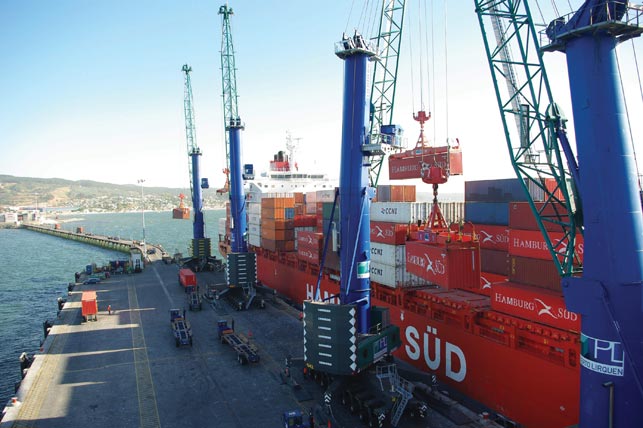
The harbours of the world have their own towering skylines, peaking with the giant cranes used to unload mammoth transporter ships of their containers.

Liebherr is an expert at engineering on a large scale, designing and building cranes, excavators and mining trucks amongst its vast portfolio. Out of its family of colossal maritime cranes, the LHM range is a mobile lifting machine, that gives its users versatility over what it can lift, and where from – using a wheeled base for mobility alongside the vessel from which it’s unloading.
Designing something of this magnitude is a long process, with assorted challenges, requiring a great deal of research and analysis beforehand.
Liebherr’s LHM mobile lifting machine, which uses a wheel base to position itself alongside vessels, can lift a whopping 200 tonnes in one go. Pictured (left) Pro/Engineer model

Walter Mietschnig, senior design manager for mobile harbour cranes, offers that this operates around the need to quantify the geometry with the system calculation. “All system boundaries - weight, transport - and the drive system were defined and clarified.

“A first system model on the basis of a 3D Pro/Engineer model was prepared including all main components, their arrangement and required space as well as their accessibility. For the steel construction an optimal force flow was investigated,” he adds.

After the first model was created a calculation of the stability and strength was created. “The finite element program Ansys was used with an iterative process of optimisation of geometry, structure, and force flow in order to reach minimum costs by a maximum of customer value,” says Walter.

The end product is a tower characterised by a tubular design that gives it stiffness and torsion resistance, while balancing the weight to allow smooth movement when the crane rotates.
The most enormous of the LHM range, the 600 model, is capable of raising over 200 tonnes in one lift, roughly the same as the Statue of Liberty, without toppling over.
www.liebherr.com

At arm’s length

The handling of containers is tricky work; their bulk and weight requires a machine with strength simply to lift them, but also poise and balance to be able to stack them five high.
Using an extending arm to lift and manoeuvre containers in all directions generates an enormous amount of stress and strain, all of which has to be balanced by a relatively small body riding on pneumatic tyres.

Designed to be quick, stable and for ease of use on the crowded harboursides of the world, the Reachstacker from Hyster, was developed with input from all areas including engineers, end users and the company’s training department.
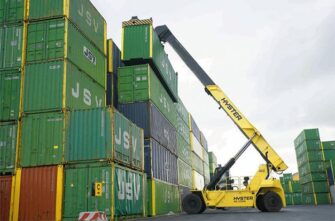
Pro/Engineer was used in the design stages, with models put through strength and strain analysis, before pilot versions are subjected to rigorous stages of testing to allow it to handle containers stacked as far away as five high and three rows back.

Product manager for Hyster’s Big Trucks department, Antoon Cooijmans, explains how they have advanced their use of 3D design to include systems for all aspects of the Reachstacker’s design. “We have specially developed software to calculate the stability of the truck,” he explains. “This software is used for the load moment indicator to protect the truck against the danger of tipping over or sideways. To simulate the hydraulic system, automation-studio is used. “Our 3D CAD system does have several add on modules for hose-routings and wire-harnesses.”
The name Hyster originated from the call of 1920s’ forest workers in the US who would shout “Hoist’er!” when a log was ready to be lifted.
www.hyster.com

Small wheels, big frame

A gantry crane is a large frame that can shift a weight anywhere within the area below; add some dinky rubber wheels and it can career around a dockside with glee.

The Rubber Tyred Gantry (RTG) crane is a smaller, more lightweight version than its heavyweight cousin that is used on engineering sites around the globe. The mobile RTG crane is preferred for the task of manoeuvring amongst the stacks of containers on the dockside and ordering the cargo into neat piles.

Today’s container handling industry is driven by demands for greater productivity and environmentally responsible operations. The Kalmar RTG crane puts this into consideration by being motorised by either an onboard diesel generator or a cable system to provide electrical power for both the mobility of the vehicle and the crane system. Its power package is designed for ease of repair and is at ground level with the electric housing close by on top of the lower beam.
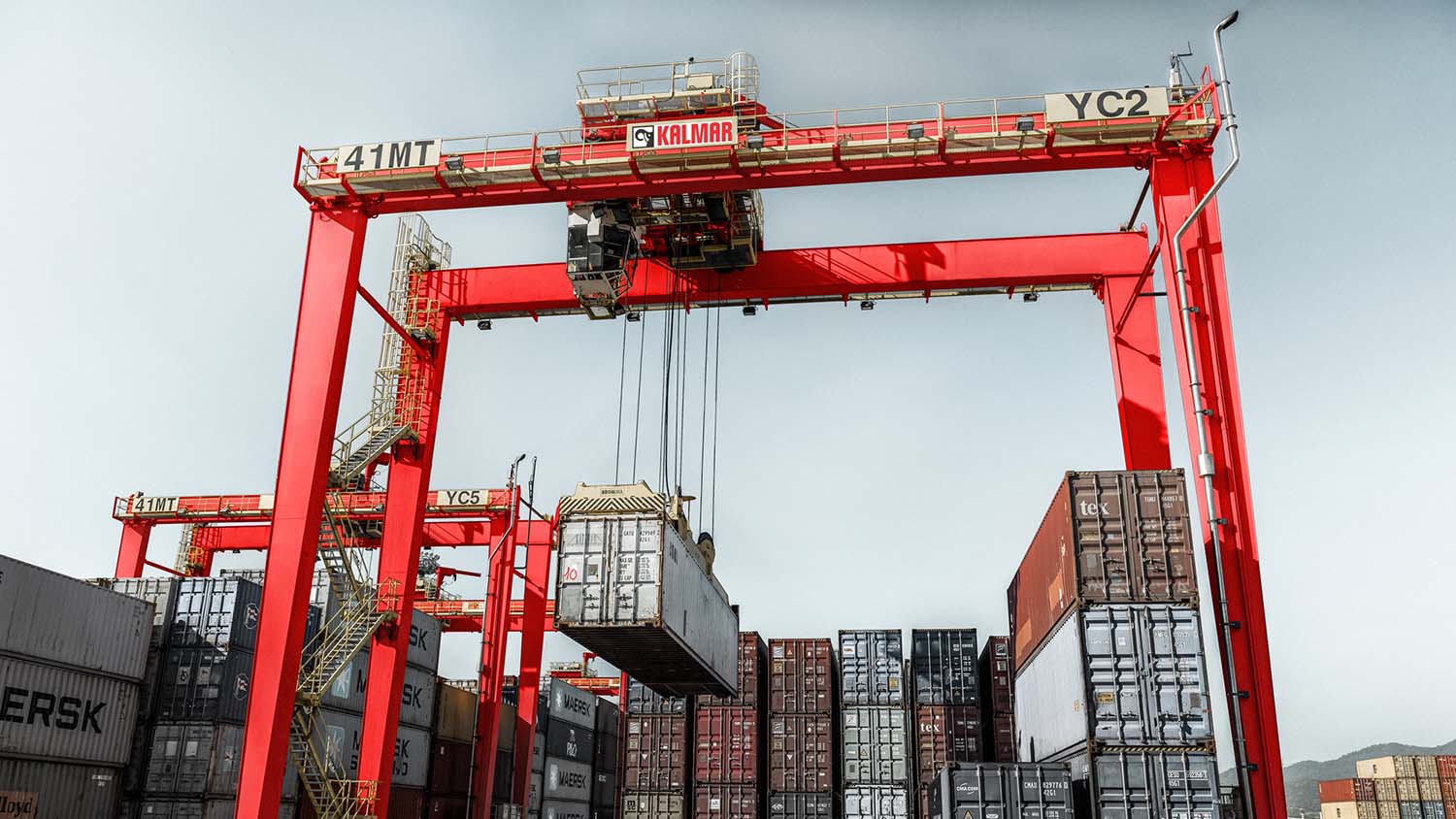
RTG marketing manager Marko Rasinen explains that its model is developed year-on-year, working to improve on a variety of issues. “Starting from the basic ideas, the concept was simplicity, with light structures, low fuel consumption, a design that makes the crane easy to service and reliable,” points out Marko, adding that from the initial stages and research the design is moved into Catia to build a 3D model that can be tested for structural strength.

www.kalmarind.com
 

Comments on this article:

Latest D3D jobs

Design Engineer

Thu, 09 Feb 2012 07:32:39 +0000

Design Specialist/Engineer

Thu, 09 Feb 2012 07:30:23 +0000

CAD / CAM PROGRAMMER

Thu, 09 Feb 2012 07:09:07 +0000

Project Design Engineer

Mon, 06 Feb 2012 10:44:52 +0000

Tags for
this article