Master blaster

31 July 2009

Process type: Design

DEVELOP3D’s very own toy soldier, Stephen Holmes, puts on his war paint to look at the advanced design technology used in the development of some of the world’s most lethal weapons, oh and an Electronic Control Device (ECD) which shocks assailants into submission

Shocking stuff

Designing a product for military, law enforcement and consumer use is a hard task, but when that technology can incapacitate a human, the process is much more than point and shoot.

The X26 Electronic Control Device (ECD) from Taser International uses a cartridge of compressed nitrogen to deploy two probes that attach to the body of an assailant and transmit electrical pulses along its wires. The pulses, which can penetrate up to one inch of clothing, affect the sensory and motor functions of the peripheral nervous system.

Variations of the X26 are being wielded on the front lines in Afghanistan, in police forces in town centres, and even legally in the hands of ordinary civilians across 43 states in the US.
All this makes its appearance, durability and the thought behind its mechanics an extremely interesting weapon.

“The unique aspect of the Taser X26 design was to maintain firearms mode of operation and features that officers are trained on [safety and trigger positions, sighting system] while designing an electronic control device product not to resemble any firearms in the market,” points out Steve Tuttle, VP of Communications for Taser International.

Most people will not have seen an X26 close-up but the dimensions are palm-sized, 60 per-cent smaller than the previous version, but still packed full of the complex electrical componentry. As Tuttle explains: “Generating and containing the necessary electrical energy and pulses required to achieve Neuro Muscular Incapacitation in a human safely and effectively,” was the hardest task to achieve.

The team works within AutoCAD and SolidWorks to transform original sketches and ergonomic foam models into 3D CAD data, with drop test simulation done inside Ansys and CosmosWorks. Parts are rapid prototyped in order to verify the design of specific components, such as the mechanism for the cartridge, before providing a pre-tooling release.

The diversity of its application, and its ability to resolve conflict with the greater reduction of death make this a truly modern weapon.

www.taser.com

Hunting season

Bowhunting brings to mind images of Rambo stalking through the forest on the set of a Hollywood blockbuster, although the reality is much different.

Bowtech uses non-linear solvers to simulate the behaviour of its high-deflection bows

The sport of hunting with a bow is incredibly popular in the US, where modern technology continues to advance the pastime. In contrast to a rifle hunter, who can shoot targets over 200 yards away, archers are restricted to taking shots from 20-30 yards, a distance that depends upon individual ability, the target, the bow setup, and the weather.

Bowtech’s latest bow, the Admiral, is a lightweight, durable weapon, reliant on cutting edge materials, dynamics, and ergonomics in order to operate at extremely high speeds in near silence.

Sketching was transferred into SolidWorks to layout the assembly of the model, incorporating modern technologies vital for a smooth draw-back motion, and the reduction of vibration and noise.

“Somewhat unique to our industry,” says Craig Yehle, head designer at Bowtech. “Is the bow’s limb, which is responsible for storing the strain energy used to propel an arrow at speeds well in excess of 300 feet per second.” Built from high-grade fibreglass they are analysed using DDS Simulation Premium with nonlinear solvers.

Non-linear solutions are required because of the high deflection values of the bow. “The trick here is to bend the limb in the software and optimise the stress distribution throughout the component,” explains Craig. “This, in turn, maximizes the strain energy that can be stored in the component without exceeding the material’s limits.”

www.bowtecharchery.com

Rotary club

Having ushered in a new way of fighting during the Vietnam War, the helicopter now plays a key role in wartime and peacekeeping operations, and the Agusta Westland Lynx is one of the most modern incarnations.

Its crew operates within one of the most advanced environments devised by engineers, and flying at over 200mph into direct conflict situations, search and rescue missions, and even anti-submarine warfare scenarios, it is vital to have essential controls at their fingertips.

To help with the correct ergonomic positioning of the various equipment, switches and dials in the cockpit and crew areas, the design team makes great use of digital human manikins. Russell Bond, human factors engineer at Agusta Westland, points out that this is key to adapting to a more sophisticated working space as technology advances. “Using Delmia V5 Human we optimised the design taking into account the most frequently used apparatus in relation to minimising operator’s negative or extreme posture.”

This was done across a full range of body types and sizes, with vision assessment also key to the process. “The software allowed us to measure the relative efficiencies of various design layouts and to accurately assess body types that would prove unsuitable for the design,” says Russell.

“Using digital human manikins in conjunction with digital 3D Catia helicopter models it is possible to analyse the man-machine interface and assess human performance within the design. Questions of visibility, task performance, physical accessibility, maintainability and other factors are investigated.”

The end result has all the ergonomic benefits that allow a crew to operate with ease in the most pressured situations. “They can be sure, through analytical feedback, that their designs are on track and optimised allowing pilot and crew to function to their best capability,” concludes Russell.

www.agustawestland.com


Comments on this article:

South of the river

31 July 2009

Process types: Design, Manage, Prototype and Visualise

As the financial crisis hits all areas of the industry, Stephen Holmes heads to one of the Capital’s most CAD proficient universities to see how it’s affecting study and students

On the southern bank of the River Thames, away from the water’s edge, London South Bank University’s final year students are completing their studies and pondering their futures.

The university has long been a champion of CAD systems, and as its senior lecturer in CAE applications and director of digital prototyping Tony Roberts explains, they have been designing in digital for over 20 years, beginning with MasterCAM V.3.

Although the university and its courses are well stocked with software and prototyping machinery, like many other universities around the country, they don’t have as great a spending power as many imagine.
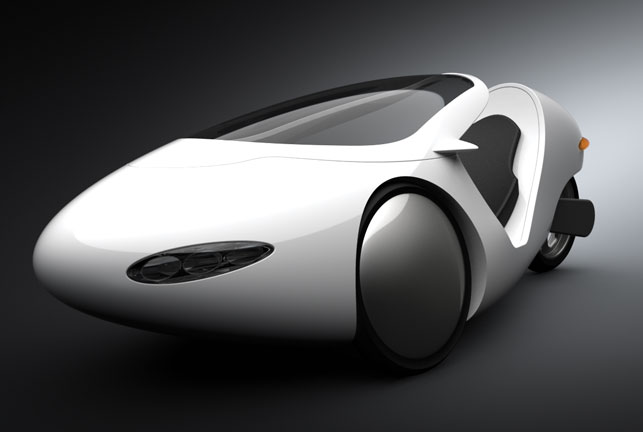
Three-wheeled, concept vehicle designed by Simeon Gentle

With student numbers across the country hitting highs as some people return to education following enforced redundancies, it is interesting to see how a university adjusts, if at all.

A new set of tools and clamping systems for a recently installed Mazak five-axis machining centre is next on the list of additions for the department, yet this proposal like many others is subject to rigorous discussion at senior level to ensure that any funds allocated will add value particularly during such economically sensitive times.

None of the restraints of procuring machinery seem to be impacting on the availability of software for students. The computer aided design course encourages them to cover a wide range of programs, developing and specialising in particular aspects of design for their final year thesis.
LSBU

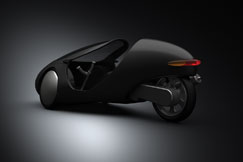
The vehicle was part of Simeon’s final year project

“We try to give them a broad understanding of the various technologies used in industry,” says Tony. “In the first year we look at AutoCAD as a 2D system but then very quickly introduce them to the limitations of that approach. We introduce Solid Edge as a 3D modelling system, but only as a part modeller.

“The assembly side of modelling is explored during the second year where we actually start building much more complex systems. NX is used in the final year where students have the opportunity to learn much more about collaborative design and the associated tools available in such ‘high-end’ systems.”

Autodesk’s AutoStudio has been adopted as the main tool for surface modelling, giving the students greater understanding of the differences between that and solid modelling and for working in a particular way when dealing with designs requiring a more flexible approach to surface form.

Outside of the normal lecture periods nothing is set in stone in terms of what students are allowed to use for individual projects, and as the students reel off the various analysis applications they have used they’re keen to point out the hours spent in the workshops as well. “They are encouraged to do physical testing and try to understand why those results can often be different to the answers from analysis software,” adds Tony.

I’ve been taught how to use a variety of different CAD software. I’ve used them to develop concepts into practical models, analyse them and use the data to manufacture using rapid prototyping’’ Simeon Gentle, final year student

The final year projects show the achievements gained by working in different applications. This year’s students are all buzzing over the effects that hyperShot has had on their work compared to other visualisation tools they’ve used.

Tony admits that even though the University has invested in Autodesk’s 3ds Max, ImageStudio and Showcase, and Rhino’s Flamingo products, he is impressed by the students’ tenacity in seeking out other options to gain the optimum results, something that also helps keep the course working with the latest technology available.

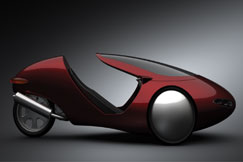
The best example of hyperShot being used is in the renderings of final year student Simeon Gentle who, for his final project, has produced a small, three-wheeled, concept vehicle ‘able to meet everyday needs.’ He aims to compare the processes of traditional clay modelling with that of digital prototyping and analyse both for efficiency and constraints.

“I’ve been taught how to use a variety of different CAD software. With these programs I was able to develop concepts into practical models, analyse them to determine feasibility and then using this data manufacture using rapid prototyping or CNC machining.
LSBU

The students produced renders in HyperShot

“When I graduate my goal is to pursue a job as a design engineer in the automotive industry,” says Simeon. “I’m confident that I have gained the creativity and engineering knowledge to adapt,” he adds before concluding that in a world where graduate jobs are few and far between, he’d gladly return to South Bank for postgraduate study, a choice it seems many will also view as the safer option.

This summer is going to be one full of tough decisions for many graduates. The financial and employment problems won’t be going away for a while yet. Education and training can set you apart from others but not guarantee you a job. However, the versatility of the students at London South Bank University is another weapon in their arsenal. Not tied to a particular software and the ability to work outside the normal methods, they should at least stand a fighting chance in what was already a challenging job sector. 

www.lsbu.ac.uk/esbe
 

Comments on this article:

Latest D3D jobs

Design Engineer

Thu, 09 Feb 2012 07:32:39 +0000

Design Specialist/Engineer

Thu, 09 Feb 2012 07:30:23 +0000

CAD / CAM PROGRAMMER

Thu, 09 Feb 2012 07:09:07 +0000

Project Design Engineer

Mon, 06 Feb 2012 10:44:52 +0000

Tags for
this article