Flexible friends
11 September 2009
Process type: Prototype
With a wide range of services including stereolithography, product finishing, vacuum casting and silicone tooling, Paragon Rapid Technologies (RT) recently extended its rapidprototyping repertoire to offer parts produced in silicone. By Stephen Holmes
Diversity is something Paragon RT thrives on, as the Darlington-based rapid prototyping bureau continues to seek out new ways and means to meet the needs of its customers.
As the economy falters, the company is looking to stand out from the crowd by increasing the range of services it offers, adding new materials and by working very closely with customers to identify new solutions to their problems.

The Nissan Qazana took centre stage at the recent Geneva Motor show and this would not have been possible without the help of Paragon RT, who manufactured almost all of the exterior “plastic” parts
“We add value with our technical support and our innovation,” says Darren Webb, business development manager. “Our innovation is one of our strengths. We already offer a lot of solutions but with research and development we are continually expanding our processes and materials.

Front grille: The full width grille is an interpretation of current Nissan styling, but this grille is a one piece clear epoxy casting, produced from a CNC master and silicone tooling. The ribs on the back are fully visible through the clear polished front face, creating an optical illusion of depth and form. Front lights: Fully CNC machined cans and lenses, painted and polished with vacuum metalised reflectors. The light source is a combination of superbrite LEDs around a luxion star for the main beam and a flexible LED array for the ‘halo’ side lights
“We’re not the type of company to just say ‘that’s the limitations of the process, that’s what you’re going to get’, we always strive to exceed the perceived limitations. Many of our customers come to us with specific requirements, whether it’s chemical resistance or a specific technical issue with a project. We’ll go away and do some research, trial new materials and prepare samples.”
This dedication and ability to seek out new processes has seen customers coming back with further work and more intricate ideas.
“We have worked closely with some of our most innovative customers and in many cases they’ve jointly funded R&D projects with us. There’s an obvious benefit for them to have a working prototype but there’s also a benefit for us if we can identify and add new services,” says Darren. “Many of our new processes, finishing techniques and materials are a result of these successful R&D projects and now our customers have the confidence that nine times out of ten we can rise to the challenge.”
“We’ve proven that this approach helps build relationships and that’s why our customers come back to us time and time again. We work very closely together, more like a partnership, rather than just another link in a supply chain.”
Silicone science
Paragon specialises in stereolithography, product finishing, vacuum casting and silicone tooling. Most recently though it has been developing processes for the production of silicone prototypes, a service for which it has created its own dedicated department to mix specialist blends and to improve processing by avoiding contamination.

Wheels: The individual spokes of the “alloy wheels” were produced as PU vacuum castings from SL masters and silicone tools, painted a metallic graphite colour and assembled to an aluminium hub and steel rim, giving the illusion of a robust, cast alloy
“We’ve adapted the vacuum casting process, applied what we’ve learnt from tooling and moulding, and now we’re producing parts in silicone,” continues Darren. “Initially they were quite simple parts such as keypads and seals, but now we produce some really complex mouldings such as full face respirators, and twin shot silicones and foams. There are very few other companies that would consider these projects.”
This has also opened up new opportunities in the health sector and a recent project with Touch Bionics drew on Paragon’s expertise in materials technology to develop a silicone-based transparent skin for a prosthetic hand.
Road tested
Paragon’s most high-profile customers come from the automotive sector and scattered around the workshops are all manner of parts, most of which are for high quality, low run projects. These are commissioned for life-size concept cars, such as the latest Nissan Qazana displayed at the Geneva motor show.
“It’s always exciting working on concept vehicles, but as always Nissan and CGi push the boundaries of innovation and we in turn have had to expand our processes and techniques, investing in research and design to come up with a solution,” explains Darren.

Rear lights: These innovative lamp units were machined from ABS, vacuum metalised and lacquered. The lenses were machined from acrylic with the internal lens tinted red with lacquer and the external lens smoked. The illumination is via optical fibres with a single central light source. The fibres feed up through a loom with 127 individual strands per side, emitting through custom made tubular holders to position the light just below the surface of the lens
In addition to concept projects, Paragon’s parts also find their way into production and the company has carried out work for luxury cars, which are produced in low numbers.
Building for the future
The business has recently focussed resources on increasing the size of the projects it can handle. An extension chamber for the vacuum casting machines has allowed it to manufacture components up to 1.7m in a single form. Elsewhere an extension to the building allows for vehicles to be driven inside and worked on directly, while also creating a space for confidential projects, which is essential when the company has competitors using its services concurrently.
Finding business between all the various market fluctuations seems to have allowed Paragon to sweep through the credit crunch relatively unscathed. By working to its strengths and expanding its range of services, the risk of diversity is paying off.
The car
The Qazana is the latest concept vehicle from Japanese car giant Nissan.
A baby brother of Nissan’s Qashqai, already in production, the Qazana is a study into how a small car of the future could look, taking cues from SUV and sports car styling. However, unlike most motorshow concepts nearly 75 per cent of this car should make it onto Britain’s roads next year.
The car took centre stage at the recent Geneva Motor show and this would not have been possible without the help of Paragon RT, who manufactured almost all of the exterior “plastic” parts.
Comments on this article:
Urban legends
11 September 2009
Process type: Prototype
The weird and wacky world of urban vinyl toys is a global sub-culture with a huge following. Stephen Holmes talked to prominent London-based artist Cris Rose about how rapid prototyping has transformed his creative business
The urban art scene has seen a commercial boost into the mainstream of late; a niche collectors market for figures is now a million dollar industry the world over.
Around the world artists are making models with a twist. Robots stalk, Manga animals threaten, and aliens pose - all in great detail, standing a few inches tall. These creations are hugely desirable to collectors who pay big bucks to get hold of the latest limited edition or custom pieces by their favourite designers.

The rough surface finish of stereoligthography helps give this rusty ‘Rotund’ plenty of character
The models are an extension of what is better known as the ‘urban vinyl’ or ‘designer toy’ scene, the biggest names being Dunnys (by Kidrobot) and Qees (by Toy2r). The industry’s high turnover rate means that artists rush to get their latest creation out to the masses, something that commonly proves a costly and time consuming process.
Production values

Large batch production in vinyl is not always practical, and to preserve exclusivity for an artist, limited edition runs might be preferred. These are made out of resin and the moulds for this process are much cheaper to produce because they are gravity fed and don’t require machinery. For short batches though they are still not particularly cost-effective as each original needs to be made by hand using modelling foams, polymer clays, found objects and car bodyfiller.
Mass customisation
With a view to driving down the cost of short batch production runs, Cris looked at rapid prototyping and found detailed originals could be produced for £100 or less. “These are the kind of originals that you would have had to have gone to a professional model maker for and spent over £750 on - up to £3,000 on a larger, very complicated design that has a lot of revisions.

“Using RP means you can get a very high quality original to cast from, but as we don’t need to sell a lot of pieces to break even, we can take more risks and produce lower numbers. Lower numbers means more exclusive and often more desirable,” adds Cris.
Starting with initial sketches, Cris then develops them inside SolidWorks to create a 3D model. This is sent to a rapid prototyping bureau and the returned figure is hand finished, before the silicone mould is created. The resin is then poured in and once set, it is cleaned, assembled and painted.
Rapid prototyping has done more for Cris than just reduce costs. He can now make much more detailed models than were previously possible with resin.
“With these designs I’ve purposely made them as thin as I could to see what I could get away with,” says Cris showing off a model’s robotic arms done in stereolithography. “You can print these tiny, little details with this type of rapid prototyping, but you can’t really cast it in resin particularly well because you get air bubbles trapped and you end up with an arm in two pieces.”

Rapid Prototyping has helped Cris Rose create a collection of Urban Vinyl individuals
In cases where manufacturing issues dictate the form of the model, Cris needs to make adjustments to the design and this is where CAD is incredibly useful. “One reason why I use SolidWorks rather than other programs is because I can almost go all the way back to the first bit of size and shape detail I put into it and just change the sizes.”
“There is no [other] way I’d be able to create something so detailed, so dimensionally perfect and have it put into production in such a ridiculously short timescale.”
Cris has always been computer literate, using CAD of his own accord back in his school days when systems were in short supply in education. Now it means he can work quicker, cheaper and give his models individual personality.
“In a lot of ways it allows me to produce new iterations, new versions and more diversity in the characters I was doing without having to do a whole new sculpture, new moulds and everything else.
“If you design it like a real product, such that they’d actually have separate joints and pieces, then you’re able to make a few different types of arms that fit the same body. They’re ever so slightly different, but it’s enough to change the whole character and expression. Whereas when working with resin where the whole character is just a single piece, arms moulded into the body, if the artist wanted to do anything further with it then it would have to be a completely new sculpture.”

The rapid prototyped figure has a rougher surface than most modellers would appreciate but for Cris this is beneficial. “I’m trying to do something which in the end looks like this when it’s painted up,” he says pointing to a finished Rotund, one of his most popular designs, “Old and rusted with lots of character – a super-smooth finish would have been counter productive.”
His influences are nature and technology: “I like the old with the new, the futuristic designed in the 1950s. [A time when] they thought we’d have little guys like this running around the house.
“A lot of modern design tends to be take away all the buttons, take away all the character - smooth it off and make it flat and perfect. Don’t get me wrong, I’m a huge Apple fan, I love the simplicity, but it seems to me that if you were going to have a robotic companion you’d want it to have personality.”
The collectables are usually produced in runs of around five pieces, although a cast from an RP model can last for up to 40 resin copies.
The future
The next step for Cris is to get his designs out to the masses. “I’m currently doing some designs for vinyl production, but the initial costs are over 50 times higher and the project has required a manufacturing partner in Japan,” he says. Whichever path he chooses, mass production or bespoke creations, Cris dreams of having his own rapid prototyping machine. This will give him instant control over modelling changes, and a whole new army of individuals to unleash on the urban vinyl art world.
Comments on this article:
Forward thinking
11 September 2009
Process type: Design
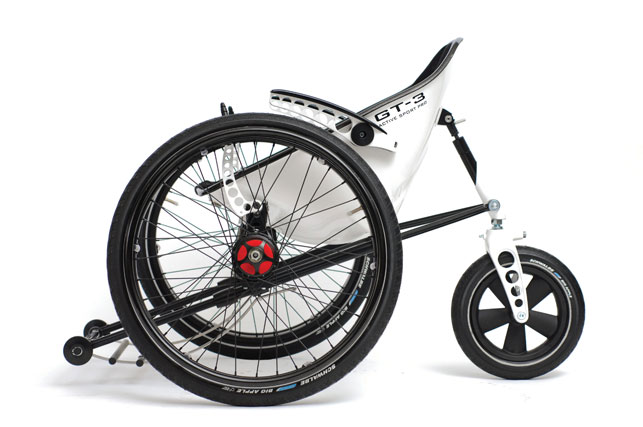
Wheelchairs aren’t usually considered to be ‘cool’, but the Trekinetic K2 All Terrain isn’t your average wheelchair. Stylish looks, coupled with an innovative front drive three-wheel design means it’s just as at home off-road as it is on the high street. By Frances Corbet
Since the first lightweight, collapsible wheelchair was invented in 1933 by the American mechanical engineer, Harry Jennings, its basic form has remained pretty much unchanged, until now.
With the use of new production tools, materials and manufacturing methods, British engineer Mike Spindle, has gone about quashing our perception of conventional manual wheelchair design with the Trekinetic K2 All Terrain.
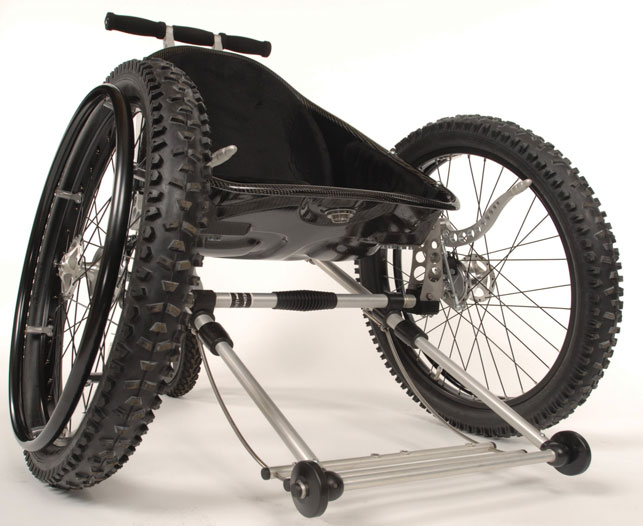
No ordinary wheelchair: The Trekinetic K2 All Terrain combines good looks with excellent handling
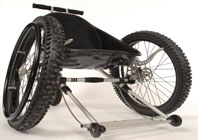
This stylish front wheel drive wheelchair sports two chunky wheels at the front and a smaller single wheel at the back, a carbon fibre monocoque seat, a dynamic braking system, ‘varicam’ quick camber change, a telescopic footrest, a quick-fold rear assembly, a nitrogen shock absorber and onboard wet weather protection in the form of an automatic umbrella. It is no ordinary wheelchair.
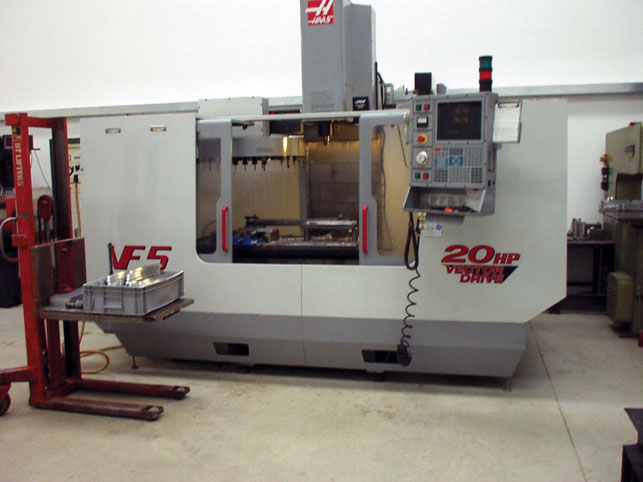
Back in 2000 Spindle realised that his Hertfordshire-based engineering company - DT-Clayton Toolmakers - that had been making components for the F1 industry and previously tooling for the motor industry, needed to diversify into new areas in order to survive. Being quite a cash rich company and having invested quite heavily in new technology over the years, including a large 3-axis Haas CNC machine, Spindle was looking to design his own, relatively high value product. He stumbled upon just the thing whilst waiting in Luton airport’s departure lounge.
Having noticed a “cool lad” in a wheelchair he was struck at how out of place he looked in his traditionally designed, purple wheelchair. “I had no emotional involvement with anyone in a wheelchair and seeing this kid I honestly thought, is that really the best that wheelchair manufacturers can do?” says Spindle. Feeling inspired that he could create something better, he started sketching out his ideas on the back of his boarding pass during the flight.
A new beginning
With a ‘clean sheet’ approach, Spindle’s mission was to build a new wheelchair from the ground up. “I deliberately didn’t look at any wheelchair designs because I thought that I may be influenced. I was going to try and come up with something as if a wheelchair hadn’t existed,” he explains.
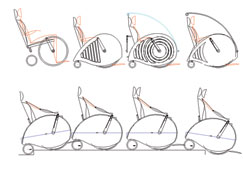
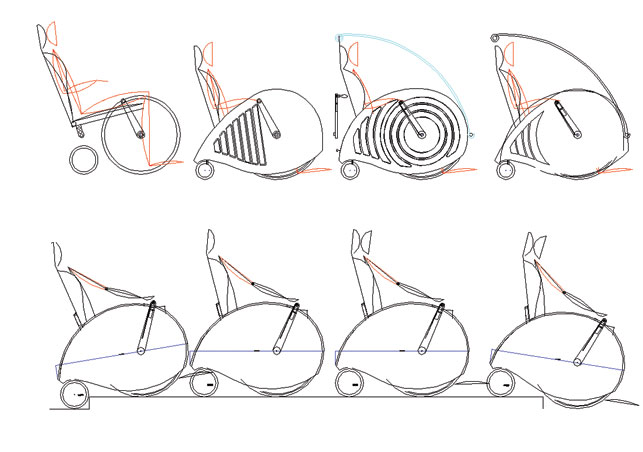
Study of wheelchair operator position in relation to front drive wheels
His initial concept and break from traditional wheelchair design was to move the smaller wheels, or castors, from the front to the back. He felt that, perhaps naively, with the castors at the front the wheelchair is more susceptible to tip backwards. He also thought that it would feel more natural for the user to have their hands next to their knees and not behind their hips. The original concept also included ratchet type levers attached to the wheels. “Instead of pushing the wheels I thought that the levers would be more efficient but, as it transpired, I was completely wrong about that,” admits Spindle.
From this kernel of an idea it took another six years and 14 separate prototypes before the K2 was ready for market. “The first prototype was made cheaply and simply out of plywood and didn’t look anything like what we have now,” says Spindle. “It was a front wheel drive wheelchair with two levers and two castors at the back.”
With that prototype he realised that the lever propulsion system was not the best solution. “When we developed it we found out that it simply wasn’t a practical method as it’s much quicker to move the wheels with your hands. A lever is too cumbersome, too expensive and it’s also difficult to put into reverse,” he explains. With subsequent prototypes Spindle discovered that a three-wheel design would offer a better solution as it meant that all the wheels would remain in contact with the ground, even on an uneven surface.
Sitting pretty
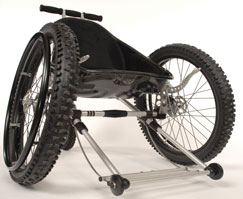
With a ‘clean sheet’ approach, Trekinetic’s mission was to build a new wheelchair from the ground up.
The real breakthrough came with the fourth or fifth prototype when Spindle decided to build the wheelchair around a moulded seat to which all the components would be attached.
“One of the remarkable things that I thought about when I saw the wheelchair at the airport was that it was still on a metal frame chassis with a seat plonked on top,” he says. He sourced an aluminium racing-car seat and weeks of painstaking measuring later, he had the CAD data that could become the basis for a comfortable and mouldable monocoque wheelchair seat.
He used AutoCAD combined with NC Graphics Toolmaker to produce the first on-screen prototype. This was then machined, full size from a huge block of solid reinforced resin. The machining took three weeks and needed great care, as many sections were a fragile 4mm thick. Once this was successfully trial assembled, manufacture of the production moulds could begin. However, although he had originally envisaged the seat being made out of aluminium, this material proved to be very costly and as a result, he chose another very strong and more lightweight material - carbon fibre.
Down to the nuts and bolts
Using AutoCAD in conjunction with NC Graphics’ Machining Strategist, Spindle created a variety of tool paths for the more complex geometries of the wheelchair design. However, another rather unconventional ‘design tool’ he made use of during the process was his son’s Meccano set. Meccano is a model construction kit comprising re-usable metal strips, plates, angle girders, wheels, axles and gears, with nuts and bolts to connect the pieces enabling the user to build working models of, for instance, planes and trains.
“Some of the linkages on the wheelchair were quite complex and even with a pen and paper or CAD I wasn’t actually sure whether they would work the way that I thought they would. So, I used the Meccano set to prove that they would,” reveals Spindle. “Sometimes you stumble upon what would appear to be a truly new solution. An example would be the self-locking trapezium that forms the basis for our ‘varicam’ mechanism. I was almost sure it would work and the theory looked flawless however, there was no prior art and I just couldn’t believe the solution was so simple and so elegant. The Meccano model proved what is now the subject of a worldwide patent.”
Although the development proved to be a long and difficult road for Spindle it was one he was determined to stay on despite having to keep creating new prototypes and then going back to the drawing board again when they weren’t quite right.
“I never quite wished that we hadn’t started but it was very difficult because when you are breaking new ground there is nobody to ask how it should be done - you have to come up with the solutions yourself. We spent £1,000s making a particular device that didn’t work and that happened many, many times,” says Spindle. But having committed the company’s resources to the project he wanted to at least get to a point where he could prove that either it could or couldn’t work.
“What I didn’t want to do is spend all this time, money and many years of my life to prove that this thing was viable and then just give up. I wasn’t prepared to give up before somebody proved that it was useless. So, I felt compelled to find a solution to the problem,” he reveals. “Also, throughout the whole journey I always believed the solutions were already there, I just had to uncover them.”
Off the beaten track
In 2003, having overcome many complex engineering challenges, he had created a solution, in fact prototype number nine, that he was happy with. He took it to Aspire Leisure Services in Stanmore, Middlesex, a fully integrated training centre for disabled and non-disabled people, where he informally showed it to a focus group of doctors, nurses and wheelchair users. This exercise showed up one of the great strengths of the design - its off-road ability.
“We didn’t know at the time but because we had put the wheels at the front, the chair was quite good on gravel, snow and uneven surfaces. We had no idea that the average wheelchair was completely hopeless off-road as the little front castors get jammed,” says Spindle. “So, we realised that we had really hit on something here.”
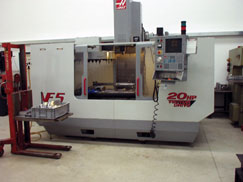
Trekinetic has its own large 3-axis Haas CNC machine in-house
One wheelchair user in particular, Robin Gibbons, a former Royal Navy diver and ex-pilot, really helped in giving a critical assessment of the product and continued to provide valuable feedback over the remaining three years of the chair’s development.
It was Gibbons who pointed out that the three-wheel prototypes had poor directional stability and were unsteady at speed. As a result, Spindle developed a mechanism that automatically locks the rear castor into the straight-ahead position when travelling in a straight line and releases it when the wheelchair is turned. He also realised that in order to make the chair more stable the wheels would need to be tilted inwards because the wider they are at the point where they contact the ground the more stable the chair would be. But having the chair permanently wide would then mean that it wouldn’t be able to get through doorways.
The solution was an innovative ‘varicam’ system - by simply turning a rotating cross-shaft under the seat the user could easily change the angles of the wheels. So, at zero camber the chair is 710mm wide and then when adjusted to negative camber of 24 degrees it becomes 870mm wide. An adjustable nitrogen gas filled, shock absorber was also integrated into the design allowing the seat angle to be adjusted. In the end, Spindle filed for half a dozen separate international patents.
Nearing the end of the road
After the fourteenth prototype he was finally happy with his creation and had it tested to British and European standards by an independent body, the MHRA. In April 2006, the tooling was ordered, just in time for the Mobility Road show exhibition in June 2006. The response at the show was largely positive and subsequent press from the BBC, CNN and national newspapers including The Independent caused heavy traffic on the website as well as many emails and phone calls to Spindle. However, the interest did not only come from wheelchair users or companies interested in the commercial possibilities - many were from architects, engineers and designers who appreciated the design aesthetic and detailed engineering.
The Trekinetic K2 went on to win the 2007 Frost & Sullivan European Product Innovation award in the field of rehabilitation wheelchairs, an award that recognised Trekinetic’s pioneering work in developing an innovatively stylish and ergonomically designed alternative to present wheelchairs, and was nominated for a series of other awards.
Mass production
The K2 All Terrain wheelchair is now in its third year of production and just in the past few months production has been moved to a bigger, purpose-built facility, which is just over 4,000 square feet.
“It is a brand new unit that we have designed specifically for Trekinetic production,” says Spindle. “We machine about 50 per cent in-house and subcontract the seat moulding and some of the components. In fact, we are probably keeping a lot of small firms going at the moment. For instance, the wheels are specialised and they are made in the UK but we have had to now order 100 at a time to keep it all viable for a small company.” This production set-up can handle 20 chairs a week.
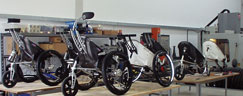
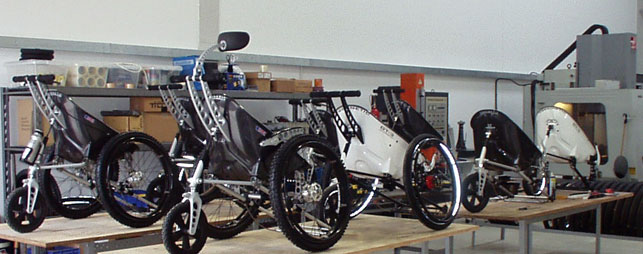
Assembly area for the all terrain wheelchair
The wheelchairs are distributed through a network of carefully selected dealers that currently consists of 11 in the UK, Belgium, Greece, Israel the Netherlands and Australia. “We have a good relationship with our dealers and more and more are opening up as time goes by,” says Spindle. As for marketing the product, Trekinetic relies predominantly on word of mouth with many of the users doing their own ‘advertising’ by using their wheelchairs off-road such as in the country or on the beach, drawing admiring glances from both disabled and able-bodied people.
“Because the chair is so unusual our users get stopped in the street and asked where they bought it from. Only this week I got a call from somebody in Dubai who actually saw someone using the wheelchair in Dubai and wanted to know how they could order one,” says Spindle.
However, not one to rest on his laurels and bask in the current success of the K2, Spindle claims that he has a number of “groundbreaking” ideas up his sleeve that he wants to introduce to the mobility sector in the next three years. One of them he reveals is an electronically powered version of the wheelchair, but the second he guarantees will take everyone by surprise. “It will be based on this chair but I don’t think anybody expects what we are going to do next,” he says. So, without it sounding like too much of a cliché, watch this space!
20 ways F1 racing is changing our world
F1 racing isn’t just about fast cars and tight boiler suits. The Trekinetic K2 All Terrain is currently featured at an exhibition at London’s Science Museum, which showcases 20 examples of where F1 technology is impacting on our lives. The F1-inspired wheelchair will be showcased alongside examples of new ways to look after patients, design sports equipment, and maintain heating systems in homes.
The exhibition runs until the 5th April 2010 and is FREE. Result!
www.sciencemuseum.org.uk
Comments on this article:
Animal house
11 September 2009
Process type: Design
With this month’s product design showcase focusing squarely on the latest and greatest pet homes and accessories, one can only presume that author Stephen Holmes has the happiest collection of hamsters, cats and chickens in the whole of Britain
Rodents in residence
The traditional abode of a hamster was always a wire cage with a wheel, however now they’ve broken out into something much more interesting – tubing.
As zoos have been redesigned to create more natural environments, on a lesser scale we are doing the same in a domestic setting for our pets, with the hamster, an adventurous rodent benefitting more than most.

Happy as Harry the hamster: The modular and colourful world of Habitrail should give your hamster endless enjoyment. Now where’s the owner-sized model?
The modular environments for different activities found in Habitrail’s world not only replicate the pet’s natural environment, but provide interactivity with the pet owners through the use of transparent plastics and modern design.
The latest Ovo range is a bright world of activity, creating unique combinations of environments and tunnels for the pet (and owner) to discover.
“My primary objective is to design products that will make the experience of owning a pet a wonderful one!” says Robin Plante, research and development manager at Rolf C Hagen, Habitrail’s manufacturers.
Beginning with handmade prototypes to review the well-being of the animal as well as the ability for the customer to interact, the team then virtually recreates the product in 3D with Pro/Engineer. Here, all the mechanical details are added as well as the moulding parameters for production.
“To validate if our 3D files would work well before making any expensive production moulds, we did several generations of prototypes made directly from our 3D files in stereolithography, and retested the animal well-being, the customer interface, durability of the mechanical details and product assembly, as well as the knock down ability for the packaging size,” says Robin.
The hardest part is designing an end product that fits all the criteria. “Obtaining the perfect balance between the cool factor of the product, manufacturing in mass, durability, affordable for the consumer, easy to use and clean, without making any compromise to the well being of the pet,” concludes Robin.
Puurfect design

The ModBox is a stylish alternative to the traditional cat litter tray
You’d be hard pushed to find a receptacle for animal faeces that has had as much thought put into it as the ModKat. This feline friendly litter box features a ‘rooftop’ entry that catches gravel as the cat walks out of the box, an ergonomic shovel with a brush to sweep up accidents, and a reusable litter bag to save money and the environment.
“We thoughtfully considered every detail, from non-skid feet that keep ModKat put, to the locking rooftop that keeps nosey pets and curious kids at bay,” says Brett Teper, who along with ModProducts partner Rich Williams, designed the product.

Initial sketches
Truly functional, yes, but form also played a critical role in the design process. “We set out to design a litter box that was aesthetically worthy of occupying prime space in a small apartment, why should one be embarrassed to have their litter box out in the open?” says Brett.
Beginning with sketches Brett and Rich then developed full-scale foam core mock-ups. From there they worked with Cheetah 3D (an Apple Mac-based 3D tool for modelling, rendering and animation) and Adobe Illustrator to develop profile drawings, hole patterns on the top and to flesh out the hinge mechanism that causes residual litter to fall back into the box.
These were passed on to the manufacturer who developed more detailed models in SolidWorks to incorporate the necessary tapering required for the injection moulding process. Several full sized models were made to test for stress, and assess colour and textures.
For further testing real cats were also let loose on the ModKat and multiple breeds, of various ages and ‘unique personalities’, all felt immediately at home. If you treat your cat to this cool looking litter tray, the chances are they might actually like you for once.
Which came first…?
The humble chicken coop has had a renaissance as an environmental wonder, a bastion of the organic – a door step protein producer, which is why it needed a make-over.

The eglu cube is not your ordinary chicken coop. It’s rotationally moulded from MDPE for easy cleaning, available in seven colours and can house up to ten chickens
“What could be better than collecting eggs from your own hens?” says Simon Nicholls, part of the team behind the eglu, including James Tuthill, Johannes Paul, and William Windham, all graduates from the Royal College of Art, London who together set up Omlet in 2003.
The first step was to get rid of the image of chicken wire and salvaged wooden panels. “Existing chicken houses were all made of wood, a material not particularly suited for animal housing because of the difficulty of cleaning, and they looked drab.” To encourage more people to keep chickens the team decided that the product had to perform better and look much more pleasing.
Since its launch in 2004 the eglu has become the world’s best selling chicken house. The team have adapted the design for rabbits and guinea pigs and in 2006 unveiled the eglu cube, which plays host to up to ten chickens.
“The slide out droppings tray makes the eglu quick and easy to clean and the smooth plastic design allows the surfaces to be disinfected and washed with a hose.” Meanwhile the run is made from strong steel weld mesh and has a unique anti-tunnel skirt to prevent predators from digging in.
After the basic concept and mock-ups a handful of fibreglass prototypes were sent out to potential users to get valuable feedback. “They told us exactly what was missing and what needed to be improved,” says Simon.

Omlet’s beehaus is designed to take beekeeping into the 21st century
The eglu is rotationally moulded from MDPE and is available in seven colours, creating large, hollow mouldings with insulating properties to keep the chickens warm in winter and cool in summer.
“CAD modelling is used most heavily during the later stages of a project for production tooling and engineering drawings. Our design engineers are fully trained in Unigraphics NX5 and SolidWorks 2009,” explains Simon.
This month also sees the launch of Omlet’s beehaus, designed with leading apiarists to take beekeeping into the 21st century. With its contemporary and easy to use design it is aimed at first time and urban beekeepers.