Wrist action

26 November 2009

Process types: Design, Manufacture and Prototype

Doing his best impression of a ‘Flash Harry’ with an array of watches clipped inside his raincoat, Stephen Holmes gets his hands on some of the most elegant timepieces money can buy

Moving with the times

The town of Glashütte in Eastern Germany is widely regarded as the birthplace of German watchmaking, home to the country’s premiere horologists.

As seen with Nomos Glashütte (below) tradition plays an important part in what is designed and built by A Lange & Söhne. With a history stretching back to 1845, the company is renowned for its timepieces the world over.

The Lange Zeitwerke combines the principles of a mechanical wristwatch with an eloquent jumping numeral display

“In fine watchmaking, progress is always a result of curiosity,” states Lutz Grossmann, head of the movement design department. “At Lange, the development of a new calibre usually starts with a watchmaker’s question: “How can the principles of a mechanical watch and a modern time indication format persuasively be combined?”

“The answer is the first mechanical wristwatch with a truly eloquent jumping numeral display. With the Lange Zeitwerk we wanted to define a new direction in mechanical watchmaking by creating a watch that lets its owner experience a new sense of time.”

A significant amount of energy is required to simultaneously advance all three numeral discs once every hour, and is delivered by a newly developed barrel with an extra-strong mainspring. This features a constant-force escapement between the barrel wheel and the balance acts as a pacemaker for the jumping advancement of the hours and minutes. “In its compactness, the mechanism is quite likely unprecedented,” exclaims Lutz.

The first prototype is built as a 3D CAD model in Solid Edge. “Each piece is designed by entering all the relevant measurements – often after having drawn the piece on a sheet of paper and having done various calculations. For some parts of the movement we have also created prototypes during this development process to test its function,” explains Lutz, adding that to a minor extent his team uses Finite Element Modelling (FEM), for example, for the improvement of springs, comparing them to the built prototypes to correct springs if necessary.

“Today’s systems don’t allow absolute calculations because of the tininess of our watch components,” reveals Lutz, adding: “but we are curious about the further developments.”

It is likely that in the future this traditional industry will build on its use of design technology, as it continues to move with the times.

www.alange-soehne.com

It’s all in the wrist

This Nomos Glashütte Tangomat watch may be the epitome of simple, elegant design, but there’s a lot going on beneath the surface to make it run smoothly.

The Tangomat is based on a classic model from the German timepiece manufacturer, based in Glashütte, Saxony. Developed over two years as a result of customer requests, it contains a movement that winds itself automatically whenever its wearer moves their arm.

Its design team takes great pride in the aesthetical beauty of its work but also spends a great deal of time developing its own parts and movements to achieve the highest level of accuracy and function.
Initial drafts are made according to basic calculations and a 2D-front view that encompasses all the additional features that the wristwatch will include.

“Now, designers and constructors can work side by side,” explains watchmaker Mirko Heyne. “The construction is set up in 3D. Taking into consideration what methods of manufacturing are at hand, and what methods have a reasonable price. We then design the individual parts. Already during the developmental process, we divide the movement into assemblies to allow for an efficient mounting.

“For construction purposes, we use Solid Edge. This software is employed to create all data for the movements and all drafts. The 2D first drafts, 3D constructions, and 2D sketches of the individual parts are all implemented with the help of this software,” continues Mirko.

When testing parts, theoretical values are calculated in advance through the design process but have to be verified by practical experience. “What we simulate, however, is the assembly process in order to allow for an efficient work process later on,” states Mirko, adding that this helps with the difficult task of predicting a date for the product’s series-production readiness.

Building all its own components requires high quality craftsmanship. This even relates to prototypes for which Nomos uses high precision nano-fabrication x-ray LIGA-technology to build models with properties similar to the final material.

Helpfully, to appreciate all this technology, the Tangomat has a glass back for the wearer to view the Glashütte art of watchmaking in all its glory.

www.glashuette.com

It’s disco time

When it comes to watchmaking, there is no more famous a land than Switzerland, a postcard picture of wooden huts in the snowy mountains with craftsmen delicately working away on wheels and cogs.

While traditional skills are still very much at the heart of the industry, new designs are benefitting from 3D CAD to save time and realise working prototypes before a single physical part is built or assembled.

Paul Picot is a highly regarded watchmaker from the the town of Le Noirmont. Chef de projet, Pascal Franck Kunz, works to produce limited collections of designs, built from precious metals. The latest project is the Technograph Discotime a stainless steel watch that features coloured disks instead of a second hand and a chronograph minute counter, to bring life to the dial.

“Our designer started to work on the disks idea with sketches on paper. Then we had to model it in 3D to see if it would be realistic,” say Pascal.

“The movement had to be tested to see how it would react to the use of disks, compared to normal hands. The force and power ratios are very different!”

After the 3D development process a physical prototype was built as there are still often slight differences between simulation and practice, however virtual prototyping is a cost and time efficient way of testing concepts.

“The achievement of our projects is the result of the combination of our people, know-how, expertise and creativity and all the technology,” concludes Pascal, acknowledging that software such as SolidWorks is allowing his team to test new concepts and materials such as slate and carbon for future luxury timepieces.

www.paulpicot.ch


Comments on this article:

Pump up the volume

26 November 2009

Process types: Collaborate and Design

The Zon hearing aid is the result of a close collaboration between Starkey Laboratories and Stuart Karten Design. Through a blend of cutting edge technology and innovative industrial design,its developers hope to banish the stigma of an often-maligned product. By Frances Corbet

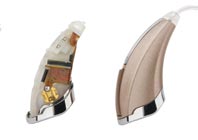
Most of us are familiar with traditional hearing aids - unattractive beige, shrimp-like objects that fit behind the ear. They certainly aren’t much to look at and it’s no wonder that those experiencing hearing loss have a reluctance to wear something that so obviously shouts disability. Despite the extraordinary advances in hearing aid technology, the actual design of the device itself has not moved on.

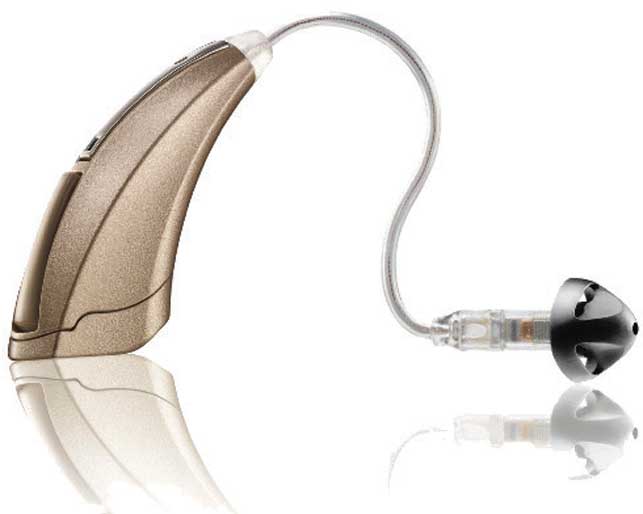
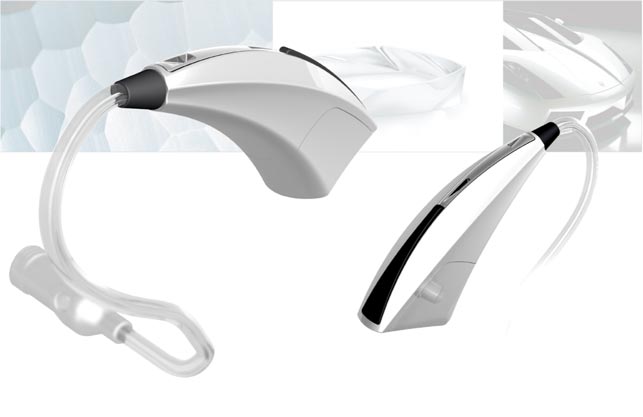
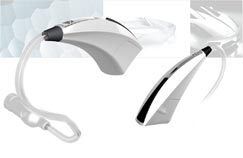
Starkey Laboratories, a global supplier of hearing aids, wanted to change that with the launch of the Zon. This sculptural 1.3-inch device, which fits discreetly behind the user’s ear, is almost jewel-like in appearance.
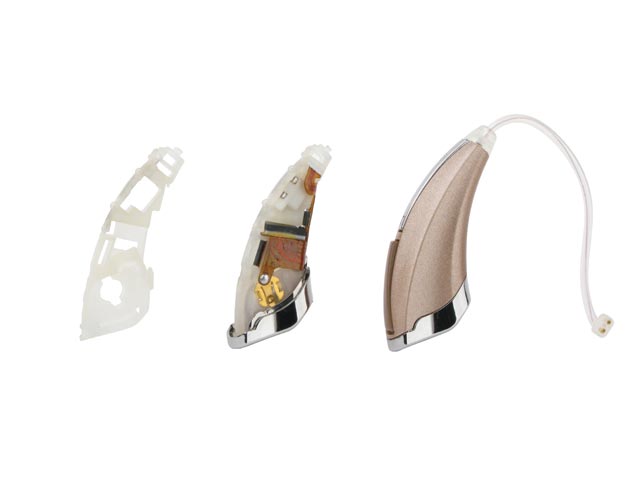
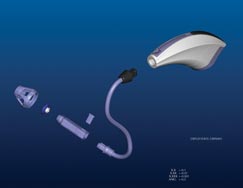
Electronic components are organised around an injection-moulded spine, which is inserted into the outer injection moulded nylon shell through an opening at the bottom

“Zon fills a real need in the market. Hearing aids have been a maligned product for years - they are costly, yet many of them pose technical challenges and there are few that visually communicate the value of the investment hearing aids require. Zon solves these problems on many levels,” explains Stuart Karten, founder of Stuart Karten Design (SKD), a Los Angeles-based industrial design consultancy that was involved in the design and development of Zon.

Starkey approached SKD to design the Zon due to the consultancy’s experience in ear worn consumer products, including the award winning BT-500 bluetooth headset for Jabra and the Voyager Pro headset for Plantronics. The brief was to package the core hearing aid technology and give it a form factor that would be ‘sexy in the hand and invisible behind the ear’. “Starkey came to SKD with a digital signal processing technology that was very advanced. It eliminates the feedback typical of most hearing aids, but the design had a long way to go,” explains Karten. “SKD’s goal was to express the value of this technology - the incredible value of restored hearing - on the outside of the product.”

Innovation through research

With the brief in hand the first thing the consultancy did was carry out extensive research. As part of this research the team immersed itself the hearing aid industry by not only studying competitor products but by attending trade shows, talking with hearing professionals and even studying Starkey’s own production and manufacturing capabilities. “Our designers even went so far as to build a hearing aid on the assembly line,” says Karten.

People will live in denial for an average of eight years before seeking treatment for hearing loss. If we could reduce that wait time the project would be a success’’ Stuart Karten, founder of Stuart Karten Design (SKD)

Of course, consumer research was extremely important and SKD spent a great deal of time with users by both talking to them about their hearing aids and observing them using them. “We conducted ethnographies and contextual inquiries in users’ homes, observing a day in the life of the hearing aid from cleaning and battery changing to adjustment and storage,” says Karten. “It was very important that our design team, most members of which are in their 20s and 30s, gained first hand empathy for the target customer, aged 65 to 80. This research is where some of our most poignant insights arose.”

For instance, they observed a seventy-year-old man trying to change the battery of his hearing aid whilst sitting at his dining room table. He confessed that if the battery dropped during this time, he would have no idea where it went because he wouldn’t be able to hear where it landed. So, the designers discovered that the tasks difficult for many users whose dexterity has been compromised by age, such as changing batteries or adjusting volume, were those areas ripe for innovation.

Form generation

Having conducted the research, the designers realised that their overall aim was to minimise the stigma associated with hearing aids. “We learned that people will live in denial for an average of eight years before seeking treatment for hearing loss. If we could reduce that wait time and make hearing aids a more acceptable treatment option the project would be a success,” comments Karten. Additionally, they wanted to ensure that the hearing aid they developed was new and different to what was currently on the market. Following brainstorming sessions they came up with the descriptors of “visually crisp and organic”, which would become the drivers for the hearing aid design.
Following the brainstorming sessions and having established the design direction, they began sketching their ideas and came up with ten initial concepts to present to the client, which were rendered using Bunkspeed’s HyperShot, a photorealistic rendering software. According to Karten, although they could have presented sketches or rough prototypes, HyperShot provides a high level of realism that helps the client envision the final product. During the presentation the chosen concept quickly emerged when weighed against the various objectives and criteria. “Its dynamic form was beautiful and provided the best wearing comfort with ample airflow and no ‘hot spots’,” he explains.

The chosen concept also incorporated solutions to many of the user challenges and needs identified in the research. For instance, the control button used to switch between digital modes and adjust volume is a single oversized push button along the hearing aid’s spine, where it is easily accessible in the worn position. Additionally, the battery door swings open from the side, allowing users to lay it on a table for additional support during the battery changing process.

Engineering collaboration

During the design process, SKD’s designers and engineers worked in close collaboration with the engineers at Starkey. The particular challenge of packaging all the components in the small space available was resolved by constantly sending Pro/Engineer CAD files back and forth between the two companies. The components that had to fit in included a pair of microphones, a battery and a hybrid chip. “The design was essentially modelled around these components, which determined the hearing aid’s size and orientation to a great extent,” explains Dennis Schroeder, SKD’s senior designer who was in charge of rendering and modelling Zon and collaborating with Starkey’s engineers to ensure the performance of the device matched the high level of design. Throughout all of this, careful attention was paid to ergonomics to ensure that the device would be comfortable and absent of hot spots. 

Listen carefully
Stuart Karten Design

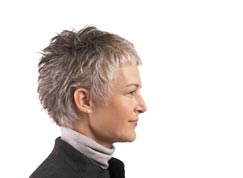
Spot the hearing aid: The Zon is incredibly discreet when worn

With one of SKD’s specific goals being to improve the Directionality Index - the hearing aid’s ability to clearly pick up sounds coming from certain directions - Schroeder and his team’s key engineering contribution was the location of the microphone port. Highlighted in chrome to delineate its function, the port was placed so that the microphones are horizontal on the user’s ear. “Starkey mentioned to us that the best way to improve directionality was to have the microphone ports line up parallel to the ground when in the worn position, ensuring that each of the two microphones are receiving sound from the same direction in front of the user,” says Schroeder. “By incorporating this principle into the design, SKD helped Starkey improve the Directionality Index of its new hearing aid by 30 per cent.”

Design for manufacture
Stuart Karten Design

Early Zon concept model produced inside Pro/Engineer

SKD also introduced Starkey to an innovative manufacturing process that would allow Zon to be assembled without parting lines or internal ribs and bosses, giving the device a smooth surface quality and a level of water resistance.

The process demonstrated how the shell could be manufactured from a single piece instead of two plastic pieces screwed together. “Electronic components are organised around an injection-moulded spine, which is inserted into the outer injection moulded nylon shell through an opening at the bottom of the piece. The microphone port cover and battery door are then attached to procure the spine in place. This process allows Zon to be assembled without parting lines, lending a clean, unified appearance,” explains Schroeder.

Colour me beautiful

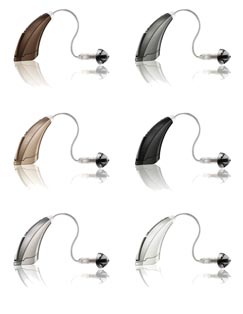
In order to answer the brief of being ‘invisible behind the ear’, colour selection and materials played an important role in the design. “SKD studied hair and skin tones, talking with make-up specialists and Beverly Hills hair colourists. We learned that natural hair and skin is made up of varying shades,” says Karten. As a result, SKD developed a palette of six understated colours that complement both hair and skin tone.

“To make our recommended colour palette even more realistic, we encouraged Starkey to use high-gloss metallic paint to mimic the natural translucency and colour variation of hair and skin tones, helping the hearing aids to blend behind the ear better,” continues Karten. This was achieved by using a new paint strategy on nylon resin, which is a very strong and chemical resistant material. “We connected Starkey with Phillips Plastics who helped make this a reality,” says Schroeder.

Refined design

Having carried out further research and testing with the prototypes in order to validate the product design, the model was then refined in Pro/E. The designers found the high level surface modelling and skeleton model functionality of Pro/E particularly beneficial.

“Pro/E allows you to attach multiple parts to a master model or skeleton and these parts travel together. For example, when you resize one part, Pro/E automatically adjusts the connected parts to the same scale so that you don’t have to manually re-size them. This was very helpful on Zon because the model had six different parts,” explains Schroeder.

As Starkey has its own manufacturing and assembly facilities, the CAD data was then sent directly to the company to produce and assemble the parts.The Zon hearing aid was launched in mid 2008 and certainly meets Karten’s aim for a design that is both crisp and organic, a fusion between the human and the mechanical.

The project also brought much enjoyment to the consultancy. “We’re happy to have a client as open and collaborative as Starkey has been. We worked directly with the company CEO who sees the value that design can add and allowed SKD to be involved at a deep level, from foundational and user research to the complete product experience-packaging and retail displays,” says Karten.
Since the launch, Zon has not only been praised by users and hearing aid professionals but has also caught the eye of the design community, one such being New York’s Cooper-Hewitt National Design Museum that presented the consultancy with an award in the People’s Design Award category at its annual National Design Awards gala.

This category allows the public to nominate and vote for their favourite design. As Cooper-Hewitt’s director Paul Warwick Thompson said at the awards, the success of Zon demonstrates that good design can indeed have a transformative impact on our everyday lives. Although SKD have received many design awards in the past, this was a special award for Karten. “To take a product that no one wants and banish that stigma is an accomplishment I’m very proud of,” he says.

However, the collaboration with Starkey doesn’t end there and SKD’s next product for the company is due out at the beginning of 2010. It uses the same design language as Zon but in a larger, more powerful hearing aid. “This new product builds upon our initial user research, introducing a new user interface that further simplifies the process of adjusting controls. SKD has done additional research programs for Starkey on hearing aid accessories, docking stations and remote controls. More products are currently in development,” reveals Karten.

www.kartendesign.com  /  www.starkey.com


Comments on this article:

Visual perfection

09 November 2009

Process type: Design

During the development of the award winning Opel/Vauxhall Insignia, GM Europe used manufacturing variation simulation and visualisation software to help it achieve high perceived quality whilst cutting development time and costs

In October, 2008, the 59 senior motoring journalists from 23 European countries who make up the jury for the annual European Car of the Year (COTY) awards chose seven finalists from a total of 37 contenders for the latest awards.

After the points allotted by the jury during the final round of judging had been counted, the Car of the Year 2009 award went to the brand new Opel/Vauxhall Insignia from GM Europe. The Insignia gathered a total of 321 points, beating the new Ford Fiesta into second place by the narrowest of margins and the Volkswagen Golf VI into third place. 

An important contributing factor to winning this award was the high perceived quality of the Insignia. Perceived quality is a key component of brand identity. It describes the first impression a customer gets regarding the look-and-feel of a product, without regard to its functionality.

In the later design & validation phase of the development process attention was geared towards the calculated gap and flush dimensions

Key to GM Europe’s success with the Insignia was the use it made of advanced manufacturing variation simulation and visualisation software during the car’s development. Known as aesthetica and developed in the UK by Icona Solutions, the software was used from the early concept design stages of the project, enabling the various design, engineering and manufacturing disciplines involved in the project to understand the manufacturing constraints and to agree on gap and flush conditions and manufacturing tolerances as early as possible in the overall design and development process. This made it possible to achieve the highest possible perceived quality in the final vehicle without negatively impacting its development and manufacturing costs.

Dimensional management

Ten years ago, as part of its focus on quality, innovation and affordability, GM Europe created the dimensional management department at its International Technical Development Centre in Rüsselsheim, Germany.
 
The International Technical Development Centre is at the heart of engineering for GM Europe. Within it, the dimensional management department, led by Edgar Lossnitzer, who has defined the new perceived quality processes, is responsible for the management of tolerances over the entire vehicle development cycle.
 
“Dimensional quality is already defined at Opel at the start of a project in a tracking schedule known as the dimensional technical specification, or DTS,” says Lossnitzer. “Dimensional quality is tracked during the entire development cycle, all the way to production. In the DTS, all gaps and offsets visible to the customer along with their nominal values and allowable deviations are specified,” he explains.

“Nevertheless,” he adds, “one of the problems we faced was that too many gaps were falsely interpreted through the tolerance simulation. This often led to controversial discussions in the DTS setting meetings, as well as in follow-up meetings, until a physical model could be produced for review. This costly and time-intensive process resulted in agreements and decisions being made late in the process, with the result that there were often additional costs involved in implementing the required design changes.”

With a view to overcoming this problem, Lossnitzer and his team set out to fully investigate how, or if, 3D visualisation software could help in the dimensional management process for the Insignia programme. This brought them into contact with Icona Solutions, developer of the manufacturing variation simulation and visualisation software solution, aesthetica, and Icona’s business partner in Germany, Casolute.

Icona Solutions’ aesthetica software is unique in that it applies tolerances and component deformations directly to the product’s 3D CAD geometry. These 3D models can then be visualised, in real time, using different light sources, colours and materials. This is unlike traditional visualisation software, which can only visualise a virtual product in its perfect, as-designed nominal condition. With aesthetica, a realistic representation of the vehicle as it would appear at various points within the range of assigned tolerances can be produced at a very early stage of the vehicle development. This enables perceived quality reviews to be carried out, in which fit and finish problems can be spatially represented in real time and solved immediately.

Perceived quality studies

When Opel made the decision to implement aesthetica it was at the very early stage of the development of the Insignia. Superior design, vehicle dynamics, safety and comfort, as well as superior aerodynamics and appearance (gap and flush) were all expected from this vehicle.

With the introduction of aesthetica, design review meetings began to be routinely carried out in a virtual reality (VR) room in order to show the meeting participants the three dimensional model without it being necessary for any physical models to be built.

Aesthetica can be used in every phase of the development process to accurately and visually present the influence of tolerances on perceived quality. The parameters used for the simulations are based on the design and manufacturing data, including the material, fastening scheme and the tolerances. Complex deformation effects such as arching, bending and distorting are represented, thereby allowing the root cause of problem areas to be identified. These parameters can be changed freely to enable all possible solutions to be tested in order to achieve the highest possible quality in the final product.
 
The first use of aesthetica on the Insignia project began at the early concept stage. As soon as the first styling data was released, the first aesthetica models for the interior and exterior were generated. From this point the digital model would be continuously updated to accommodate styling changes and/or the development progress. This process continued through the design & validation phase up to the final confirmation and improvement phase.

Considerable resources have been saved by eliminating the need for physical validation models

Early engineering used the digital models in order to visualise the effects of the different tolerances and if necessary, to kick off changes at a time when the cost of change was minimal. aesthetica made it possible for the calculated variations and their effects to be visualised in 3D. Alternatives could be brought directly into the aesthetica model and the effects of technical implementations could be shown immediately in the 3D representation.

For the interior the concentration was placed, above all, on the area visible to the driver and passenger in order to allocate the priorities for the tolerances in this area. This allowed areas that are difficult to see or aren’t seen at all to be used to compensate for build tolerances. Overall, additional attention was given to “forgiving design” in which design elements and their optimisations were evaluated in 3D in the VR room before being implemented in physical products.

In the concept phase of the new vehicle development process it was crucial to include key stake holders in meetings in order to present the new product, as well as all tolerances and the effects of those tolerances. As a result, very early in the development process the target specifications could be defined based on realistic images. Decisions were able to be released for product development simultaneously, thereby avoiding future surprises, because agreements were more quickly obtained.

In order for discussions in the VR rooms to be completed as efficiently as possible, a type script was generated beforehand. With this, the area of the vehicle, perspective, material combination and light sources for the visualisation were defined and stored in aesthetica. As a result, every condition could be quickly reconstructed. The new points and desired notes from the meeting could also be directly entered and stored in the same manner. This allowed new ideas to be discussed immediately and either pursued, or rejected, partially eliminating the need for physical models and resulting in cost and above all, time savings.

Depending on the phase of vehicle development, different goals were pursued in these meetings. Here the 3D visualisation capabilities of aesthetica were indispensable because, in the absence of a physical vehicle, no conclusions could have been reached otherwise.

This was especially so in areas of the vehicle in which many components interface with each other, for example on the boot lid and the front end of the vehicle, as well as the area where the dashboard and door trim meet. In the development of the Insignia Sports Tourer, this area was investigated with aesthetica and its “Gap- / Flush- Fitting tools”. Using this, different possibilities for gap and flush could be judged until an image representing an optimal combination could be found.

In the later design & validation phase of the development process attention was always geared towards the calculated gap and flush dimensions. The results of these calculations were based on the assembly processes, component geometry, component tolerances and assembly tolerances. For visualisation, separate interior and exterior models were required because the development phases started at different times.

Design elements and their optimisations were evaluated in 3D using VR on a powerwall

As a rule, only partial models were generated in the interior area. These models included the front door trim, instrument panel and the centre console. In order to observe these areas from the viewpoint of the driver and/or passenger, information from the RAMSIS human models was also used in these models. Additionally, within the aesthetica model, rotation points were set in the position of the eyes in order to evaluate the view in all directions.

With this, sensitive areas could be identified and the required focus could be applied to the resulting images. Moreover, this avoided a situation where certain areas were defined as problematic as a result of being evaluated from unrealistic views.

In the exterior area, the tolerance calculations that were categorised as critical were visualised on the Powerwall in the VR room using the “Gap- / Flush- Fitting Tools” of aesthetica and presented to the decision makers. This provided a great advantage because the meeting participants easily could see how large the adjusted gap dimensions were.

As the models became more advanced further attention could be applied to elements such as visible structural items like screws, rivets or ribs within the gap, clip connections of components within the visible area, visible sub-materials such as sealing foam or glue, and elements visible through transparent components such as headlamps. This all helped to improve the overall visual appearance, or perceived quality, of the final vehicle.

Real benefits

“As a business that has actively integrated dimensional engineering into the vehicle development process for more than ten years, Opel was looking for a tool to support decision making,” says Lossnitzer.

Icona Solutions’ aesthetica software was developed as a visualisation tool that enables vehicles – and other products - to be developed in a cost efficient and effective way. Although Lossnitzer acknowledges that some people were initially critical of the high investment needed for the software and 3D visualisation on a Powerwall, he points out that once it became clear how easily concrete decisions could be made, they were convinced of the value.

Summing up the benefits, Lossnitzer states, ”Since introducing aesthetica into Opel there have been no more long-winded and time-consuming discussions regarding a few tenths of a millimetre. Communication to management of necessary changes has improved, decisions are made faster and as a result, development costs are saved. Considerable resources have been saved by eliminating the need for physical validation models, which together with the time savings have more than compensated for the acquisition costs of the software.”

http://www.iconasolutions.com


Comments on this article:

Life on the farm

09 November 2009

Process type: Design

Drawing inspiration from his local harvest festival Stephen Holmes investigates the high-tech world of agricultural machinery

Just a cotton-pickin’ minute

John Deere with its green and yellow livery is one of the most recognisable brands amongst farmers and its leaping deer motif patrols fields across the world.

A specialist machine is needed for the process of cotton harvesting, in which the company has been at the forefront for the last 60 years. To enable the most efficient way of harvesting from the giant cotton fields John Deere’s design team has produced the 7760 Cotton Picker, a machine that can harvest non-stop, providing on-the-go packaging of seed cotton as it moves.

John Deere’s 7760 Cotton Picker can harvest non-stop, providing on-the-go packaging of seed cotton wrapped in a special plastic

The picked cotton is automatically wrapped in a special plastic, forming a secure, round bale, which then drops onto a rear handler shelf that can lower the bale to the ground at the end of the row. Throughout this process the driver need not stop and can continue to harvest more cotton.

Having spent time testing multiple concepts to find what shape of bale and mechanism would be best suited to the harvesting process, David Winter, the global manager of John Deere’s cotton engineering sector, relied heavily on 3D design tools to develop the final design.

“All components of the machine are created in a virtual environment using the 3D modelling software Pro/Engineer,” says David. “These models feed downstream tools to analyse the design and make improvements before actual parts are made. 

“For example, the model geometry is imported into a finite element analysis tool to help determine if the part, or parts in question, will meet the rigorous demands of the final product. Manufacturing also uses the 3D models to perform virtual builds, helping them define assembly methods and the production line configuration well before a build begins.”

One of the biggest challenges faced by John Deere was designing the cotton picker for two specific groups of users that would transform the way the cotton harvesting workflow operates. The design not only had to meet the requirements of the cotton farmer, but also the those of the downstream user of the new ‘packaged’ cotton, the cotton ginners, who process the raw cotton by removing the seeds from the useful fibres. Through careful consultation with both sets of users the final result is a product that saves time and lowers waste for all involved in the industry.

www.deere.com

Blades of glory

Agricultural mowers are tough pieces of kit, far more so than the Flymos used for preening the garden, but even they can have difficulties when the land gets steep.

Kuhn GMD

The GMD Compact mower is optimised to work in hills and mountains while being light enough to be operated by small or low powered tractors

A new range of front disc mowers from Kuhn have been designed to tackle this problem. The result is the GMD Compact which is optimised to work in hills and mountains while being light enough to be operated by small or low powered tractors.

The mowing unit adapts to ground contours through its central pivot point. The ground pressure adjustment is made directly from the tractor for those equipped with an integrated front lift suspension or using powerful springs.

The design of the cutting discs means there is no area where two discs rotate simultaneously frontwards, allowing forage to be moved more efficiently to the rear.

One of the main concerns with the design was to keep the weight low without sacrificing the reliability of the machine and this was considered throughout the design process. Keeping the weight below 600kg the team aimed to give the machine the lowest possible overhang to allow it to mow grass on steep slopes.

Kuhn GMD

Concept sketches wanted to give the GMD a ‘sporty’ effect

“For the computer assisted conception we use Pro/Engineer software and its different attached modules, which enabled us to make structure resistance calculations, kinematics simulations as well as realistic pictures of the machine,” says design engineer Gilles Fischbach.

Away from the practicalities of such equipment, Kuhn aimed to give the piece of equipment an innovative style of its own, contrasting with the majority of the Kuhn range of machinery. “The scope was to obtain a somehow ‘sporty’ look, with dynamic and harmonious lines,” says Gilles.

The end product is both small and manoeuvrable, but tough and designed with purpose for the ever-expanding reach of modern farmland.

www.kuhn.co.uk

I’ve got a brand new combine harvester…

The infamous song of West Country bumpkins and their preferred choice of agricultural machinery failed to mention exactly what these machines are capable of doing – it must have been the cider.

New Holland combine

New Holland’s CR9090, a beast of a combine harvester, holds the world record for harvesting: 551.6 tons of wheat in eight hours. That equates to, er, quite a few loaves of bread

The CR9000 Series is the giant of New Holland’s combine harvester family, with particular attention devoted to capacity, operator comfort, grain and straw quality, and residue management.

The technically advanced rotary model was launched last year with a series of unique features, much to the delight of farmers across the globe. An electronic stone detection and ejection system stops any unwanted stones entering the straw elevator; a Twin Rotor threshing and separation system ensures high capacity and gentle handling of grain and straw; a camera system measures the concentration of chaff and the amount of broken grain in the grain sample and the CR9000 also has one of the largest and quietest operator’s cabs available.

Designed primarily in Pro/E, the giant machine underwent substantial model testing before anything was built. Pro/Mechanica was used for force simulations and FEA and CFD for respectively assessing strength and air flow in the cleaning systems. The design team also uses in-house software to calculate drive lines and variators needed to ensure the machine can handle all worldwide crop variations.

New Holland run its designs through its very own virtual reality room DMU (Digital Mock Up) linked with Pro/E to verify any build interferences. This became key when packaging the sub modules into one assembly, ensuring access and serviceability is available for all the required components.

Soon after being set loose on the world’s crops the flagship model, the CR9090, set a world record for harvesting: 551.6 tons of wheat in eight hours. This astonishing feat was achieved in the UK in September 2008, and it is still unbeaten.

www.newholland.com


Comments on this article:

Clean living

09 November 2009

Process types: Design, Manufacture, Prototype and Visualise

The new @ease from Electrolux is designed to put the fun back into cleaning. During the development process, the global design team learnt much from watching consumers interact with prototypes of the upright vacuum cleaner. Frances Corbet reports

Let’s face it - unless you’re Freddie Mercury - vacuuming is a bore. However, if your vacuum cleaner is simple to use, can be manoeuvred with ease, doesn’t require any bending, winding or stretching and is also good to look at, you may just enjoy it that little bit more. This is exactly what Electrolux set out to achieve with its latest product offering - the aptly named @ease.
“Vacuuming isn’t seen as the most fun thing to do - there is physical effort involved and it takes time. We wanted to make that easier and more enjoyable for people,” says Randy Sandlin, general manager of consumer experience and innovation at Electrolux Home Care Products, who was responsible for bringing the new @ease to market.

The @ease eliminates stretching bending or winding. All controls are either hand or foot operated for ease of use.

Electrolux, a global appliance brand that sells more than 40 million products including refrigerators, dishwashers, washing machines, vacuum cleaners and cookers to customers in 150 countries every year, prides itself on being a ‘Thoughtful Design Innovator’. This means that it wants to be portrayed as a customer-focused company that is dedicated to creating innovative and thoughtfully designed products that meet the real needs of customers.

This may all sound a bit like ‘marketing fluff’ but according to Sandlin, extensive consumer insight really does drive the product development. “At Electrolux, we have a thoughtful design philosophy. It starts with the consumer - identifying their needs and finding ways to deliver on them. We then look at functionality, usability, how people actually interact with the product, aesthetics and capturing the brand identity. It’s really a holistic approach to the product. It’s the total experience,” he explains.

Global design

Electrolux has its design roots in Scandinavia, a region renowned for its clean and simple yet intuitive creations. The company’s headquarters are in Stockholm, Sweden, but the industrial design team, that consist of 140 designers, model makers, surface designers and project leaders, are also spread between Electrolux Design Centres in Porcia, Italy; Curitiba, Brazil; Sydney, Australia, Singapore, Anderson, California; and Bloomington, Illinois.

@ease, designed in alias

Concept development of the @ease was carried out using Alias

However, despite being geographically dispersed, Electrolux’s designers don’t work in isolation. Not only do they collaborate on projects with their design colleagues in Stockholm but they also work as part of an integrated team in-house that consists of both engineers and marketers. “Good design happens when design teams work with other departments to ensure that essential brand aspects are seamlessly integrated into the product,” says Sandlin.

Consumer appeal

Every project starts with consumer insight and instead of the industrial designers merely relying on what the consumer researchers tell them, they actually go out there and get involved in the research themselves. Sandlin refers to this research as ethnographies, and it involves actually going into people’s homes to observe them using their appliances and products. “You can’t make a product succeed without knowing for whom it is intended,” he says.

“A good design is born when a product answers a specific need existing in the real world and this can only be accurately determined through interaction. Ethnographies are the best way to achieve this interaction.”

Interaction with consumers doesn’t stop there as throughout the design process focus groups are held, which the designers also attend. “Understanding that consumer first hand - getting to see their body language and visually see how they interact with products - is so important because that is where you can get those big ‘eureka’ moments,” he adds.

In the case of @ease, the designers had several different areas that they wanted to explore based around making the vacuuming process easier for the consumer. One of the first things they wanted to look at was the cord and instead of the user having to bend down to wrap the cord, they wanted to look at the possibility of creating a button that they could push to automatically wind it in. According to Sandlin, although the cord rewind is common on canister vacuums, it is not heavily used on uprights.

Another design feature that came out of the brainstorming sessions was use of two zones on the product – one zone at the top consisting of buttons and interaction points controlled by hand and then a foot zone where users can change the height adjustment and access the on/off button. “From consumer insights we saw people bending or just not doing things because it took some physical effort and we wanted to avoid that,” explains Sandlin.

@ease designed in Unigraphics

The internal components and external structure are developed using Unigraphics

With the consumer opportunity identified, the design process - which Sandlin refers to as a pretty in depth stage gate process - now begins. It either kicks off with a primary development, which is when a new technology needs to be developed, or, as in the case of @ease, progresses straight into concept development. Here the designers and engineers worked together to come up with concepts that incorporated the cord rewind, telescopic handle and telescoping wand. They then constructed some very quick engineering rigs. “These are not beautiful,” says Sandlin, “but you can mess with them and can cobble some stuff together from other projects to get some kind of prototype to interact with.” The designers will then start working on concept sketches and utilise Alias software to create renderings.

Product development

Having identified the segment they want to go after, found the consumer need they want to focus on, established the business case, and what timeline they are working towards, the designers can then move into the product development phase. In the first stage they will continue the design exploration. “We do a more in depth dive into how we are going to make all this work - from a technical and a design side,” says Sandlin. So, whilst the designers create their external surfaces in Alias the engineers will be working on the internal components using Unigraphics. The designers and engineers will then both work in Unigraphics to build the structure. This is a very collaborative process as the designers and engineers will work concurrently transferring files back and forth.

In order to test their designs and show how the product solution has been interpreted, physical models are produced, by sending CAD files to either the in-house CNC or SLA machines. “If we send a file to our SLA machine, the next day we can come in and see the parts to verify that design,” explains Sandlin. In the case of the @ease, testing the product’s height adjustment using your foot took rounds and rounds of prototyping to make sure that it was something easy for the consumers to do both with a shoe on and off. At this stage the US team can also get input from the Stockholm design team by sending the Alias files to them to review and give feedback on.”

@ease SLA model

Rapid prototype models are produced in order to test designs and show how the product solution has been interpreted

Next is the ‘design freeze’ where everybody stops what they are doing and scrutinises the full size prototype to make sure that they are all in agreement with its size and features. “Our goal is that we freeze the external design and make sure that the engineering technicals will fit within that design,” says Sandlin. They look at things like the structure, the ribs and the parting line of the plastic parts. Doing this prevents costly and labour intensive changes having to be made further down the line.

After the design freeze there are various stage gates that the team needs to go through including the engineers working on finishing external surfaces in Unigraphics and release tooling. “When we get parts back from tooling, we will do reviews. Engineering will review it from all their technicals and we will review it from an aesthetic and consumer interface side,” says Sandlin. Towards the end of the process when they are nearing production, they carry out a final review of the product checking that it fulfils the original design intention that was set for it. “Part of the development is focussing on what you want to do and not making compromises on those areas,” he says.

Colour me beautiful

An important area that the designers need to consider before the product goes to production is the graphic application and colour. “We have to look at the colours we are going to use and how we are going to communicate the brand and the features with the graphic on the product,” explains Sandlin. In the case of @ease - white with cyan and then white with magenta were chosen for the two different models. “We use splashes of colour, which is very fresh and new compared to what is happening in the category with other products just being one colour. Colour draws the consumer’s eye to particular features and details,” says Sandlin. Interestingly, consumers in the UK and European markets have different feelings towards colour compared to the US market. “White with magenta does well in the UK but doesn’t get the same response when we do colour research in the US,” says Sandlin. “In the US we did a similar model in grey and they reacted differently.”

Production ready

When the product is ready for production, communication with the factory is done through the engineering group that sends the 3D CAD data. Like many companies, Electrolux wants to remain competitive and that involves cutting costs and so it has embarked on a comprehensive restructuring program. By the time this program is completed in 2010, approximately 60 per cent of the group’s appliances will be produced in low-cost countries, including Poland, Hungary, Mexico, China and Thailand. The company is also saving on its purchasing costs, mainly by increasing the share of purchases from suppliers in these low cost countries.

The @ease was launched in September and despite a difficult market, Electrolux is hoping that with its foot operated controls, looped telescopic wand and 8m cord auto rewind it will stand out from other products in the category and connect with consumers. As for Sandlin, after 15 years with Electrolux his enthusiasm is not waning. “There are so many unfulfilled needs out there that need to be solved. So when we start the next project, it’s a new set of consumer problems that we are tackling - we are not doing the same product over and over and just making it look a little different,” he says. “They all start with that consumer problem and you dive in to find out how you can make that product better for the end user. That’s what makes it really fun.”

www.electrolux.com

Comments on this article:

Finishing strong

06 November 2009

Process type: Prototype

Long established modelmaker and industrial prototyping specialist, Malcolm Nicholls Ltd (MNL) is a company that doesn’t dwell on its past. Stephen Holmes finds out what is driving them forward

A short drive from the historic town of Stratford-upon-Avon, with its Shakespearean heritage, leaning timber framed buildings and legions of waddling tourists, MNL operates from its own historic base.

Having been in operation since 1971, beginning with the production of humble milk crates before introducing a technological edge, the company now continually pushes boundaries in the industrial prototyping industry. It services prestige brands and little known designers alike with its knowledge of the processes and materials required for professionally finished models.

An MNL employee working through the finishing stages of a high-end visual appliance casing that once painted will go straight into a commercial product

“Having the years behind us that nobody else has, we can say ‘Oh, we were doing that years ago’. We’d developed our own processes for that,” enthuses technical sales manager Tracy Nicholls.

This confidence that the company exudes is born from the huge range of skills it has built up in its 38-year history, working on a gargantuan number of projects.
From automotive parts to mens’ shaving equipment the company’s portfolio is certainly diverse, but it’s in the area of surface finish that MNL has recently been getting most attention.

The PowerBreathe inspiratory muscle trainer is designed to help exercise and strengthen the muscles used in breathing

The company has an almost religious zeal for producing the best possible finish to a product, and this has now become another source of income. “We actually do some work for our competitors because they’re not at the level we are,” says Nicholls. “We offer our services on the finishing side. Not many companies work directly with their competitors in this industry.”

Across the board, vast improvements have been made in the speed, cost and quality of what the team can now produce, to the extent that a part can be taken from CAD data to physical model in under two weeks. But most importantly the materials used in these parts are close to production quality, making the process ideal for short batch manufacturing.

“The polyurethanes are 80-90 per cent the chemical properties of production materials,” says Nicholls. “When you make them UV stable as well they’re so close [to the production variant]. To some companies that don’t need multiple thousands or millions a year, and need only a few hundred it’s perfect. They can use our tooling as production.”
For small production runs, or even a handful of pieces, the line between prototype and production is blurred. A perfect example of this occurred last year when the team was approached by a wealthy Saudi Arabian man who wanted lightweight replicas of some very expensive ornaments to adorn his private jet.

MNL sent a team to the customer’s house in Mayfair, London to scan the artworks. This picked up all the minute details, down to the artist’s signature, before being collated in a file for the team to work from.

“We took that data, built them by SLS, hand-finished those and then had them painted with a metalised gold finish for them to go on his plane,” says Nicholls. “He didn’t need the armed guards stood next to these!”

The economic troubles of late have had little effect on the business as sectors such as automotive, defence and medical continue to approach MNL with work. There are fears that this work will begin to slow as budgets continue to be readjusted, but having weathered several recessions previously the company has got through this latest period relatively untroubled, primarily through the continued development of processes and products.

“Obviously medical is an easier sector to get into than defence,” states Nicholls. “But I think our new material for the SLA has really helped because it has a medical classification and grade to it which has made people in that industry sit up and think.”

Expansion into new sectors and new techniques is proving to be a key factor in MNL’s continued success. By making new advancements in technology and processes, coupled with the vast experience the company brings with it should ensure that MNL will be around for some time yet.

www.mnl.co.uk

Breathing Easy

The PowerBreathe inspiratory muscle trainer is designed to help exercise and strengthen the muscles used in breathing.

Developed for the benefit of both medical and sports users, the device increases the ability to take deeper and more controlled breaths, and improves strength, endurance and recovery of the respiratory muscles.

Designed by HAB Intl and Coventry-based design consultancy Smallfry, MNL was approached to help with the product development and to produce an accurate prototype.

“It was a bread and butter job for us in terms of the materials and processes used,” explains MNL general manager Ross Nicholls. “We were presented with full 3D data from the outset, but the customer required different finishes on parts of the model.”

Silicone tools were used to produce a production quality model. “We used different polyurethane (PU) materials to represent the materials they required in production, including the ‘water clear’ flexible PU for the mouthpiece,” adds Ross.

“Roughly you would be talking about around a day to have the masters done and three or four days for the finishing. You can’t rush the gloss finishes – and that is what makes us different - that we make sure all the finishes are absolutely spot on. Silicone tooling takes one-to-two days and if we did ten sets of PUs then we’d probably get them done in less than a week too.”

The finished product reaches market this month having been developed on the model built by MNL. The ability to develop and bring a product to market in such a way has speeded up the process and allowed testing and marketing to take place much sooner than originally anticipated. The final result is a breath of fresh air.

Comments on this article:

24-carat industry

04 November 2009

Process type: Prototype

In a small workshop in Hatton Garden, the heart of the British jewellery industry, lies PP Manufacturing, whose combination of rapid prototyping and CNC machining gives it an edge in an increasingly competitive market. Stephen Holmes reports

The design and manufacture of jewellery is no longer the laborious task it once was, thanks primarily to the abilities of companies like PP Manufacturing to work with the latest technology.
The use of 3D software and rapid prototyping (RP) machines in jewellery design has continued to grow throughout the industry, and because it gives the designer creative freedom this positive adoption is likely to continue.

This is evident at the heart of the British jewellery industry, London’s Hatton Garden. On an entire street of gleaming gold and diamonds, set behind the storefront bling is a small but industrious CAD bureau that specialises in jewellery design and manufacturing.

Gemvision Matrix is used by PP Manufacturing to create new jewellry designs

PP Manufacturing began life nearly five years ago. In 2006 it moved on from engraving technology into full CAD, and although admitting that it fell into it by chance, it was a great time to begin. The company now has the right experience and know-how to take a lead in a fast developing area for 3D design technology. 

From its small workshop, Paul Burton and Paul Thurston, the founders of the company, have built their business through reputation, and being situated in the nerve centre of British jewellery production they have steadily built their business.

“It’s through word of mouth that people will come to us,” explains Paul Burton. “Customers come for either the whole job - for instance they bring in a sketch, we do the drawing, make the wax cast, and produce the finished piece - or some will come along with a file and we will just make the wax cast for them.

Stepping into the office the advanced machinery stands out from those areas more traditional to a jeweller’s workshop, although both are needed to complement each other. A piece made from a RP machine still needs to be hand finished, and the artisan skills associated with the craft are certainly in demand.

Since setting up, the company has made an effort to try and maintain the right balance of machinery, software and traditional skills to give customers what they want.

The role of CAD

Working in Gemvision Matrix, a dedicated 3D jewellery design software, Paul spends most of his time building the 3D models to be cast in wax. The software offers specific toolsets for a jewellery designer, helping to make it quick and efficient for selecting styles, shapes and gem settings. Alternatively a designer can start from scratch and draw out all the shapes themselves.

Heart ring

Rendering is done using Matrix’s in-built Vray renderer

Being an early adopter, Paul found it had the edge over other jewellery software and maintains that he still finds it best for PP Manufacturing’s workflow. “Coming to this from previous software, which was engraving software for us, it’s quite similar, being very basic,” he says. “Although it’s no use learning how to use it and then using it only once a month. I sit on this all day everyday.”

The final design can then be rendered using Matrix’s in-built Vray renderer, specifically designed for jewellers, giving a quick choice of colour variations for precious metals. However Paul has to remind customers that the impressively sharp edges of the render will have to be smoothed off in reality to make it safe to wear.

From here the designs are ran through ModelWorks inside SolidWorks to create the toolpaths for the print before being set to the SolidScape T66. Similar to an inkjet printer, there are two inkjet heads, one depositing a cyan thermoplastic material (InduraCast) that acts as an investment casting wax. The other is a sacrificial wax (InduraFill) that is dissolved when the model is complete. The models are then cleaned up and the finished result is ready to cast.

Mould production

The company was the first to take on a Revo Mill in London, and as a result can produce fine detail casts much smoother than the ‘build-up’ process of the SolidScape machine. Essentially a fine detail 4-axis milling machine, it transforms wax blocks into detailed moulds with a surface “as polished as glass” when completed. By having both machines PP Manufacturing can offer a wider range of surfaces, from rings and cufflinks, to pendants and medals.

wireframe ring

A designer can start from scratch and draw out all the shapes themselves

The company is a popular choice for customers from different backgrounds: the big jewellers of Hatton Garden frequently use the company to meet a request of a customer; a person with their own design might walk in off the street, or a jewellery designer at the other end of the country might send over a CAD file for a wax cast to be made.

“There are quite a few people on Hatton Garden that use CAD software, and more and more people are buying into the technology,” says Paul, explaining how the company fits into the surrounding market. “We were the first to have the Revo Mill and it just offers something different from the SolidScape machine. Not many people have both sets of machinery.”

The technology might be new and the product may be small, but as PP Manufacturing proves, the end result has to maintain the same quality and craftsmanship that traditional methods have always offered.

www.ppmanufacturing.co.uk

Comments on this article:

Latest D3D jobs

Design Engineer

Thu, 09 Feb 2012 07:32:39 +0000

Design Specialist/Engineer

Thu, 09 Feb 2012 07:30:23 +0000

CAD / CAM PROGRAMMER

Thu, 09 Feb 2012 07:09:07 +0000

Project Design Engineer

Mon, 06 Feb 2012 10:44:52 +0000

Tags for
this article