MAXXing out bike design

24 March 2010

Process type: Design

Tall or short, it doesn’t matter; MAXX Bikes is changing the way people buy their bicycles

MAXX Bicycles customers no longer have to select from among the bikes on hand at the local bike shop. When cyclists choose a bike they work with a dealer who helps them select the size and components that are right for them and their budget.

From there expert technicians assemble the bike and send it to the dealer in about a week. If the dimensions of a premade frame don’t fit a rider, MAXX can make a custom frame in about four weeks.

Based in Rosenheim, Germany, MAXX’s four frame designers use AutoCAD LT software for all their drafting and detailing needs.

As ideal as the MAXX approach sounds, it is not without challenges for the company. Uwe Matthies, general manager and head of research and development, explains, “We have to respond to orders for custom frames very quickly. Otherwise, the individual bike solution we offer might be less appealing than an off-the-shelf compromise.

“To keep our custom frames competitive, our processes and tools must support both productivity and communication.”

The solution

Using CAD the designers have custom frames down to a science. “Even at very busy times of the year, we have no problem meeting and exceeding customer expectations.

“We can configure a premade frame with individualised components in a little more than a week, and customers are often surprised to learn that it doesn’t take much longer to get a bike that includes a frame made just for them.”

All the bikes components can be customised to the rider’s size

It begins when measurements for the frame arrive from a dealer, then a designer opens an existing frame design that closely matches the request before modifying the model in AutoCAD to meet the customer’s measurements.

AutoCAD LT allows us to draft and detail each custom frame quickly no matter how unusual the customer’s measurements,” says Matthies. “For example, we just designed a frame for a man who is 2.15 meters tall.

“I don’t think any premade frame available would be comfortable for him.”

Communicating the details

When the frame design is complete, the designer publishes it as a PDF for the customer and dealer to review and approve. After approval the DWG file is forwarded to the frame manufacturing resource.

Following the design details exactly, a skilled craftsman cuts and welds each piece by hand. When complete, the maker sends the frame to the MAXX facility in Germany where the frame is painted and varnished and the components specified by the customer assembled.

From order to final delivery, the entire process takes only about four weeks.

“We can create a drawing of a completely new frame in about two hours,” explains Matthies. “The process is so simple that even new employees can become productive quickly. New employees who know a bit about drafting and bikes can learn our process in only a day.”

Whatever the dimensions of the rider they are sure to be quickly on two-wheels as a result of some speedy design.

www.maxx.de


Comments on this article:

Factory engineering

11 March 2010

Process types: Simulate and Visualise

Taking a break from the usual shiny products in DEVELOP3D Stephen Holmes gets a kick out of conveyor belts, and a buzz out of bottle fillers as he reports direct from the factory floor

High roller

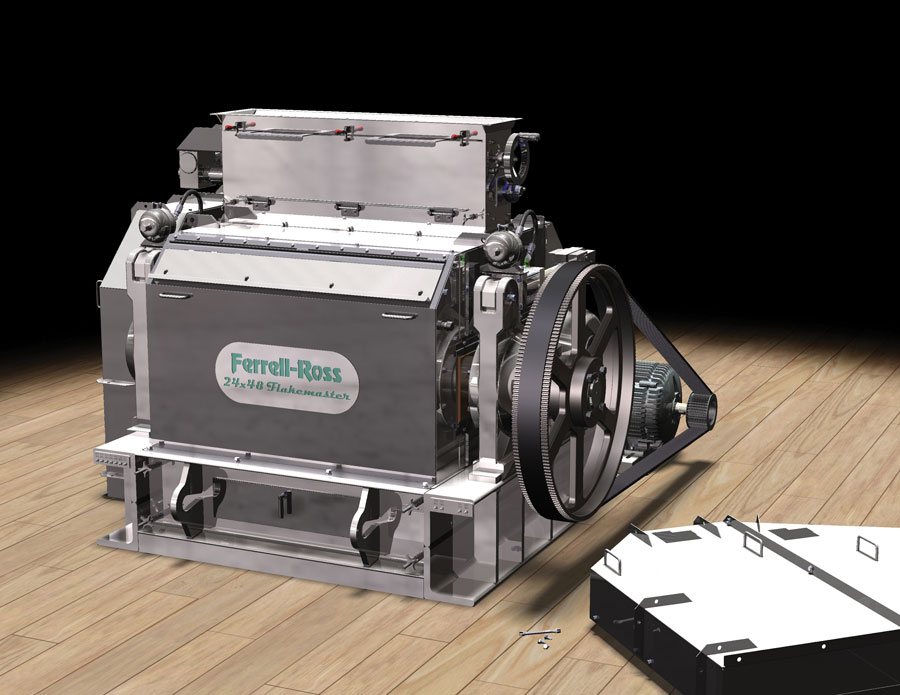
The flakes in corn flakes, the toffee in chocolate bars and the oats in porridge have all probably been flattened, rolled or otherwise processed by equipment from A.T. Ferrell.
The Indiana-based parent company has been serving the agricultural, food and industrial markets since 1869, manufacturing rollers, flakers, and cracking mills responsible for producing some of the world’s biggest brand breakfast cereals.

A.T. Ferrell design engineer and CAD manager, Allen Gager, is currently working on a new high capacity cracking mill to be used for cracking the shelled grains.

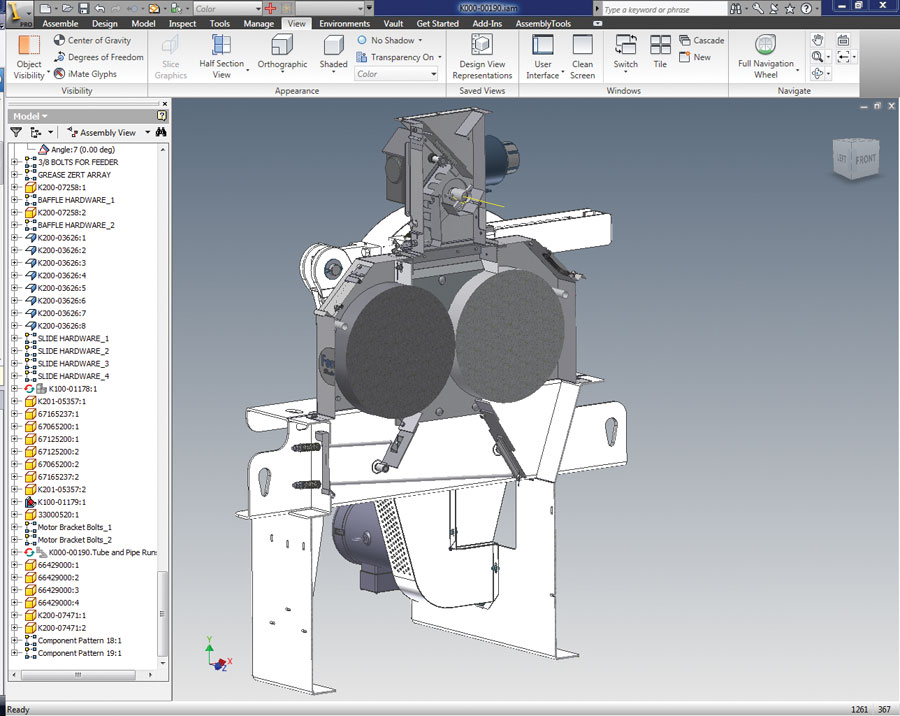
The team works with Autodesk Inventor, using its parametric modelling and finite element analysis capabilities to design machines that can work under high-pressure conditions while meeting all the necessary tolerance requirements.

According to Allen, with livestock prices falling and grain costs rising, the performance of the machine is critical to the end user. “Our products are engineered to be reliable and perform year after year,” he says, adding that by using a 3D CAD model the design team knows how a mill will perform before it is built.
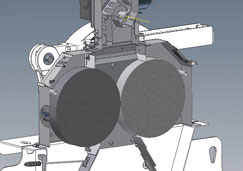
“Using Inventor software to create a 3D digital prototype means we no longer have to cut metal to prove the feasibility of a design,” continues Allen, stating that by modelling the product they save greatly in getting the product to manufacture.

“It would be safe to say the design cycle of these projects is cut in half as a result of working in 3D.”

Additionally Allen and his team use Autodesk Vault Workgroup as a means to keep track of the design process and to improve the ability to reuse designs and components.

Overall this speeds up the development of new products and ensures that breakfast is on the table.

www.atferrell.com


Best of lock

Fortress Interlocks designs and manufactures safety access systems from its new factory base in Wolverhampton.
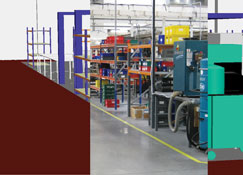
Far from everyday locks, these are for industrial situations such as switchgear, nuclear power stations and automotive plants - all of which are hand built in a prebuilt factory building along an assembly line, the layout for which was proven in 3D.

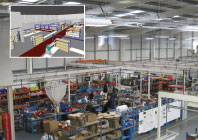
“We did the layout in the traditional way, with bits of paper, then that was transferred into 3D CAD where we could do a fly through video so we could get an appreciation of what the place would look like,” says operations director Simon Bailey.

Using Pro/Engineer, the same system used to build the product models, the team sets about transforming the 2D sketches into a 3D model. This was rendered in the same program, and a flythrough video was produced.

It was key to make the workplace organised and comfortable for the staff to move into. “When you’re moving factory, it’s the getting the shop floor people involved in the process [that’s important],” says Simon.

“You have to have some way to show them what they’re going to get, in a way that they can understand.” The flythrough proved key in helping decide on the workflow layout of the shop floor and the series of benches that form the assembly line.

The new factory is now up and running, and with all workflows previewed in a 3D model the company was locked in and ready to begin production with the minimum of disruption.

www.fortressinterlocks.com


From the ground up

Hyde Group is a key post-production component supplier for the aerospace industry, using 3D CAD models not just to build parts but also the entire factory process.

Supplying Airbus, BAES, and Rolls-Royce, the firm builds composite materials for ‘future wing design and development’, with techniques developed to create single-piece wings up to 20 metres in length.
The skills and capability to design and manufacture in composite materials are vital in the aerospace industry, so a bespoke engineering solution is needed to meet the challenges the material poses and the growing demand.
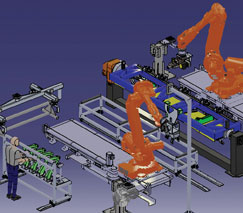
“Traditional build systems used for aluminium wings are unworkable for carbon fibre wings so a modular approach, using robot technology and ‘off-the-shelf’ automotive-style flowline solutions, is being perfected for this application,” explains Hyde Group technical director Richard Waring.

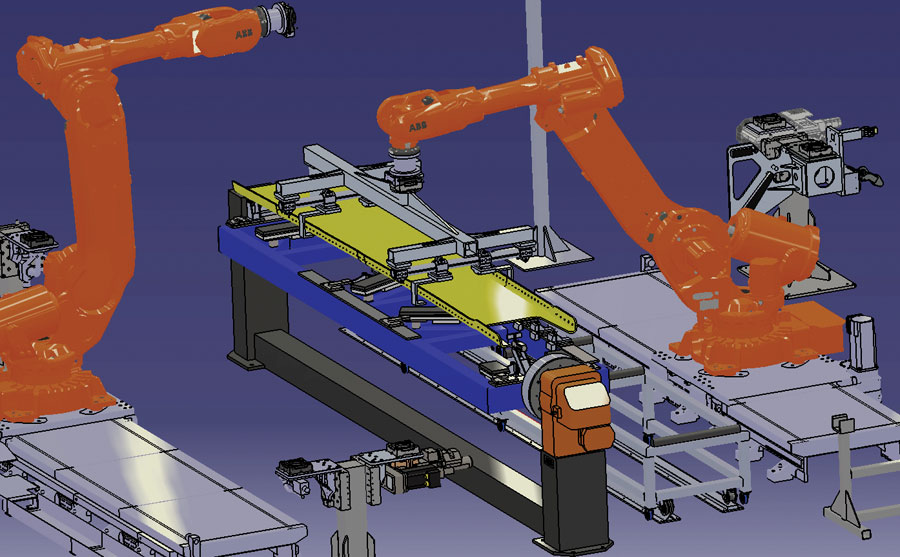
The company works with Dassault Systèmes’ Delmia software in order to design a factory floor in 3D that can fully simulate a process of robotic systems and human input capable of producing 40 sets of wings per month.

“Pulsed manufacturing methods are optimised using Delmia V5 R19 and Delmia Automation with component handling and mechanical operations fully modelled and simulated in kinematic 3D. By taking a modular approach, using robotic systems, manufacturing flowlines are developed.

“Operational sequencing and full simulation of robotic activity allows us to programme the robots and indeed design the whole flowline at the outset of product design,” says Richard.

Production programming, as part of a full design process, means that costs and waste are minimised, and helps ensure that the as yet to be built factory need not take up any more space than needed.
This all-encompassing approach means that 3D CAD models are literally used from the initial product part designs, right down to the factory floor they are to be built on.

www.hydegroup.com
Comments on this article:

Collapsing star

10 March 2010

Process types: Design and Manufacture

Folding bike specialist, Brompton takes a hands-on approach when manufacturing its legendary two-wheelers. Frances Corbett took a trip to old London town to find out how the star of British manufacturing does it.

It’s becoming a rarity to find a company that both designs and manufactures in the UK and rarer still for it to have a West London postcode.

But, from a 2,000m2 site located in walking distance of Chiswick high street, folding bike specialist, Brompton now produces over 26,000 bicycles a year.

A whole world of colour, the Brompton bicycles are an attractive choice for commuters

From brazers, assemblers, office workers, designers and engineers, over 100 staff from all over the London area come to the site everyday to play their part in building a bicycle from scratch, and most arrive on the machines they build. And with over three quarters of a bicycle’s 1,200 components being unique to Brompton, the company also has to design and build the machines, tools and fixtures needed to manufacture these unique parts, including over 500 purpose-made press tools, moulds, braze jigs and assembly fixtures.

The brainchild of Andrew Ritchie, Brompton has had a tumultuous past but 30 years on from the first prototypes, over 175,000 Bromptons have now been sold worldwide and the company remains true to its philosophy of providing people with a personal transport solution that allows them to rethink how they get around.

Although there are other folding bicycles on the market, there are none quite like the Brompton - a full-sized, robust yet agile steel frame that can be easily and quickly converted into a compact, portable package. In fact, with a little practice, the Brompton can be folded in 10 to 20 seconds. Then, weighing just 9kg to 12.5kgs (depending on the model and configuration), it can be easily picked up and carried onto a train or into work to be placed under a desk or in a cupboard until the journey home.

Up until the year 2000 Ritchie was not only Brompton’s managing director but also its chief designer. The company’s second designer was employed shortly after Sturmey Archer, the Nottingham-based hub gear manufacturer, was forced into bankruptcy in September 2000. This had a profound effect on Brompton as it relied on Sturmey Archer’s three and five speed hub gears, which were fitted to every Brompton model. Fortunately, a new hub gear manufacturer was found - SRAM in Germany - but in order to buy time to reengineer the bicycles around it, Ritchie went over to Nottingham to secure as many Sturmey hubs as he could.

“I had been at Sturmey Archer for 13 and a half years in total when I was laid off,” says Steve Rickels, who at that time was Sturmey Archer’s design manager. “I met Andrew Ritchie in the car park when he came to pick up the last of the gear hubs and he asked whether I wanted a job.” Rickels of course said yes and ten years later he is still Brompton’s design manager and heads up a design department that now consists of four designers.

The digital dawn

When Rickels first started, his primary task was to convert all the drawings into CAD. “Initially all the drawings for the original bicycle were all done on tracing paper,” he says. “I redrew a lot of these in AutoCAD and Mechanical Desktop because that is what I knew and had used in the past.” However, a year and a half ago with more designers on board, which ultimately meant more software licenses, and the fact that Autodesk was no longer supporting Mechanical Desktop, Rickels had to find new CAD software.

“We had to abandon Mechanical Desktop because it was an obsolete programme,” he explains. “We had basically set ourselves a choice of either SolidWorks or Inventor. In the end, after a lot of debating, we decided that the best thing to do would be to go with SolidWorks because we felt that more of our suppliers were using it.”
SolidWorks is now used at Brompton for designing new components, redrawing the bicycle and converting all the old Mechanical Desktop files over to SolidWorks, and also designing specialist tooling and equipment for the factory.

Small steps

The principle of the folding bicycle Ritchie conceived over 30 years ago is more or less the same today however, the design has evolved year on year through a continuous process of small incremental steps. An example of such a step was the creation of the rear frame clip a few years back.

Previously, without this feature the rear wheel would just fall down whenever the unfolded bike was picked up. Although many Brompton users liked this as it enabled them to park their bicycle instantly, others found it disconcerting. They would prefer that the rear frame was attached in some way as it would make them feel more comfortable whilst riding it and also for it to remain in one piece when picked up.

As a rule, the company refuses to design obsolescence into its bikes, so this meant that any new improvement had to be capable of being retrofitted to older Bromptons. “Lots of people had been asking us for a rear frame clip and we knew that as soon as we did this there would be a lot of pent up demand for people to retrofit it to their old bike. So it was key that this feature had to be retrofittable,” says Rickels.

Rickels worked on creating a rear frame clip that would give the choice of either latch mode or non-latch mode, depending on the user’s preference. The solution he came up with was to design a recess into the rear suspension block. When the block was turned so that the recess was on the bottom, the clip would automatically engage. For non-latch mode, the user simply turns the block through a quarter turn so that the recess is in a different place and so no longer engages.

“The beauty with this design is that the Brompton owner can have both the original design as well as the new design all in one part,” says Rickels, explaining that in order to create an elegant solution he used CAD (at this time they were still using Mechanical Desktop). “Obviously this was easier to do in CAD than it was to do on a drawing board,” he comments. “Once we had decided on a CAD model we were able to get an ABS plastic rapid prototype made by sending the CAD files to our plastic moulders. Although the prototype was not a perfect finish, it’s functional and we can get a much better feel for how it would look.”

The rear frame clip is now available on all new Bromptons and any owners who wish to fit it to their old models can purchase a retrofit kit. “This is a good example of a small incremental step to some extent. It’s an improvement to the design and it didn’t add any weight in the end, or just a couple of grams overall,” says Rickels.

Giant leaps

The evolutionary design process that Brompton employs is occasionally boosted by some fundamental improvements. Over the past few years one of these changes has been the reengineering of the hinge on the mainframe into a malleable casting. This also allowed the wheelbase to be extended by a few centimetres and as such, increase the stability of the ride. However, such a major change to the bicycle also meant retooling and redesigning the brazing jigs as they are not generic. “You just change one thing and it’s a domino effect all the way down - you have to sort everything out,” comments Rickels.

Brompton’s jigs are crucial because without them the brazers can’t perform the high quality craftsmanship that the company is renowned for. As opposed to the more common practice of welding, brazing is a highly-skilled and labour intensive process. Using a gas flame, a filler metal (in this case a brass compound) is heated to melting temperature and distributed between two or more close-fitting steel parts to join them without deformation. Due to the folding nature of the bicycles, many of its joins are highly technical and consequently, it can take up to two years for a brazer to be competent in all aspects of Brompton frame building.

In order to showcase its brazing craftsmanship, six years ago Brompton decided to go to a bike show to exhibit a model that was just a steel frame painted in a transparent lacquer so visitors could see the neat brazing on the joins. Although, it wasn’t its intention, Brompton started taking orders for this bicycle at the show and today it is one of their more popular models, despite the fact that people have to pay a premium for the attention that has to be paid to the frame during production.

Tooled up

Much of the tooling, including the brazing jigs, are unique to Brompton so they are all designed in-house. “We have changed the jigs over the years to improve them as we have learnt. Sometimes combining more than one brazing operation on one jig,” says Rickels. He and one of the other designers are currently working full time on tool design and have recently designed a brazing fixture in SolidWorks for a new auto braze machine.

“To some extent the jigs are where a great deal of the expertise is because anybody could go buy a Brompton bicycle, measure it and try and produce a copy. But without the tooling for the brazing and everything else they are going to find it difficult to make an accurate bike just by doing it by hand,” says Rickels. Additionally, it would be difficult to imitate because with all the different components in a folding bike, they have to work to very tight tolerances (most of the time 0.1mm) in order to ensure the highly accurate frame alignment.

As Brompton has currently more demand than it can build, the company is looking to reorganise the factory in order to optimise the space and increase production. At the moment all the brazers are located on one side of the factory building the frames. Once these frames return from being painted by an outside company, they are then put on trolleys with all the other components needed to build ten bikes and wheeled over to the bike builders on the other side of the factory.

Each bike builder can build between 15 to 20 bikes a day, which equals roughly 120 bikes in total. However, in order to reach their goal of producing 35,000 bikes this coming year the manufacturing team is planning to move from batch towards cellular production. This form of lean manufacturing means that the factory floor will be arranged into semi-autonomous and multi-skilled teams, or work cells. So, instead of having all the brazers in one place, they will be in different cells that make the entire front frame, rear frame, handle bar supports and so on. The idea is that the jobs are split up a lot more and bikes will be constantly moving through.

Despite the modernisation of its manufacturing process, Brompton will continue to take pride in every bike it makes, and although one of its folding bicycles will set you back around £700, you can be sure that you are investing in a rare piece of true British hand-built craftsmanship.

www.brompton.co.uk

Comments on this article:

Weapons grade fakery

09 March 2010

Process types: Design and Prototype

Ever wondered where the defence industry goes to buy ‘day clothes’ for its weapons? Stephen Holmes cuts through the red tape to find a model maker in the East Midlands with military connections

At the world’s largest defence and security exhibition, DSEi, held at the London Excel centre, two giant halls display everything from tanks and armoured personnel carriers to helicopters and howitzers.

These are the biggest and baddest of all boys’ toys, but not everything is as it first appears. Nestled in-between the weapons on display are some imposters. And despite their fierce looks, the only harm these replicas could cause would be if you dropped them on your foot.

‘Weaponry fakes’ are becoming big business. Under the Section Five Firearms Act, displaying the real thing in public means cutting through reels and reels of red tape and this leaves costs prohibitively high. Armed security is a must, as is the production and de-activation of the actual weapon, and when all the required form filling is taken into account, this adds up to tens of thousands of pounds. As a result, many weapons manufacturers are turning to John Lawson Ltd to produce dummy models, which cost a fraction of the price and take up considerably less time.

Military connections

A former armaments technician in the Royal Air Force, John left the military in 1984, setting up his own firm to make model cars and motorcycles, which eventually moved into model armaments and defence.

“It’s a bit of a niche market that I’ve got prior knowledge of and a fundamental understanding of the equipment,” says John in a Scottish accent that belies his Midlands location. “The chances of them finding someone in the world that’s a trained armourer and understands the equipment intimately, and is also a model maker, is nil! That makes customers comfortable. They like that I understand what they’re talking about and the various subtleties of their designs.”

Attention to detail

For many of the pieces that John Lawson produces maintaining the security of technical details is paramount.

Typically, on receiving the full CAD model, it is translated into SolidWorks, usually from defence industry staples like NX or Pro/E. The models are broken down into different sections to be built at different workshops, with the model maker having little idea what the finished part will be used in.

“Sometimes with some of the larger models because of technical regulations we have to simplify technical details so that you’re not giving away any technical aspects of the machinery,” says John.

“We’ve got to look at the ‘thing’ and decide, if someone wanted to copy this, what measurements would they want to take?” So we will deliberately confuse a measurement, or put it a different way, or block up an aperture or create a new one. So that it still resembles the full sized equipment but nobody could use it to learn or copy from it.”

“The M621 in particular was what’s known as a ‘space envelope’, so there were no internals to it at all,” says John referring to a 20mm cannon used on light vehicles. “All we’d literally done is bolted on the outside a mechanism whereby you could attach the feed belts to it to make it look real. This was added onto a turret, which was then put on top of a tank, and suddenly the whole thing looks the part.”

Scaling things back

John Lawson’s model making is not exclusively reserved for fearsome, life-size pieces, and it is often the case for scaled pieces to be made for dioramas, presentations, or gifts.

Every industry is different and each has its own challenges, explains John as he proceeds to give an example of the model ships and submarines he produces for firms such as Qinetiq. “Ships are an odd one, in that a lot of the ship design guys use Rhino for creating the surfacing because it’s a surfacing program.”

He goes onto explain that this sometimes leads to file conversion problems, but in the case of Qinetiq the model is transformed into Parasolid using Qinetiq’s naval architecture design and analysis software, ParaMarine. Then it can then be easily transferred to SolidWorks and broken into the required sections to be built.

Model development

Rapid prototyping plays an important part in the model development, to the extent that the firm is looking to expand its use of Fused Deposition Modelling, a process that can be used to create moulds for fibreglass ship hulls, and detailed parts for scale models.

All of the models have to be built for sustained travel - be it to a trade show, a director’s office, or to a meeting of engineers all across the world. “They’ve got to be tough,” says John. “They’ve got to be able to stand-up to the rigours of airline and ship travel, so we use a variety of materials.”

Design discussion
Recently the company has been producing engineering models of rigs for global mining companies. As tools for discussion they provide valuable information as they are built from the same 3D CAD data as the real thing, and can often throw up information that can help the design of the full scale product, such as clash detections or weight imbalances. Plus, they provide an excellent icebreaker.
“If you plonk that in the middle of the boardroom table before you start your discussions there’s a little bit of ‘the little boy’ in all of us. Even the most stern chief executive is going to be fascinated by a little detailed model,” jokes John.

Taking in the complexity of the models in John Lawson’s workshop it’s clear that these aren’t toys. But from the look of awe on the faces of onlookers it would seem that the ‘little boy’ in all of us still find big guns exciting, even if what we’re looking at isn’t as lethal as first thought.

www.jlawson.com

Comments on this article:

Latest D3D jobs

Design Engineer

Thu, 09 Feb 2012 07:32:39 +0000

Design Specialist/Engineer

Thu, 09 Feb 2012 07:30:23 +0000

CAD / CAM PROGRAMMER

Thu, 09 Feb 2012 07:09:07 +0000

Project Design Engineer

Mon, 06 Feb 2012 10:44:52 +0000

Tags for
this article