Black box recorder
24 June 2010
Process type:
New technology has audiophiles clambering for the best hi-fi equipment, but in order keep working to its luxurious peak the Naim HDX has employed some crafty thermal design.
Audiophiles are forever harking back to a time of warm, smooth bass tones and clear top notes, and will usually spend top dollar in pursuing it from today’s modern hi-fi equipment.
The HDX component hard drive: 500Gb of bit-perfect, CD quality sound storage, is designed by Naim, a high-end audio equipment firm that does a fine line in serious audio systems that cost roughly the same as a nice car (incidentally, on the side, Naim also fit out nice Bentleys with audio systems).

Luxury sound quality at it’s coolest
Although clothed in a rather charmless-looking black box, the HDX is trying to help with the mammoth task of motivating thousands of middle-aged men into giving up their giant vinyl and CD collections and transferring their beloved LPs into MP3s, without harming the sound quality.
It’s no looker, but on the inside it is a marvel of design and electronic engineering in a business where the quality of the sound counts.
Sold worldwide, in a variety of climates (I’m guessing mansions in tropical paradises) keeping the hard-drive at a relatively constant temperature was the main challenge for the team of 30 designers at Naim’s headquarters in Salisbury.
“We had to be very conscious of the temperature inside the unit,” says Paul Neville, Naim’s audio mechanical design manager. “Hard drives have a temperature they like to turn at, and it reduces their life expectancy if they run too hot. The bearings wear out, for example.
“The HDX was our first product with a hard drive, and it also has significantly more software than anything else we’ve designed. A complex product means more electronics, and more electronics generate more heat. At the same time, they reduce the amount of room in the unit that allows heat to circulate through.”
As a result, thermal analysis was key to the design.
Naim used SolidWorks Flow Simulation, taking a CAD model of the HDX as a starting point to create a thermal analysis. The model enabled them to predict the flow patterns and maximum temperatures inside the HDX.
Designers modified the CAD models in response to the thermal analysis, then ran another analysis to ensure the modification would work.

Using SolidWorks Flow Simulation Naim saved the time and cost of building ten physical prototypes
It also worked well for giving comparative solutions. “If we changed the material or thickness of a heat sink, we would run another analysis to see what effect that had on key components,” explains Paul. “Otherwise, we would have had to use physical prototypes, and that would have taken a lot of time.”
By testing 10 different scenarios in the CAD model the HDX design needed only two physical prototypes to verify the thermal results. As Paul points out: “If not for the software, we would have needed 10 prototypes.”
Using the results as a guide, Naim settled on a design that includes a 5mm thick aluminum product case that provides a built-in heat sink for the components and a path to remove heat from product. Components were mounted to the case so their heat would radiate out of the product.
Designers moved the primary hard drive close to the cover to shorten the path heat had to travel to get outside, and the internal air flow keeps the fan off unless the temperature rises above 25C.
Here at DEVELOP3D we’ll be ordering one for when we open our new offices in Mauritius.
Comments on this article:
Cutting it fine
23 June 2010
Process types: Collaborate, Design and Manufacture
Manufacturing close to 300,000 components each month, time is money for Kobe Aluminum Automotive Products (KAAP). With the help of Delcam PowerMill, the company was able to decrease the machining time of its dies by 40%
Automotive manufacturers are using increasing quantities of aluminium forgings for their suspension systems in order to reduce weight and increase mileage.
In 2005, Kobe Aluminum Automotive Products (KAAP) started production in Kentucky to help meet this demand. It now manufactures around 280,000 components each month. The company’s customers
include some of North America’s major automotive companies.

PowerMill simulations show the surface finish that will be achieved in the final die
KAAP’s greatest programming challenges are closed forging dies. These dies are used to produce parts with geometry ranging from simple to complex shapes, such as a half metre long link that starts
off shaped somewhat like a baseball bat, tapering down over its length to meet a larger diameter end. The end itself has a number of different radii that blend into each other.
“We were able to program these parts with the CNC software that we used in the past even though it was not very intuitive,” recalls Victor Steele, tool shop manager for KAAP. “Roughing operations
were relatively slow because the tools spent much of their time cutting air.” The most efficient way to rough out a forging die is to start with a large tool and use it to cut as much of the cavity as possible.
Then, you switch to the next size smaller tool and again cut as much of the cavity as possible.

Final machined closed forging die
The problem with KAAP’s previous software was that each successive cutter traced the complete path of the part profile even when there was nothing for it to cut, either because the section had already
been finished or because the cutter was too large.
Kobe Steel’s Japanese operations had successfully programmed this type of die with PowerMill and recommended that KAAP try the Delcam software. “One of Kobe Steel’s programmers from Japan
visited us and showed us how to use PowerMill,” said David Taylor, engineer for KAAP. “Despite his limited English he was able to teach us how to use the program without a great deal of difficulty. We liked the way the user interface is laid out.”
Later, KAAP programmers had two days of on-site instruction provided by the local Delcam reseller, Design and Software.
“As we got to know the software in more detail, we were impressed with the large number of powerful machining strategies that it offers to help optimise cycle time and accuracy of machining operations,”
Mr. Taylor added.
“The big difference with PowerMill is that you can generate a stock model of the material left from the previous tool,” explained Mr. Taylor. “The software compares the material that is left on the workpiece with the geometry of the next tool and determines the areas of the part that it is capable of cutting. PowerMill then produces a toolpath that rapidly traverses directly to the areas that can be cut by the tool while skipping areas where there is nothing it can cut.”
“These rest machining capabilities save us a considerable amount of time, reducing cycle time by 40% to 45%,” Mr. Taylor explains.
“It now takes about 24 hours to machine a complete die or about two hours to machine a die repair.”
KAAP has also benefitted from PowerMill’s simulation capabilities. The software provides fully integrated simulation and collision detection, to ensure the CNC program is both safe and efficient, and also to predict axis reversals and surface quality.
“PowerMill has helped us substantially improve the efficiency of our machine shop operations,” Mr Steele concludes. “We have been able to substantially reduce the time required to machine dies and greatly reduced handfinishing times. The software is also much easier to use which saves time in training additional programmers.”
Comments on this article:
Cleaning up with RP
16 June 2010
Process types: Collaborate and Design
A specialist manufacturer of plumbing products is using 3D printing to help its clients create exclusive one-of-a-kind high-end bathroom fittings
Avid viewers of the BBC TV show Grand Designs will know that bathrooms matter. The room is a canvas for architects and interior designers to showcase their talents in a way that helps set a property apart from the pack.
More fundamentally though, the bathroom “experience” is a critical factor in the discriminating consumer’s willingness to spend and select one property over another.

Symmons Design Studio was used to create the tap fittings for Boston’s Four Seasons hotel
For these reasons, the humble bathroom fittings – the taps, the showerhead, the doorknob – are far too important to overlook when building or re-modelling hotels and luxury homes. Property owners are increasingly demanding oneof-a-kind fittings to deliver a unique experience.
Symmons Industries, a 70-year-old manufacturer of plumbing products, has long served this market with custom design and manufacturing services. The company broke new ground with the launch of a first-of-its-kind virtual design studio for architects, designers and property owners, called Design Studio Live (live.symmons.com).
Design Studio Live is a Web-based program that allows users to create their own products and receive colour 3D physical concepts of their designs within four days, metal prototypes in approximately 15 days, and delivered product for their property in as little as 16 weeks. With the help of this innovative new tool, architects and designers can create unique ideas that translate into exclusive fittings for their
projects right from their desks. Users can begin by digitally paging through a virtual catalog of ready-made designs, dragging them to a virtual light box, and modifying them with Google SketchUp, Adobe Photoshop, SolidWorks, or any other 3D CAD program.
Symmons design consultants are available for program guidance or design advice. However, users are encouraged to experiment as much as they’d like because the tool is designed to encourage reativity.
Physical attraction
Critical to the Design Studio Live formula is the ability to quickly and affordably churn out 3D physical models at high volumes. With this demand, handcrafting models was out of the question due to the time and labour involved. For Symmons, a 3D printer was the answer.
The company had invested in a 3D printer long before Design Studio Live was conceived, but its design consultants only used it intermittently because they had to wait some time for a part to be built. A single tap fitting took 15 hours to print, says Eric Spear, Symmons’ director of custom services. With Z Corporation’s Spectrum Z510 Symmons found it was able to print 12 models in 3.5 hours.This gave it sufficient throughput to create 3D models on demand.

3D printing has helped Symmons more effectively communicate a range of exclusive designs to its clients
“The design process itself is exciting, but there comes a point when it’s really helpful to see a tangible, physical example of it,” says Spear. “By ZPrinting 3D models, designers can stop looking at their screens and see what the part really looks like in context and feels like in their hands.”
The physical 3D models also strengthen the relationship between an architect and a property owner. “Architects can slide a set of ZPrints across the table – perhaps faucets [taps] of different sizes and shapes – along with a red pencil,” says Spear. “The property owner gets a rare opportunity to handle the models and mark them up. The architect comes back with revised models a couple of days later, and the owner is blown away by the architect’s responsiveness.”
Sitting pretty
3D printing has helped enable Symmons to show off its design capabilities. For example, the Mandarin Oriental, New York wanted a distinctive look and feel for its bathrooms, and its design firm turned to Symmons to help create the details of the design. The bath design called for a shower system that incorporated fittings with a ceiling-mount drench showerhead and a Roman tub filler that was both stylish and simple to operate. Symmons developed custom concepts for its client with an elegantly simple, single control for on/off, hot/cold operation, a feature that helped to overcome the language barrier many international guests experience. ZPrints helped Symmons communicate a range of options to the client, which enabled the team to quickly close on a final solution.

Z Corporation ZPrinter 510
Symmons prints at full tilt five days a week, 20 models a run, according to Spears. In the first four months of use, it produced 4,000 3D prints for a wide range of applications. Most were for client projects, but models also went to tradeshows, “lunch and learn” seminars with designers and architects, and to Symmons’ industrial designers.
The colour capabilities of the ZPrinter are also being exploited and Symmons uses them to accurately represent the popular finish of Onyx. Colour prints also make great promotional handouts – for instance, a brightly coloured model of a tap fitting with an architect’s name on it.
Concluding, Spear says, “It’s a great experience to be the first in market to do this. Our unique ability to host a fullservice virtual design studio with 3D printing capabilities, and do it so painlessly, is a real differentiator and a powerful one that keeps us in top of mind to our clients. Z Corp’s unique speed, colour and affordability make this possible.”
www.symmons.com
www.zcorp.com
Comments on this article:
Oh baby!
14 June 2010
Process types: Design and Prototype
From high chairs and car seats to transforming prams, Stephen Holmes checks out the latest products designed to keep babies safe from harm and most importantly out of mischief!
Pram-tastic!

The Mylo begins with a baby’s carrycot, before adapting into a pram then pushcahir as the child develops
Prams have come a long way since the chrome-plated juggernauts pushed around by Mary Poppins and now serve as uber-functional, consumer friendly modern products.
A great example is the Mylo from Mamas & Papas, whose chassis can wheel around a baby’s carrycot in the early days and then transform into a pushchair as the child grows.
This overhaul of the traditional pram design and its re-imaging as a ‘baby transport solution’ was the first product overseen by Amanda Scacchetti, the eldest daughter of company founders David and Luisa.

The design is an interchangeable parenting marvel
Working with design consultancy DCA, the brief was for a pram that puts the baby at centre stage and designing from the seat and carrycot outwards, rather than from the frame in – making the comfort of the baby a priority.
“Working from a brief, the team at DCA ran a scoping exercise to explore new manufacturing methods as well as understanding the needs of consumers and users,” says Amanda.
“Once the concept was approved, the team began to design and ‘CAD’ each component, and our internal design team designed the soft seat and all the fabric accessories.”
The sketches were transformed into SolidWorks models where testing using Cosmos could take place.
“When designing a pushchair every aspect is interlinked,” explains DCA creative director, Nick Mival. “So what might seem the smallest visual change may stop the product folding up.
“Using SolidWorks enabled our engineering team to constantly check the pushchair functionality in a virtual environment as well as through real prototyping.”
The ‘real’ prototyping was at the heart of getting the product to market. “From early ‘pins’n’pipecleaners’ creative workshop tools through many iterations of FDM prints and SLS components, to very advanced prototyping of two hundred components in material correct components. At DCA prototyping is at the heart of what we do, literally the workshop is in the centre of the building!”
The end product is an interchangeable parenting marvel that still adheres to Mamas & Papas’ design ethic.
As Amanda puts it: “Mamas & Papas do not adhere to the belief that aesthetically driven individuals will abdicate their good taste and style values once the hormones are flowing and a baby arrives.”
Precious cargo
Transporting an infant in the family hatchback is the stuff of nightmares for most parents, which is why a secure baby seat is key.
The key brief for designers is to provide a secure shell and restraints in the case of an accident, but the seat must also be comfortable enough for a child to travel in.
The Britax Baby-Safe Plus SHR II has all this in place and more, with special attention paid to impact zones, and the threat posed by a collision to the seat from the side.

A key feature of the Baby-Safe Plus SHR II is a device called ‘D-SIP’ which significantly improves restraint performance on side impact
“The hero feature introduced on the Baby-Safe Plus SHR II is a device called ‘D-SIP’ which improves restraint performance on side impact significantly,” explains Richard Frank, Britax European engineering director, from its design centre in Germany.
“By having that technology in place, the kinematics of the child restraint system and the baby is much better controlled. By having the system being linked to the car’s accelerations and crash phases, delta velocities of the system to the car and intruding door are kept at a minimum.
“At the same time, the D-SIP transfers and distributes forces generated by the applied acceleration and system masses more beneficial to the structure of the Baby Safe shell to avoid load spots and stress areas on product and child.”
Before any designs take shape a clear target-related brief is drawn up based on analysis of existing products, respective behaviour and test results on different side impact load cases.
Catia V5, supported by Rhino, enabled the majority of the modelling, but it was the virtual analysis using Madymo and LS Dyna simulation tools that really progressed the seat’s development.
“All tools and methodology applied are kind of standards in automotive, specifically in fields of restraint systems,” says Richard. “Computer aided engineering was key for analysis and evaluation of key changes and validation of component and product design.
“By having the load cases/environment validated by a number of tests the accuracy of the simulation result versus hardware test has got a very satisfactory level of about 2% - 5% deviation.”
It takes a lot of engineering, calculations and testing to ensure that your baby’s seat is the most protected in the vehicle and your precious cargo is safe and sound.
Cradle to behave design
An infant squealing with delight as food is flung from a highchair is a demon best avoided – but at what age should the little angels be placed in one?

Drawing inspriation from classic furniture design bloom’s fresco highchair is able to safely cradle a baby straight from birth
This was one of the questions facing bloom, a business started by four dads who felt that products designed for their children hadn’t changed in 20 years, and lacked the innovation and progress of other consumer products.
Through research bloom found that an infant should be using a highchair at around six months old when babies’ necks are sufficiently developed to hold their heads up properly. However most parents actually buy the highchair when the child is only three months old. so the dads set out to design a highchair that would safely cradle the baby and be usable straight from birth.
“The design leads have quite a lot of experience in designing products for the world’s top brands,” says Jon Lake, co-founder, bloom, in relation to his company’s fresco chair. “In this case, they move quite quickly from rough pencil thumbnail sketches to CAD modelling, the modern 3D sketching tool.”
Instead of choosing the cheap vinyl and plastic covered tubing common with most baby chairs bloom’s designers looked to establish their own aesthetic drawing on the work of the past decades from design greats such as Ray and Charles Eames, Verner Panton, and Eero Saarinen.
Working with Alias, Pro/Engineer, Solidworks, and Rhino – whatever each designer was most comfortable with – the chair was first modelled, and then a wide variety of rapid prototyping techniques were used to build a working chair to help solve ergonomic issues.
“Children grow very fast so there is a broad range for the typical life of a product,” explains Jon “Getting the very best fit usually requires quite a lot of testing and evaluation.
“After using ergonomic models, we also check with a variety of kids. Fortunately, we have a large pool to select from: our own children are our most popular test subjects!”
The end product helps include babies in the social areas of the home - as a cot from its first days, straight through to a launch pad for flinging yoghurt months later.
Comments on this article:
Fast track to China
11 June 2010
Process types: Design, Prototype and Visualise
From its small studio in Norwich, UK, Product Resolutions is hands on in the entire product development process from concept to manufacture. Tanya Weaver discovered how it makes its strong relationships with Chinese manufacturing firms work to its advantage
For a design consultancy with such a vast and varied international client base it’s amazing that Product Resolutions works out of a small studio located in Norwich’s city centre.
With only a handful of computers and not a single piece of prototyping equipment or machine tool in sight the firm undertakes the full design and development of dozens of products each year.

Product Resolutions worked on the recently launched Scalextric Start system
Its business model combines in-house design skills with the technical and manufacturing expertise of Chinese suppliers in order to create commercially successful new products. “Our unique approach as a design consultancy is to consider every aspect of bringing a product to market: covering not only function and aesthetics, but also ease of manufacture and product profitability,” explains Product Resolution’s director, Nick Harvey.
Fellow director, Paul Robbins, lived and worked in Hong Kong and China for seven years prior to setting up Product Resolutions in 2000. It was when he was working at the first independent western design consultancy to be set up in Hong Kong, which was helping UK companies looking to manufacture in China, that he saw the opportunity of doing exactly that, but from the UK.
He felt that he could establish a UK design business that would really set itself apart as a consultancy that had a fresh approach to creating new products. “I saw the opportunity to have all the creativity and innovation that is associated with UK design but present it so that it is ready for manufacture,” he explains. “So, it would take into account the cost constraints in terms of tooling but also the engineering of the product so that it fits with Chinese manufacturing.

Product Resolution’s director, Nick Harvey visiting a supplier factory in China
“Our approach in terms of combining the creativity but with the technical knowledge has always been our USP. Even now many design consultancies say that they can work in China but it’s often nearly always through a joint venture or agency set up, whereas we talk directly to Chinese factories and suppliers every day,” he adds.
Celebrating its tenth anniversary this year, the company has designed and developed a wide range of products from consumer electronics and medical devices to toys and cycling accessories for a variety of clients, which also include lone inventors who need assistance in both developing their ideas and sourcing manufacturing.
As Product Resolutions is capable of managing an entire project from the very beginning right to the very end, they tend to fit well with a certain type of business who requires them to work on a project from concept through to a minimum of production level data.
“We have quite an influence on our client’s design process,” says Robbins. “We especially tend to fit well with businesses that haven’t used design before.”
For instance, Product Resolutions has been working with Lumie, a European specialist in light therapy, for seven years and with each project is involved from initial concept stage right through to manufacturing liaison. Hornby is also a long-term client and although it has its own in-house design resource, its team enjoys working with Product Resolutions.
Hornby not only finds the Norwich firm to be very in tune with the commercial realities of mass production but also believes that its designs are innovative and straightforward to manufacture. Projects that Product Resolutions has worked on for Hornby include the Digital Command Control system for trains and the newly launched Scalextric Start system.
From concept to development
Over the years Product Resolutions has refined a product design process that includes all the vital stages required to produce a successful design. Although, in theory, everything should run smoothly, according to Harvey, depending on the client and what they are designing for them, it very often deviates.
All projects begin with a brief, which, depending on the project, is followed by research and then a 2D concept design phase that in most instances involves presenting the client with three concepts to choose from.
The next stage is to move into 3D and produce a CAD model, including the mechanical design, using SolidWorks. Being a small team Product Resolutions feels that being able to do mechanical design in-house is very important. “
A lot of the fine tuning of a design happens at this stage and if there is an alteration to the design because a component gets changed we want to be in control of that,” explains Robbins. “So we go from sketching up concepts to drafting up screw posts and that is part of the enjoyment of the process as well.” From then on in the process China features quite heavily as most of the prototyping, tooling and manufacturing is done using Chinese suppliers and toolmakers.
The Road to China
The recent development of a controller for an electric bicycle for Hungarian company Gepida, through its UK client GPEG, perfectly showcases Product Resolutions’ ability to work efficiently with its Chinese suppliers. However, the start of this project was slightly unusual in that the consultancy received a basic CAD concept model from the client and was tasked with redesigning it so that it could be manufactured efficiently and cost-effectively. This involved not only mechanical design but also defining the PCBs and ensuring that the product would pass the IP56 waterproof rating.
From the design multiple prototypes were then made and the Chinese toolmaker produced the tooling, which involved die-casting and injection moulding. As Gepida had to have twenty prototypes ready for a bike show, the timeline for this project was very tight and Product Resolutions had three months from the start to having tooling made. “On a product like this the design process might be six to eight weeks and then tooling takes five weeks which is pretty good,” comments Robbins.
Although Product Resolutions does use UK prototyping companies including Paragon Rapid Technologies and Laser Prototypes, 90 per cent of its prototypes are made in China.
In the case of the Gepida product it knew that the Chinese supplier could use CNC machines to produce the parts needed from polycarbonate and aluminium as well as doing silk-screen printing. It could also deliver it in just five working days for a very good cost. “But it’s not just about the cost,” says Harvey, “the quality is really excellent especially as there was a lot of waterproofing issues to consider in the bicycle controller product. The prototypes are so good that you can’t tell them apart from the real thing.”
The tooling for the GPEG project was also made in China, which included die cast moulds, composite parts for the brackets, injection moulded parts and even to the point of helping to source cable lead manufacturers.
Although many UK companies find it difficult to work with Chinese manufacturing partners, according to Harvey, for them it’s a bit of a black art. It’s not so much about Robbins being able to speak Cantonese, something he learnt whilst living there, but it’s also about respecting what the toolmakers and factories do and understanding what they are good at and how they like to work.
“I wouldn’t deal with a non-English speaking factory because that would be too difficult but the suppliers we use we have known for a long time and it’s to do with the way you speak to them and how you give them information,” says Robbins.

Concept sketches of the Lumie Starter, a light emitting alarm product: Product Resolutions typically presents the client with three concepts to choose from
Communication is mostly done through Skype calls and email with Product Resolutions emailing CAD data, initially in the form of a SolidWorks eDrawing, together with clear and concise instructions. Harvey has found that it works best when all the information is given at once – a bullet point format works particularly well – and that when new information and instructions are emailed you request that previous emails are deleted as this lessens confusion.
“The key is understanding the way that they work and understanding where their skills lie and understanding where our skills lie,” says Robbins. “It’s almost like handing a project to a mechanical engineer in a way or handing over to the marketing department. In this case, they are the manufacturing department and they are really good at doing that as long as you give them the right information in the right format and follow a clear process.”
The personal touch
Although project management can be done remotely, in order to build a personal relationship with the toolmaker and factory it’s important to actually go out to China and meet them face-to-face. “I try to go over twice a year. It is definitely beneficial because it reinforces relationships with factories. I even go on the production line and talk to the people assembling the products,” says Robbins. “They like you to visit them because they are very proud of their factories and they want to show off what they have got.”

SolidWorks eDrawings are often used to communicate information to China
For Robbins another way of earning respect and ensuring a long and happy working relationship with the factory is to manage expectations very early on. For instance, he will inform the factory that a client is going to do a pilot run of 500, after that they may do a first order of 1,000 and thereafter it could gradually creep up.
With this knowledge the factory will then set their pricing accordingly. Whereas, if you hammered the factory down on price promising an order of 50,000 in the first year but then only ordering 2,000 then everyone is unhappy because the factory has had to squeeze their unit price in order to achieve this.
“Managing expectations of the factory and being really clear about where they are going to make their money is very important. Because if they don’t make money they won’t be there in a year so it’s in our interest to make sure that they are,” comments Robbins.
Strictly confidential
There is always a fear of products being copied and although confidentiality agreements are in place with all suppliers, according to Robbins it really comes down to choosing the right kind of companies to work with.
For instance, the prototyping company that Product Resolutions uses is a pure prototyping company meaning that it doesn’t offer a design service or undertakes manufacturing. “It’s the same with toolmakers,” he says. “Most of the time we use a pure toolmaker rather than a toolmaker that has an assembly factory or an electronics factory. So, our toolmaker will inject the parts and then give them to our assembly partners who only do contract manufacturing. That is one of the ways that you can protect your intellectual property because they simply don’t have the route to market to copy your product.”

Photorealistic Rendering of the Lumie Starter
Being able to work so efficiently with its Chinese suppliers has also enabled Product Resolutions to have additional income. “Most of our business is fee-based but we have set it up so that we have a mix of different income streams.
It makes the financial side much smoother because in consultancy if you are not working you are not making any money. I hate that, so we get in a situation that if we are not working we still have income coming in from other sources and this works quite well,” he adds.

Prototype of the Lumie Starter
For instance, the company earns commission for introducing a new customer to its Chinese toolmaker. “The factory is happy to pay us commission because they get new business and we are also there in the background to help if there are any problems with communication,” says Robbins.
The road ahead
Product Resolutions is now starting to do more risk and reward type projects where it will either work for reduced fees, or no fee, in return for royalties or part ownership of intellectual property. For instance, this arrangement is in place on a medical product it is currently working on that Robbins has a feeling might do very well.
It’s this unique combination of UK creativity, Chinese technical ability and manufacturing efficiency that is the real hook for Product Resolutions’ clients and keeps them coming back for more. Some future products to look out for include new 2012 Olympics licensed products, a range of audio and video products for up and coming UK brand Veho, a new child safety device and the latest in the range of Lumie Bodyclocks.
Comments on this article:
Armour up!
07 June 2010
Process types: Design and Prototype
Stephen Holmes caught up with Legacy Effects, the team responsible for bringing Iron Man’s legendary suit to the big screen

We step behind the scenes of Hollywood to find out how to build a suit fit for a superhero
With a gleaming gold and red suit of armour, pulsating with weaponry and a glowing orb set in its chest, Iron Man has returned.
The blockbuster movie of the summer is big, bright and brash; everything one would expect from the Hollywood machine pumping all it has into an action driven special effects spectacular.
Behind the world of glitz and glamour, red carpets and beautiful people is a hard working industry dealing with design issues most will never have to encounter, and that’s before we get to a superhero’s wardrobe.
Special effects are a massive part of this and none come much bigger than Legacy Effects, the progressive name for the legendary Stan Winston Studios. The projects that the company has worked on read like a list of all time great special effects films, including Terminator, Jurassic Park, and more recently Avatar.
Legacy built the suits for the original Iron Man film and the company has now followed this up with a Mark IV suit for the sequel. While Robert Downey Jr. certainly looks the part in his armoured exoskeleton, there is no Hollywood trickery when these suits are used on set.
“It was very challenging as when they film these Iron Man movies they go all the way – it’s a live action movie,” says Jason Lopes, systems engineer at Legacy Effects, fresh from finishing up another Marvel superhero movie, Thor. “They’re actually using our parts, hitting our parts, beating each other up with our products, so there’s a constant call to make more.”

Robert Downey Jr, as billionaire industrialist and master engineer, Tony Stark, AKA Iron Man
The unsung heroes
The entire process of designing and manufacturing these parts is technology driven: concept artists dive straight into 3D, CAD files are shared between the team for adjustments and editing, and rapid prototyping is used to build models from scaled down maquettes, to full size parts.
A key figure in the design team is Simon Webber, a concept artist, who via the wonders of modern technology, can be based in the UK while his compatriots work in California. Legacy works closely with the film’s director on what characters and real effects will be needed and then along with the other concept artists Weber is provided with background and sketches.
“We get notes based on the script and then we’re at a concept stage where we try out lots of varying ideas and see what lands,” says Simon. “We turn that stuff over to a director and see if anything hits the mark.
“We’re doing that three-dimensionally from the beginning, we’re not doing lots of concept art that then needs to be turned into a model or an asset later on, it’s straight into the 3D world. The changes that you make, you’re making to what will become the final asset.
“Because we’ve got experience at sculpting in the real world with clay we just go straight in with ZBrush and design it in there. It’s a quicker end result.”
Simon has over ten years of experience in practical special effects make-up, and he only moved over to digital design two years ago, but has never looked back. Now working with a Wacom tablet, using ZBrush 3.5 and Photoshop running on a Windows-driven Mac Pro, Simon is amazed at how quick and fluid the entire process is.
“It was sculpting that I was used to,” he says of the digital tools. “But I was able to illustrate from it, paint from it and you’ve then got an asset that you can do so many things with.”
The designs are sized to human proportions, and the actor who is going to wear the costume or parts is scanned in 3D so the model can be scaled to their exact proportions before any of it is built.
“The speed that you can churn out concepts and ideas, and the flexibility of being able to hand an asset over to someone and they can make changes; it’s such an editable, organic process,” continues Simon.
“You can do a design one day, then the next day you can have a bunch of parts sitting on a desk that represent that model and another day later you’ve got a full maquette in front of you, painted up that looks like your design, and a director can see it from all angles, see how he’s going to light and shoot it.”
The need for speed
The development process has been accelerated with the help of rapid prototyping techniques. First used in the production of Jurassic Park 2: The Lost World, 3D printing has since come into its own in the world of special effects.
For Iron Man 2 the team looked to Objet for its rapid production capabilities, taking on a range of printers including the Eden 260v and 500v to make sure the action-packed movie was never short of parts that were subjected to some extreme conditions on set.

Legacy Effects re-invented the way Robert Downey Jr’s chrome plated gauntlets were assembled to maximise movement
“We were responsible for the whole suits, so I did mainly the gauntlets, pieces of the boots, different pieces of the helmet and the face mask,” says Jason from Legacy’s headquarters in San Fernando, California.
“With Iron Man, the concept art was brought to us and had to be tweaked from there, and to show how to make it. A lot of these concepts, especially for the superhero genre, a physical person could not fit into a suit as such, so we’ve got the artists here and they know how to really bring the vision into reality.”
The route from concept to finished part is not always smooth and Jason had issues with the with original production gloves for Robert Downey Jr. “They just did not come out to our satisfaction the first time around and we wanted to address that,” he says.
“Once we brought the Objet in-house with its detail and accuracy we were able to redevelop our ‘gauntlets’ (what we call our gloves – the Iron Man gauntlets) and basically introduce some pretty kick-ass movement in the gloves because it’s a live-action film. So Downey Jr. had to be able to be physically able to do stuff without having the arms sacrificed.
“We re-invented the way that we assembled these gauntlets and designed them, and we were going for full gloves, which took about eighteen hours for left and right hands, to fully chrome plated, and in some instances mechanically put together in a day and used.”
With the film set located little over 20 minutes away from Legacy Effects’ design studio, and the sheer volume of action scenes in the film, you get the impression that the team was on constant call.
The list of parts goes on - pieces for Whiplash, the film’s villain played by Mickey Rourke, were printed directly for his armbands and weapons.
Back to the future
With Legacy Effects Jason has continued to progress the use of technology that began with Stan Winston’s own vision, the place where he began his career. “I actually interviewed with [Stan Winston] which was pretty intense – that was at a time when we had a different structure with the digital department. With his vision we started to create a digital department that went hand-in-hand with the traditional practical effects.

Whiplash, the villain in Iron Man II played by Mickey Rourke, didn’t actually make his own armour for the film
“He basically wanted the department to be unlike any other department in his studio.
“We’ve pushed the envelope with the processes, but Stan’s core foundations are still behind it. We’re very meticulous to our craft and we’re doing more hands-on work.
“We have a traditional design department, and by traditional I mean we use every package out there. We have people using Maya, people using SoftImage - ZBrush is a huge part of what we do now to edit detail and the different processes that we use here now. We use Rhino, we use Modo – basically whatever an artist is comfortable with, we use.
“We even have some little techniques in house, stuff that we’ve developed over the years.
“It takes a really special artist to understand how to design something on a computer screen and bring it to real practical life.
“We take input here from all the people that work here, and even outside clients, but the job falls with me constantly looking for tools and technology that don’t take away from the art, that’s the big problem, that’s something we really stand by.
“There’s a lot of different technology out there but the minute it takes away from the art, or makes our deadlines shorter because of how complicated it is we consider it a fail, because we always want to stay true to our original vision.”
The big blue
By far the biggest project the team has undertaken was the work done for James Cameron’s epic movie Avatar.
“Avatar was on such a big scale that it was still not cost effective enough to fully print large pieces on Objet technology, but where we could we would – pieces that involve detail and stuff like that,” explains Jason.
Legacy Effects uses Objet’s Eden 3D printers - here shown printing out a Na’vi from Avatar, which James Cameron used to visualise the film’s blue skinned stars
“What’s really cool about our workflow is that we did all the Na’vis for Avatar – all the blue people if you will – and we got to digitally sculpt organic characters and then print out the small 1/8th scale models for Cameron to actually look at.”
It wasn’t all small scale, with Legacy building a giant Amp Suit, the armed mechanical walkers in the movie.
“As far as the Amp suit goes we were really proud of growing that full suit in the huge pieces – it’s ridiculously big.”
When asked for his favourite project so far, Avatar leads them all. “Avatar – by all means Avatar! The scale of things was quite demanding at times, just working with James Cameron is enough to rally you, but the sheer volume of the work that was coming through, and what was expected, and seeing the whole team just building this stuff out was pretty phenomenal.”
With a team of eight to eleven people in the digital design department, combined with upwards of 100 staff working on the shop floor, Legacy has a gargantuan amount of work. Last year alone it worked on 245 television commercials and numerous feature films.
“The commercials are so hardcore compared to the films that we have to up our game because of what we’re expected to achieve in such a little amount of time,”
says Jason.
Leaving Jason to get back to his incredibly busy job he nonchalantly mentions that next up is work on two separate projects “with Spielberg and Favreau”. The glamour of Hollywood can’t be all too bad surely?
Dryly, Jason sardonically replies, “At five’o’clock you just want done with it, you know?”
It’s just another job, but in another world.
Comments on this article:
The sound of summer
03 June 2010
Process types: Design and Manufacture
With a design built around its monocrystalline solar panel, the sound of this summer could be coming from the first in a new era of self powered consumer products
The sun is beginning to show its head and with our typical response to a glimmer of sunlight us Brits are flocking outdoors regardless of the temperature.
Adding a bit of music to the situation can help while away the hours as you soak up the rays, and having a device that’s going to take as much enjoyment from the sunshine as you are can’t be a bad thing.
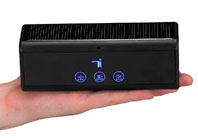
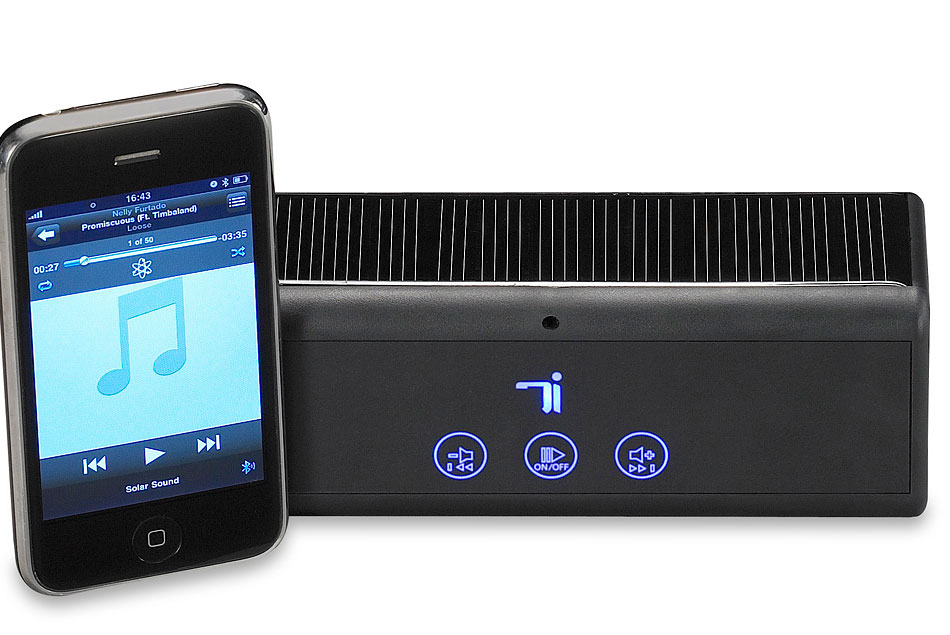
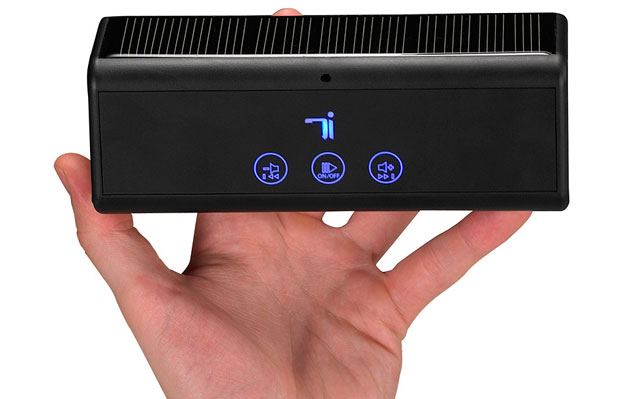
Designed to be taken to the beach, by the pool, or in the park, the Solar Sound 2 is the latest in the evolution of self-powered consumer products
Here at DEVELOP3D we’ve looked at solar power before, albeit on a more industrial scale, but now solar energy is becoming more viable and reliable on a consumer level.
The Devotec Solar Sounds 2 is a small portable speaker linked to your MP3 device via Bluetooth, ideal for those sunny days in the park or by the beach, but with a design dictated by the inbuilt monocrystalline solar panel that means it will play on happily all day.
“The concept was born from practicality in terms of placing the functional parts which make up the speaker, and the best layout was actually that which offered the best acoustic qualities,” explains Devotec technical director Oliver Mitchell.
“The Solar Sound tends to disagree with most people’s stereotype of portable battery powered products which run out of juice so easily. It hints at a future where battery life is not a problem.”
Using Pro/Engineer for the majority of part and assembly modelling, the product went straight from concept to feature-based model without touching paper.
With the core of the product being a single piece housing the design team relied heavily on computer aided manufacturing to aid with injection mould flow analysis.
“The one-piece moulded ABS housing was the most difficult thing to achieve and required relatively complex injection mould design with careful consideration of plastic flow in the mould,” says Oliver.
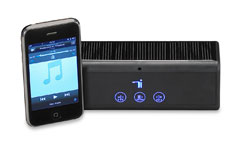
The portable speakers use Bluetooth technology to receive the music, but rely on the solar cells to provide the power
“The other elements were not difficult to achieve as they are structurally supported by the housing which is incredibly strong and stiff.”
Taking the acoustic properties of such a small portable device seriously Oliver’s team also used Matlab for simulating acoustic responses in designing the cabinet and drive units.
“Every cubic centimetre of space is used, making the Solar Sound extremely compact in size for the level of sound it can reproduce.
“While most portable speakers sacrifice the most important aspect as known by acousticians, the cabinets, and then attempt to rebuild sound response by over-engineering everything else, we use large and stiff opposing speaker cabinets.
“These can provide room-filling sound and there is no constraint on how to place to the speaker; it sounds great from every angle!”
Ideally when sprawled out in the sunshine this summer.